
AI Art Digest is shared with a curated international network of 3,687 museum and 2,391 gallery leaders.
Why Machine Dreams: Rainforest Matters Before It Even Opens?
Generative art is no longer asking the museum for hospitality. It is beginning to stop presenting itself as a technological exception and is starting to produce its own institutional model.
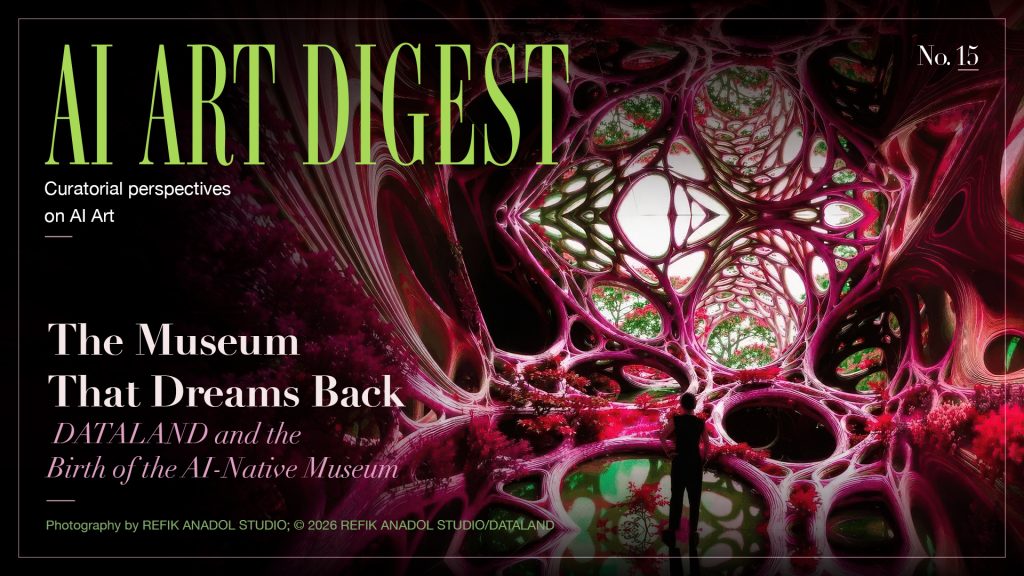
This is the real stake of DATALAND, the new Museum of AI Arts opening in Los Angeles on June 20, 2026, with Machine Dreams: Rainforest, its inaugural exhibition presented by Refik Anadol Studio and announced through January 31, 2027. DATALAND defines itself as the world’s first museum dedicated to AI art. It will be located at The Grand LA, in the cultural district of Grand Avenue, within a complex designed by Frank Gehry. The institution will include five public galleries and a dedicated technological infrastructure, for a declared total surface of approximately 35,000 square feet.
Yet the decisive point is not the claim of being first. Cultural firsts are fragile formulas: useful to the press, less useful to art history.
What makes DATALAND important is that it moves AI art from a condition of intermittent presence — installations, fairs, biennials, special projects, temporary immersive environments — toward a permanent institutional form.
Here we are not simply looking at a Refik Anadol exhibition. We are looking at a threshold case: an institution explicitly built around data, generative models, computational systems, living archives, public interaction, and images produced in real time.
This is why Machine Dreams: Rainforest matters before it even opens. Because its announcement makes visible a broader transformation: AI art is becoming a museological question.
From this moment, the question changes.
DATALAND pushes us to stop asking whether AI can enter a museum and forces us to begin asking what the museum becomes when the artwork becomes model, dataset, and infrastructure.
In recent years, generative art has sought legitimacy inside already existing institutions.
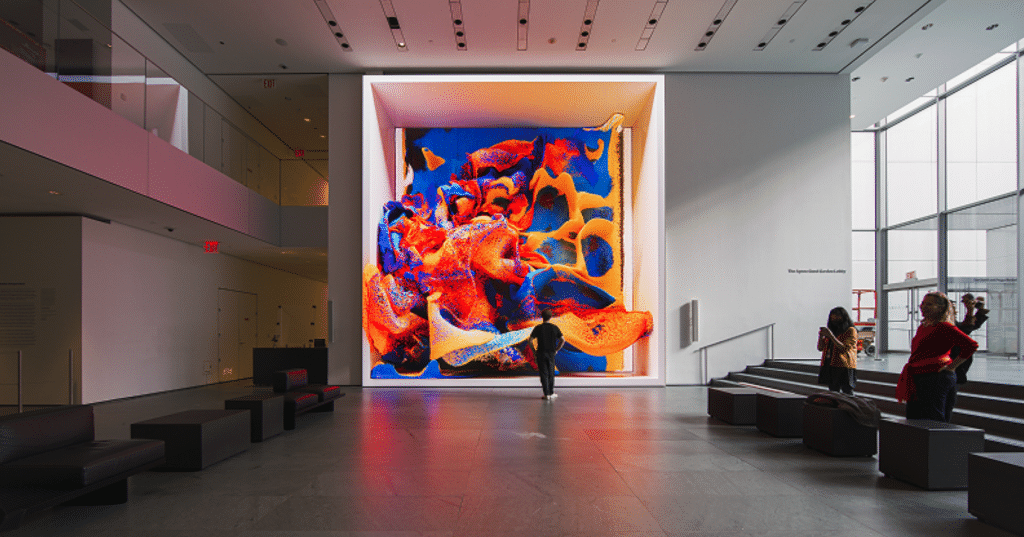
The most visible case in Anadol’s trajectory is Unsupervised, presented at the Museum of Modern Art in New York from 2022 to 2023. MoMA described the work as a large-scale generative installation built from publicly available data from its own collection: a machine interpreting more than two centuries of modern art and producing from it an audiovisual form in continuous transformation.

That project mattered because it brought AI into the museum genealogy of modernity. The machine was not generating images from nothing; it was remembering the essence of modern art after passing through the museum’s archive. Artificial intelligence was placed in contact with an already consecrated memory, and the museum remained the site of legitimation.
DATALAND changes that relationship. It is no longer the museum making room for AI. It is AI art giving itself an institutional home.
The difference is significant.
In the first case, AI is welcomed as a new medium within a pre-existing museum framework. In the second, the framework itself is rethought through the medium. The exhibition space does not simply serve to display works generated with artificial intelligence; it serves to organize an ecosystem in which datasets, models, servers, interfaces, images, audiences, and curatorial narrative function together.
An AI-native museum is not simply a museum that hosts generative artworks. It is an institution in which generative logic shapes the form of the exhibition, the relationship with the public, and even the idea of the collection.
The birth of DATALAND is a case of institutional pressure. It forces everyone — beginning with contemporary art museums — to ask whether traditional categories such as exhibition, artwork, archive, installation, media art, collection, and conservation are still sufficient to understand what generative AI is producing.
That DATALAND opens with a rainforest is significant too, more than it may seem.
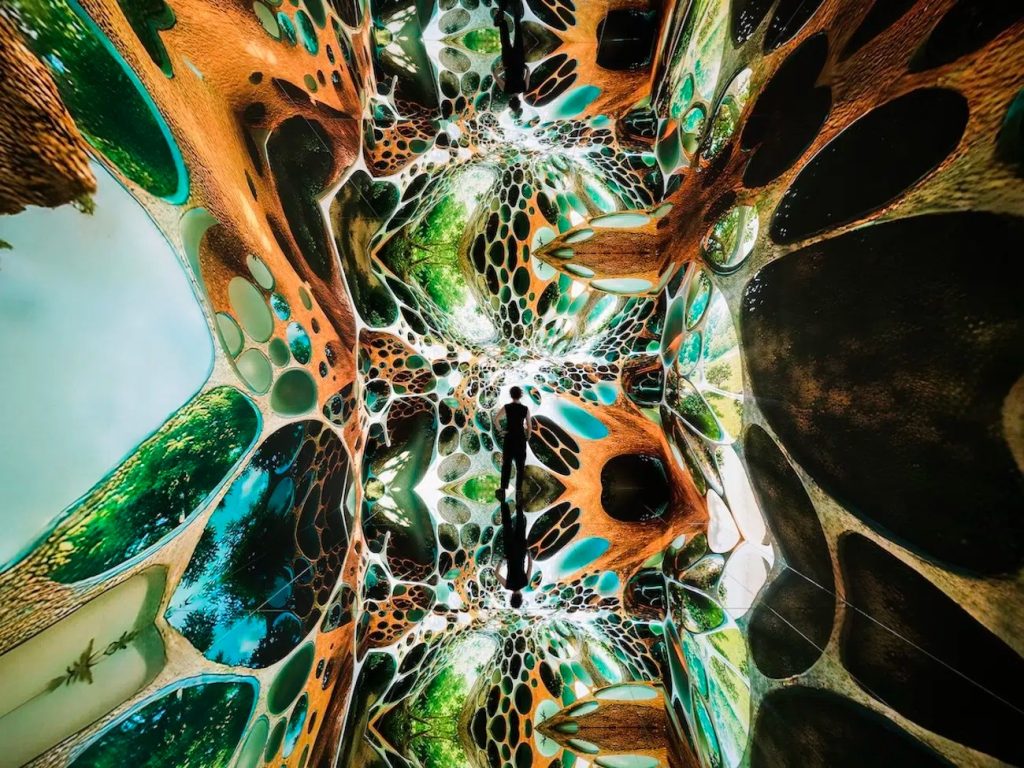
According to the official announcement, Machine Dreams: Rainforest grew out of a journey by Refik Anadol and Efsun Erkılıç to the Amazon. The exhibition is presented as an experience unfolding across five galleries, built around the relationship between artificial intelligence, the natural world, and human presence. The rainforest is described as an interconnected system, capable of transforming light, humidity, time, and information into living form.

It is a powerful choice, but also a risky one.
Powerful, because it moves AI art away from the most obvious technological imaginary: screens, future cities, synthetic bodies, robotics. Here, the machine does not narrate the machine. It narrates nature.
Risky, because nature is one of the easiest territories to transform into digital sublime. A generative rainforest can become a perfect immersive scenography: seductive, spectacular, emotionally immediate, and yet perhaps too constructed to return the ecological complexity it claims to evoke.
This tension should not be avoided. It should be placed at the center.
The curatorial question is not whether Machine Dreams: Rainforest will be visually impressive—I am certain it will be. The question is whether it will be able to transform wonder into empathy. A rainforest generated by AI can make perceptible patterns, relationships, rhythms, and scales that the human eye cannot grasp. But it can also replace nature with a luminous mythology of nature: domesticated, consumable, easy to absorb.
The task of a serious curatorial reading is to remain inside this ambivalence. Not to celebrate the machine because it produces beauty. Not to reject it because it produces simulation. Instead, to ask what idea of nature becomes possible when nature is translated into dataset, model, and immersive environment.
The formulation is suggestive, but it should be read with caution.
Nature does not “speak” by itself inside a model. It is selected, photographed, recorded, annotated, classified, normalized, transformed into data. Every model carries with it a politics of the archive: what it includes, what it excludes, who produced the data, with what permissions, through which tools, and for what purposes.
This is why the Large Nature Model is not a neutral technical element. Far from it. It is a curatorial fact.
In the traditional museum, the archive preserves works, documents, images, testimonies. In the AI-native museum, the archive can become generative. It does not merely preserve: it produces, participates in the form of the artwork, becomes environment.
This is one of the most radical transformations of generative art. The artwork no longer coincides only with what we see. It includes the system that makes what we see visible. It includes the dataset, the model, the computational infrastructure, the rules of updating, the energy conditions, and the governance of access.
The curatorial question, then, cannot stop at the immersive image. It must move back along the chain that produces it.
This is where many museums risk misunderstanding AI art. To treat it as a new aesthetic means seeing only its surface. To treat it as pure technology means handing it over to engineers or, even worse, to marketing. The challenge is more complex: we all need to learn to read generative art as a new ecosystem of the image, in which aesthetics, infrastructure, and provenance are inseparable.
DATALAND’s announcement insists on a decisive point: the museum as a place where art is no longer presented as a finished object, but unfolds in real time through data, computation, and human presence.
Beyond the promotional language, this sentence introduces an important reflection, somehow destabilizing for the current museum system.
The modern museum has built much of its authority around relatively stable works: objects, images, installations, documents, reconstructable performances, conservable media. Even when contemporary art challenged the traditional object, the museum often continued to function as a device of stabilization. It selects, preserves, catalogs, historicizes, interprets.
Generative art unsettles this stability. A work may no longer coincide with a definitive image. It may be a field of possibilities. It may change in real time. It may react to environmental data. It may produce different outputs at each activation. It may depend on software, servers, models, updates, and computational conditions that change over time.
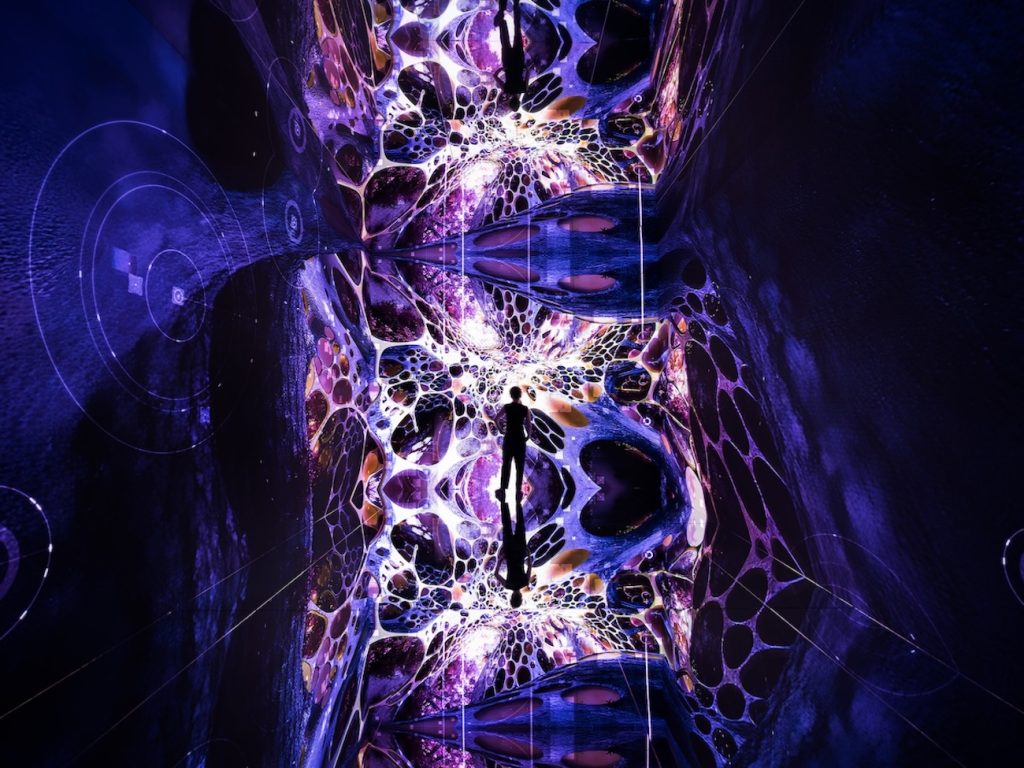
Curating, in this context, also means curating operational conditions. Not only choosing works, but understanding systems. Not only building a visual path, but understanding how to make a behavior legible.
A museum approaching generative art for the first time does not only need an innovative curatorial project. It needs a curatorial approach that prevents technology from remaining opaque.
DATALAND makes this need evident.
And precisely for this reason, it is a useful case even for institutions that will never adopt its immersive or infrastructural model. It shows the problem in its most concentrated form: when the artwork is a generative system, the museum must learn to exhibit not only forms, but processes.
DATALAND’s main risk is also its strength: wonder.
Refik Anadol has built one of the most recognizable aesthetics in contemporary generative art: data flows transformed into sensory environments, luminous architectures, liquid forms, images that seem to oscillate continuously between landscape, memory, and hallucination. This capacity to make data visible has been central to projects such as Unsupervised at MoMA, Echoes of the Earth: Living Archive at Serpentine, and other monumental installations.
Wonder is a powerful point of entry. It brings the public into a complex language without first demanding technical expertise. But wonder can also become a shortcut. It can make sensory intensity appear to coincide with critical depth.
This is where an AI-native museum will have to prove its maturity.
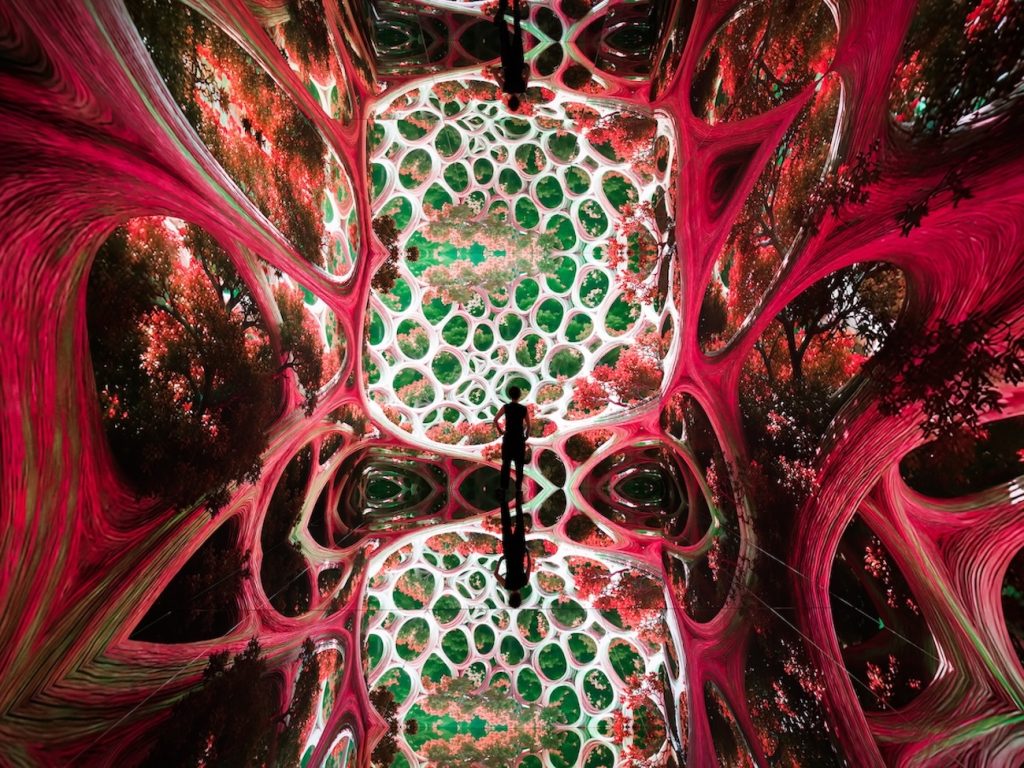
If DATALAND will use wonder as a threshold, and not as a destination, it may offer an important contribution to the institutional history of AI art. If, instead, wonder remains the main content, it risks confirming the perception that generative art is primarily a spectacular language: large scale, large screen, large emotion, little critical resistance.
For this reason, Machine Dreams: Rainforest should not be evaluated only for its visual power. It should be evaluated for its ability to short-circuit nature and dataset, immersion and thought, ecology and algorithm.
A museum worthy of the name cannot merely fascinate. It must give depth to looking.
That principle reappears with unexpected vitality in generative art. Contemporary artists working with AI do not usually quote Arcimboldo literally. What they inherit is subtler and, in some ways, more interesting.
They inherit his central intuition: that food can be more than subject matter. It can become identity structure.
The fit between Arcimboldo and the generative image is not accidental. His works already rely on dense visual memory, high-definition surface recognition, the assembly of wholes from fragments, and the suspense between object and face. These are all dynamics that speak powerfully to the current image regime. Artists working with AI respond to different parts of his legacy. Some pursue metamorphosis and bodily unease. Others move toward identity and consumer image. Others still explore illusionism, ornament, and stylized abundance.
These are important signals. But they are not enough on their own.
In the context of AI art, trust is not produced by a formula. It is built through transparency, coherence, and legibility. A model may be declared ethical, but the public and institutions must be able to understand what that means: which data, which permissions, which communities, which licenses, which costs, which exclusions, which forms of restitution.
This is a crucial point for contemporary museums that want to enter the field of generative art. The risk is not only aesthetic. It is reputational. An institution that commissions or presents AI art without an adequate critical framework may appear naïve, complicit, or simply unprepared.
This is why curatorship capable of cultural translation is needed. Not curatorship that “explains the technology” in a didactic way. But curatorship that makes visible the implications of the medium: what the work produces, what it consumes, what it inherits, what it erases, what it promises, what it risks.
DATALAND will be a test case here as well. If it can make its own functioning legible, it may become an epochal ethical model.
DATALAND’s Living Encyclopedia is described as an AI system dedicated to nature, designed to transform the traditional encyclopedia into a dynamic, multi-sensory, interactive experience. The platform promises modes of research and creation, allowing the public to explore the Large Nature Model through images, sounds, and interactions.
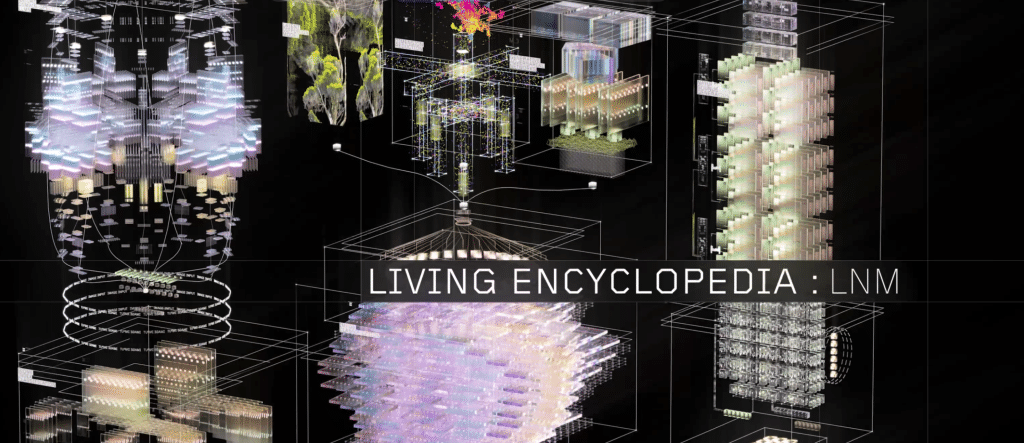
This passage is significant. AI-native museums cannot be only places to visit.
They will have to include platforms, digital access, generative tools, searchable archives, memberships, shareable outputs. Here one of the most important questions for the museological future of AI art begins to emerge.
When the museum becomes a platform, its relationship with the public changes. It cannot be exhausted in the time of the visit. It must continue afterward, through digital tools, generated content, personalized experiences, remote access.
This promise, however, is also ambivalent. It can democratize access, carry the museum beyond itself, and transform it into a cultural environment. But it can also flatten the cultural institution into the logic of digital platforms: engagement, membership, continuous content production, personalized experience.
This is why the Living Encyclopedia is much more than an extension of the museum. It is a laboratory of future museology. It shows how AI can transform the museum from a container of works into an extended cultural interface.
But who governs this interface — and how? How does a museum discipline complexity when it becomes interactive?
Refik Anadol is now an unavoidable figure in any discussion of the public legitimation of AI art. His work has brought the language of generative data into museums, iconic architectures, public spaces, and global immersive environments. His aesthetic is immediately recognizable, and his ability to reach broad audiences is rare.
But precisely for this reason, he must be read with precision.
Anadol cannot be reduced to “the artist of spectacular AI.” His work has posed real questions about the relationship between archive, memory, architecture, perception, and machine. At the same time, he cannot be turned into the only paradigm of AI art. The generative scene is far broader, more irregular, more painterly, more conceptual, more intimate, more critical, and more anti-spectacular than the immersive imaginary may suggest.
DATALAND, then, is necessary but insufficient.
Necessary, because it makes AI art institutionally visible on a scale few other projects have reached. Insufficient, because the curatorial future of generative art cannot coincide with a single aesthetic; still less can it be identified with a single figure, a single infrastructure, or immersion alone.
For museums, this distinction is vital.
An institution entering AI art through DATALAND must understand that it is looking at a highly visible part of the field, not the entire field. The risk would be to confuse AI art with technological monumentality. But generative art also includes quieter practices: static images, latent painting, new still lifes, synthetic portraits, unstable landscapes, narrative forms, critical practices around datasets, post-photographic works, minimal installations, video, performance, participatory systems.
Curatorial value lies precisely here: in building maps, not in chasing the brightest beacons.
DATALAND should not become a shortcut. It should not lead us to think that exhibiting AI art necessarily requires vast immersive rooms, monumental infrastructures, or global-scale technological partnerships.
The real lesson is deeper.
DATALAND shows that AI art requires institutions capable of thinking simultaneously across several levels: aesthetic, technical, ethical, historical, museological, public. It forces us to reflect on the fact that every serious exhibition of generative art should ask itself new questions.
These questions are more important than the single case of DATALAND. They are the legacy DATALAND may contribute to the minimum vocabulary of a mature curatorship of AI art.
A museum that has never presented generative art does not need to imitate Los Angeles. It needs to avoid two opposite errors: treating AI as a futuristic gadget, or dismissing it as a technological fashion. Between these two extremes, the real curatorial work begins: historicizing without domesticating, explaining without simplifying, showing without surrendering to hype.
There is a reason why this event deserves to be observed before it opens.
After the opening, the public discourse will be dominated by images: photographs of the galleries, immersive videos, visitor reactions, judgments about the experience. All of this will matter. But it will also risk reducing DATALAND to its spectacle.
Before the opening, instead, we can read what DATALAND declares itself to be.
It is in this phase that the real institutional questions emerge: what does it mean to found a museum of AI art? What does it mean to build an inaugural exhibition around the rainforest? What does it mean to transform a generative model into a public archive? What does it mean to promise ethics, sustainability, and access in a field still marked by suspicion and conflict?
The thesis is simple, but radical: DATALAND marks the moment when AI art stops being merely exhibition content and becomes an institutional project.
This does not mean that DATALAND will automatically be the best model. It does not mean that AI art has found its definitive form. It does not mean that every museum should become AI-native.
It does mean, however, that from this moment on AI art can no longer be treated only as a “new medium.” It must be addressed as a change in the very conditions of exhibition.
This is the real stake. And it reaches far beyond DATALAND.
It concerns every museum that, in the coming years, will want to address generative art without merely chasing a trend. It concerns the possibility of building exhibitions in which AI is not a theme, but a lens through which to reread landscape, memory, body, nature, image, archive, and the future of the institution.
DATALAND opens in Los Angeles. But the question it poses is global: who will know how to curate generative art not as novelty, but as cultural transformation?
The formula “AI is the future of art” is too poor to be useful. Art does not have a single future, and AI is not a destination. It is a new condition within which many artistic practices are learning to operate.
The more serious question is another one: what must the museum become if it does not want to be a passive spectator of this transformation?
DATALAND offers one possible answer, perhaps the most visible and spectacular one. But its greatest value does not lie in presenting itself as a single model. It lies in making the question unavoidable.
A contemporary art museum that has never presented generative art can look to DATALAND not to copy its scale, but to understand the complexity of the field: the artwork as system, the dataset as archive, the model as medium, infrastructure as part of the aesthetic, ethics as a condition of credibility, the public as an active interlocutor.
Machine Dreams: Rainforest will rightly be judged when it opens. But it is already producing an effect: it forces generative art to measure itself against the museum-form, and it forces the museum to measure itself against artistic forms that are no longer fully object, image, or installation.
This is where the curatorial work of the coming years begins.
It will not be a matter of bringing “a little AI” into the museum. It will be a matter of understanding which new forms of imagination, responsibility, and knowledge become possible when the machine is no longer merely a tool, but part of the cultural environment in which art takes form.
DATALAND does not close the conversation. It inaugurates it.
𝘝𝘪𝘵𝘰 𝘋𝘪 𝘉𝘢𝘳𝘪 𝘐 𝘍𝘰𝘳𝘮𝘦𝘳 𝘌𝘹𝘦𝘤𝘶𝘵𝘪𝘷𝘦 𝘋𝘪𝘳𝘦𝘤𝘵𝘰𝘳 𝘐𝘔𝘐 𝘜𝘕𝘌𝘚𝘊𝘖



© 2026 – Vito Di Bari – AI Art Digest – Scouting Gen AI styles and blue-chip generative artists.