
AI Art Digest is shared with a curated international network of 3,892 museum and 2,548 gallery leaders.
Why these animals are no regulars? This is not an abstract question.
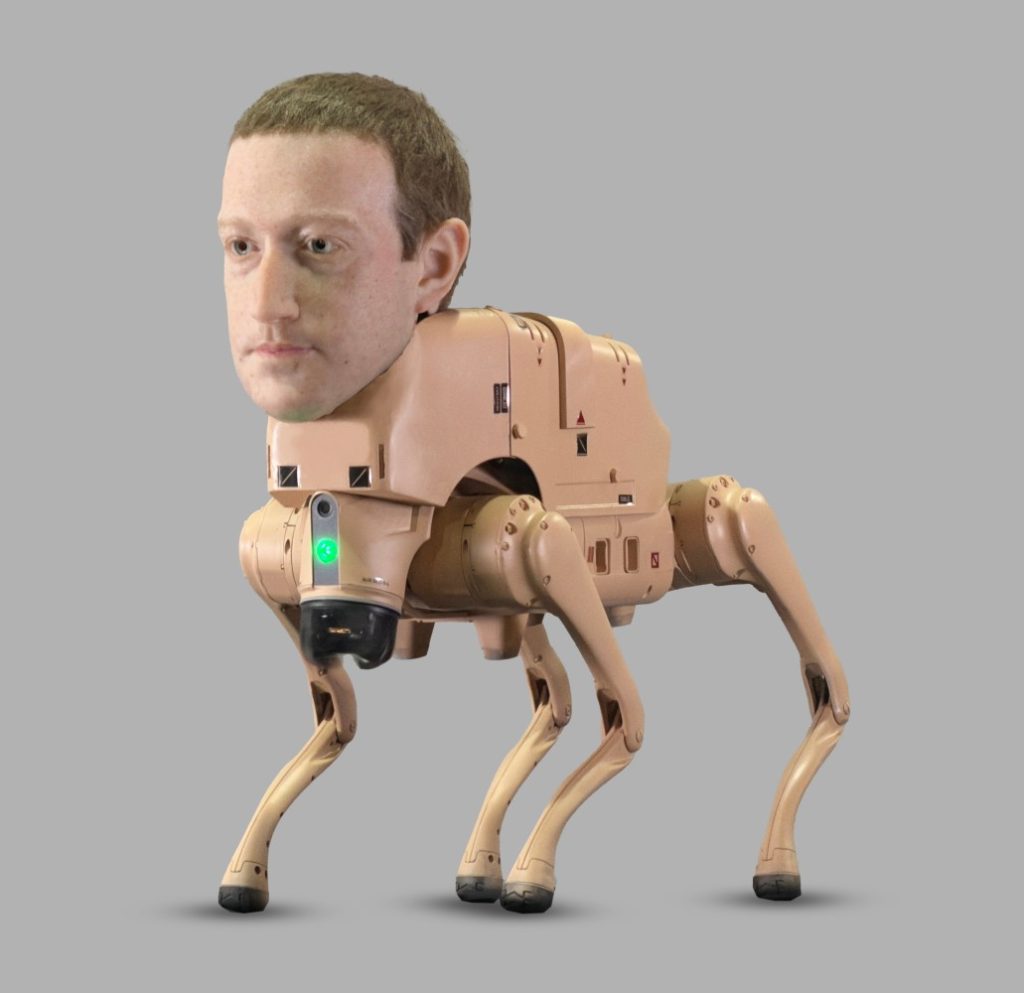
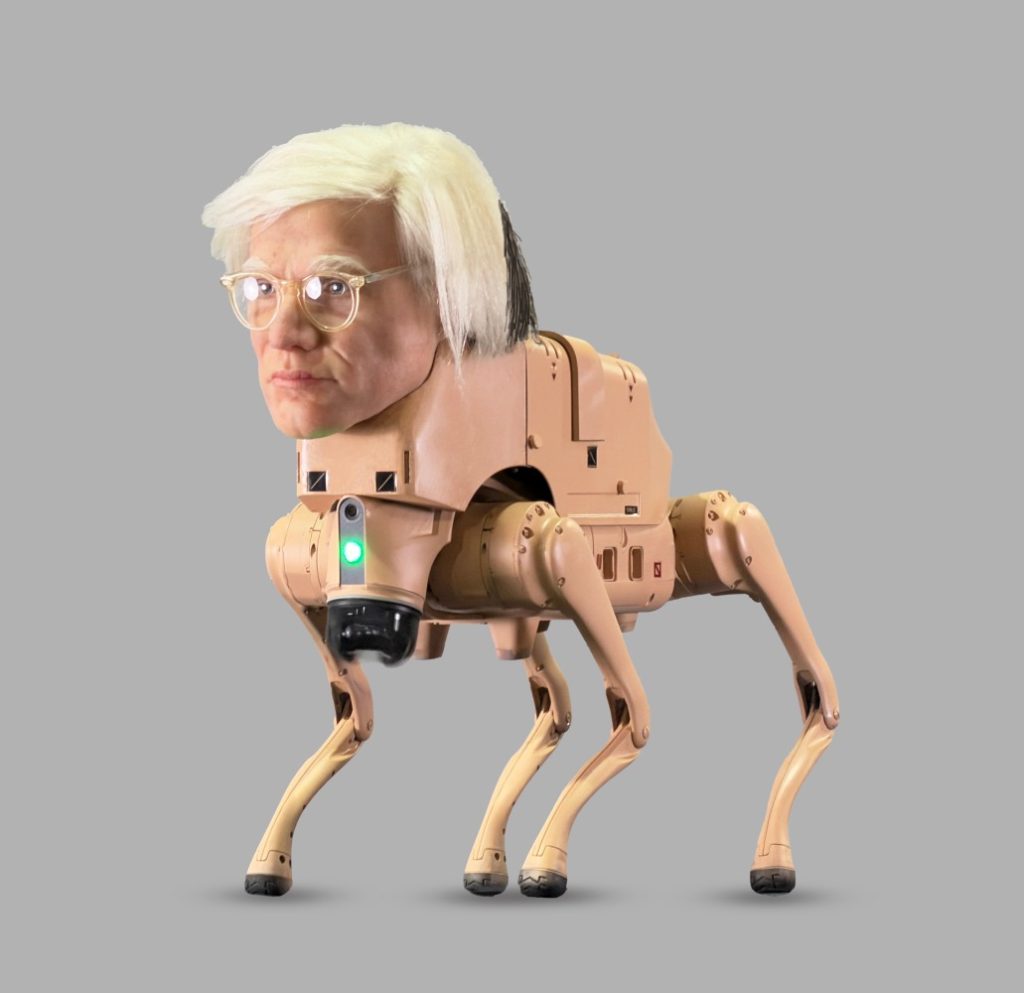
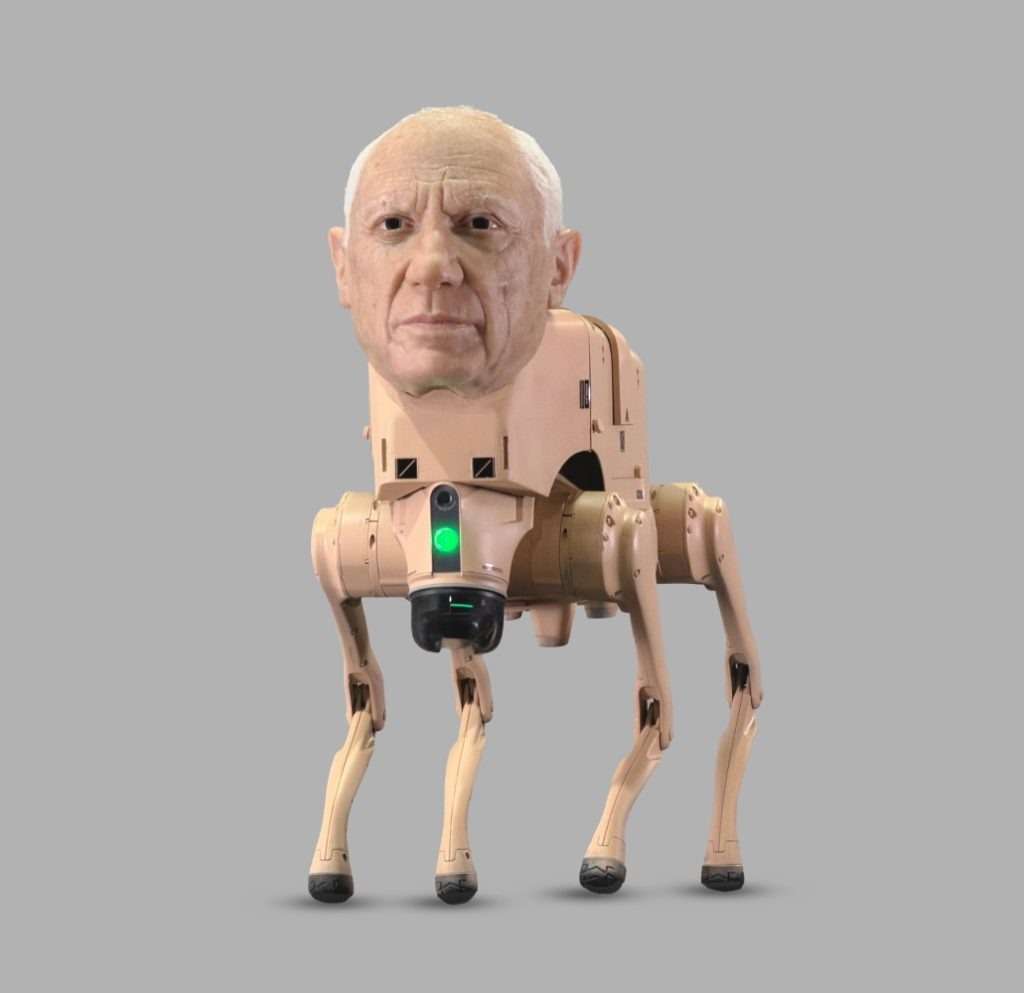
In the lower foyer of the Neue Nationalgalerie, Mike Winkelmann, aka Beeple, has staged a group of autonomous quadruped robots fitted with hyperrealistic heads modeled on leading figures from contemporary technological and artistic culture.
These human-faced robotic quadrupeds move, observe, capture images, reinterpret them through AI systems, and produce prints. The final gesture is deliberately low, almost childish: the images are expelled from the back of the robots — and then distributed to visitors.
Regular Animals operates under a theatrical, caricatural skin. But that skin should not mislead us: the work functions as a contemporary allegory of the algorithmic system.
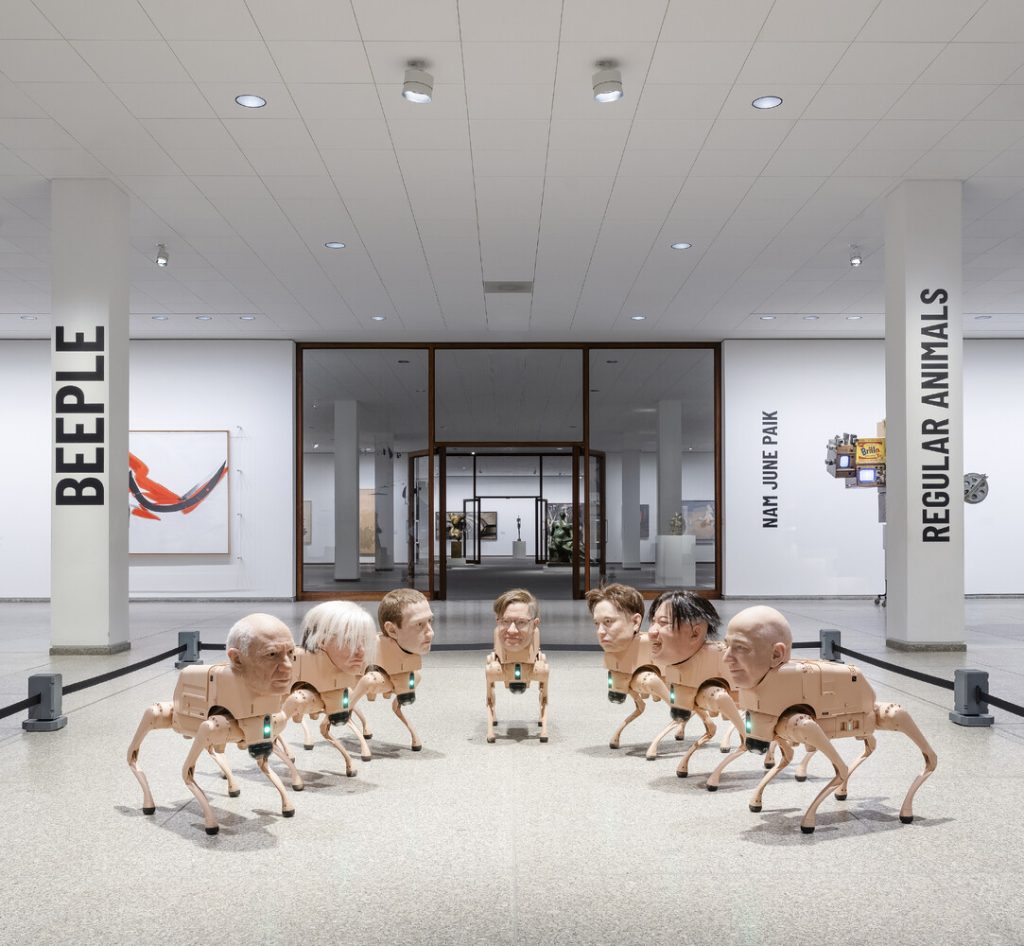
The thesis is simple, but not harmless: in the age of AI, an image no longer comes only from a hand, a camera, or a piece of software. It comes from a sequence: sensor, model, style, platform, visibility, distribution.
Beeple takes this process and turns it into a pack of ridiculous animals, mobile caricatures of money, technological power, and art canonized by the market. He turns it into an iconoclastic techno-artistic performance. And, not incidentally, he places himself inside the pack.
The point is not to decide whether these robots are beautiful — they are not. The point is how much they attract us, and how much they disturb us. Too technological to be sculptures, too explicit to be metaphors, too comic to be solemn.
Too much, in short.
And this is precisely their strength: too disturbing to be loved, too ironic to be dismissed, too symbolic to be ignored, too ridiculous to be taken entirely seriously.
Beeple, born Mike Winkelmann in 1981, is an American artist known for large-scale digital installations and for Everydays, the long-running project through which he has created and published a new digital artwork every day since 2007. His work combines 3D modeling, AI, animation, and satire, often with a direct gaze on contemporary culture, technology, politics, and consumerism.

His international prominence is also tied to the entrance of digital art into the global art market, most notably through the 2021 Christie’s sale of Everydays: The First 5000 Days for $69 million. That result made Beeple an unavoidable figure in the recent history of NFT art, but it also risked reducing the reading of his practice to a single market event.
Regular Animals is interesting precisely because it moves Beeple away from the pure digital image and from the frame of the record-breaking auction. Here, his technological satire takes on physical form: it becomes robot, behavior, public caricature, and a hybrid installation between museum space, AI, and performance.
Regular Animals emerged in the context of Art Basel Miami Beach 2025, where its first strength was its fairground spectacle. Robots with hyperrealistic heads of famous figures, flesh-colored bodies, autonomous movements, prints expelled from the rear. In a fair, a work like this is both a risk and a magnet. It is built to be seen, filmed, shared — but also to be consumed quickly.
The Neue Nationalgalerie changes the setting and, in part, the nature of the work itself. It does not neutralize its message. It cools it down, isolates it, puts it in a different perspective.
Inside and around Mies van der Rohe’s architecture, these grotesque automata seem like a system error. Modernism imagined a high, rational, disciplined transparency made of glass, steel, measure, proportion. Beeple inserts into that frame a mutation of flesh, machine, and algorithmic process that neither possesses nor seeks any purity. Its presence in situ is incorrect, and Beeple knows it.
This friction is decisive.
In Miami Beach, Regular Animals could be read, and perhaps reduced, as a fair event. In Berlin, the work becomes a museological challenge and carries with it a series of questions. Does the museum elevate the metaphor or domesticate it? Why does a museum allow the work to bring within its walls a portion of that noisy, visceral spectacle that museums usually try to filter out? Is this the sign of a broader shift? Is it a signal that digital art will no longer enter museums only as an image on a screen or as a collectible file? That it will increasingly enter as behavior, infrastructure, public experience?
There is no single answer. And it would be premature to look for one. The relationship between generative art and the museum is still taking shape: it will need time, attempts, failures, and critical and institutional consensus.
Whatever the answers may be, this exhibition opens a precise field of reflection. Showing at the Neue Nationalgalerie does not automatically turn Beeple into a canonized artist, but it forces his work to measure itself against a longer genealogy. The setting does not erase its pop, aggressive component; it requires it to withstand a harder confrontation: with the history of media art and performance, with the tradition of political portraiture, with the museum as a machine of legitimation.
And this brings its contradictions with it: market, spectacle, hype, low language, platform culture. The museum, in fact, cannot fully purify this work. To host it, it must accept part of its contamination. It must become, at least for the duration of the exhibition, its companion on the road.
The functioning of Regular Animals is as important as its iconography.
The robots are not merely mobile sculptures. They are perceptual devices. They move within a defined area, capture images through integrated cameras, reinterpret what they see through AI, and transform the output into physical prints.
The print is not a souvenir. It is the concluding act of the work’s metabolism.
It visualizes a sequence that has become canonical within technical and algorithmic culture: input, processing, output. The sequence remains intact, but here it becomes observation, digestion, expulsion.
The system becomes a body. Or rather: it simulates one. There is no flesh here, but a caricature of flesh; no metabolism, but an algorithmic translation of metabolism. The famous face stands in counterpoint to the vulgarity of expulsion: a mask of power mounted on a body that watches, processes, and discharges.
This choice is more sophisticated than it appears. Much generative art remains attached to the fascination of the final image. Regular Animals shifts the attention to the apparatus that produces it: the mechanical eye, the algorithmic processing, the applied style, the generation.
If the work is viewed as an interpretation of a process, the free distribution of the prints to visitors adds another layer. The work produces symbolic value and, in the same gesture, disperses it: the generated output is removed from scarcity and handed over as a free residue.
The result is not just a small print. It is the physical trace of a passage. Something has been seen, filtered, transformed, and returned. But not by a human eye. By an artificial body that imitates the behavior of the living and carries it to the point of caricature.
Regular Animals has a precedent that cannot be ignored: A.I.C.C.A. — Artificially Intelligent Critical Canine — by Mario Klingemann / Quasimondo, developed with ONKAOS and presented in 2023. There, too, a robot dog moves through the space of art, observes what it encounters, interprets it through AI systems, and produces a physical output expelled from the back of its body. The structural kinship with Beeple is evident: quadruped robot, artificial vision, algorithmic processing, printing, scatological gesture, humor as a form of critique.
The difference, however, is important.
A.I.C.C.A. does not generate images. It produces critical texts. It is an automaton-curator, or perhaps an automaton-reviewer: a sophisticated parody of interpretive authority within the art system. Klingemann, after all, has long worked also as an intellectual of the generative system: he does not merely produce artworks; he interrogates the devices that make them credible.
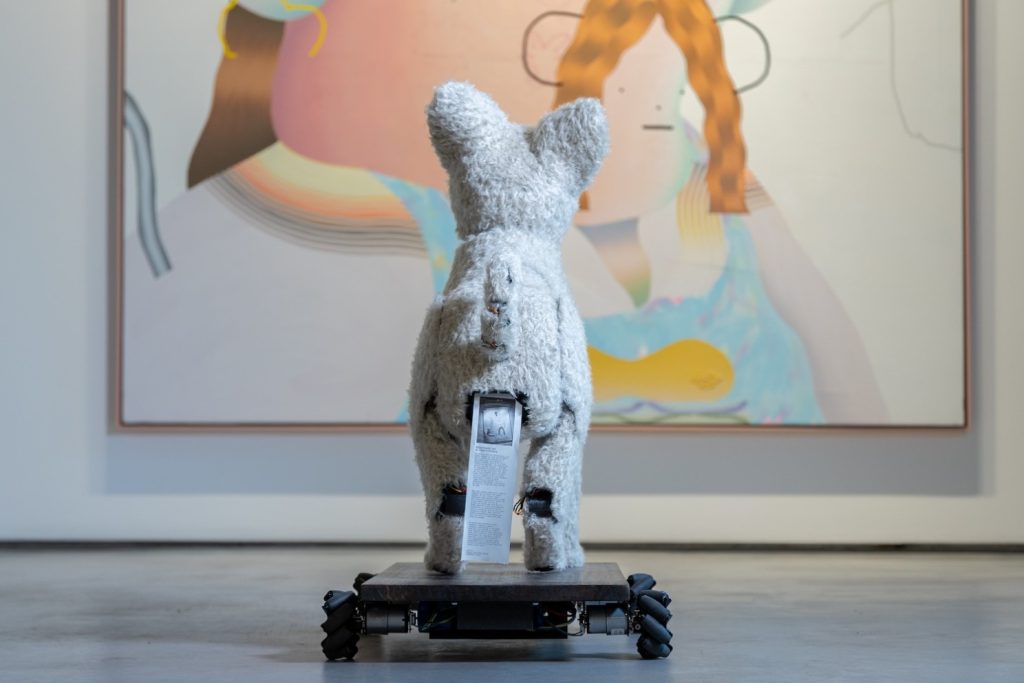
The dog looks at artworks and returns judgments printed on thermal receipts, as if criticism had become receipt, output, automated service. Klingemann is not only targeting AI. He is also targeting the language of art, its rituals, its need for mediation and validation, the way a critical sentence, in the right context, can become a device of value.
Two years later, Beeple shifts that mechanism from text to public image. His Regular Animals do not critique artworks hanging on the walls. They absorb the environment, filter it through masks of power — artists and billionaire technology entrepreneurs — and return prints as visual residues. Where Klingemann stages the automation of judgment, Beeple stages the automation of vision.
One cannot claim that A.I.C.C.A. explicitly influenced Beeple. But the chronology and the conceptual resemblance make A.I.C.C.A. an unavoidable precedent. Once again, Klingemann appears as an anticipator of a direction that AI art would later make more visible: the machine not as a tool, but as a performative and critical subject.
With A.I.C.C.A., the robot dog becomes a critical body for AI within the art world. With Beeple, that body multiplies into a pack, a spectacle, and an allegory of the platform. In both cases, the machine is not only an instrument. It is performer, cultural digester, comic and disturbing body of automated interpretation.
Regular Animals is also an exhibition about portraiture, although in distorted form.
The robots’ faces depict well-known figures from global technology — Elon Musk, Mark Zuckerberg, Jeff Bezos — and from art history — Andy Warhol, Pablo Picasso, and Beeple himself. The list does not construct a linear genealogy. It deliberately mixes two families of power: canonized artists and technology entrepreneurs.
The point is not that these people are famous. It is more precise than that. It says that the collective gaze is shaped by artists canonized by the market, but also by those who control infrastructures and platforms, channels of distribution, and economies of attention. This is a theme already present in Beeple’s practice, and clearly represented since the 2013 short film Transparent Machines.
Warhol and Picasso shifted the history of the image. Elon Musk, Zuckerberg, and Bezos control the conditions through which images circulate, are seen, evaluated, and monetized. Between the lines, this suggests that AI art is not only a question of generated style, but also a question of visual power.
Who decides which images we see? who organizes the filters of reality?

Beeple does not seek interior depth. The face becomes a falsely biological logo mounted on a machine that watches and digests the world around it.
The fact that Beeple places himself among the animals matters. He does not present himself as the artist judging the system from the outside, but as someone aware of belonging to the very ecosystem he is parodying: digital market, hype, NFTs, platforms, meme culture, technological spectacle.
When Beeple inserts his own face into the pack, he acknowledges that he too is part of the machine. That does not resolve the contradiction. But it certainly makes it more honest.

Paik’s presence moves Regular Animals beyond the simple chronicle of AI.
It reminds us that the problem did not begin today. Long before generative models, media art had already understood that image, machine, celebrity, and transmission could no longer be separated. Paik builds a robotic Warhol with televisions, video cameras, magnetic reels, screens, and media fragments. Beeple adds AI, autonomous robotics, blockchain, platform culture, and post-internet satire.
Paik preserves a poetic and historical complexity that Beeple often sacrifices to the directness of the gesture. Beeple is more frontal, louder, more willing to create immediate short circuits. But this is precisely why the comparison is productive. It reveals a transformation in the language of media art: from television to computation, from monitor to sensor, from transmission to generation, from the represented body to the machine-body acting in space.
The comparison is not meant to suggest that Beeple is “the new Paik.” That would be a reductive curatorial shortcut. Rather, it places the exhibition within a genealogy still in formation. Paik worked with television as the living material of his time. Beeple works with AI, robotics, and the meme as living materials of ours. In both cases, the human body is reassembled through technologies that mediate its public presence.
Robots with the heads of powerful icons and filtered images; physical output and scatological gesture; platform critique in an important museum. Everything arrives strong, clear, shareable.
Here the doubt begins: is this immediacy the work’s strength, or its limit?
This is the delicate point. The technological satire is so legible that it almost seems to close the question before opening it. It leaves no wound exposed; it is perfectly convertible into meme form, it speaks about the platform, but it is also perfectly at ease inside the platform. In short, it risks being reabsorbed by the very system it seeks to critique.
On the other hand, Beeple comes from that culture. And he remains coherent with it. But a critical reading cannot ignore that the work walks a thin line between the effectiveness of allegory and the propulsion of spectacle.
If the public stops at the strangeness of the robots, the resemblance of the faces, the gag of the expelled prints — as it likely did did in Miami — the work risks becoming a brilliant episode in the history of generative technological spectacle.
The Berlin venue helps precisely because it slows down this reading.
It forces us to look beyond the effect: the construction and the dialogue with Paik, the context of Gallery Weekend, the position within the architecture of the Neue Nationalgalerie, the free admission and the free distribution of the prints. All these elements move Beeple’s work into a larger question: what form will generative art have to assume when it stops being only image and becomes behavior?
Regular Animals should not be judged only as an installation of self-moving robots. Nor as an eccentric episode in Beeple’s career. It should be read as a symptom of a broader mutation in generative art.
For AI Art Digest, this is the most relevant signal.
Much of the discourse around AI art has so far focused on the final image: style, quality, originality, relationship to painting, resemblance to historical archives, error, or virtuosity of the model. Regular Animals shifts the center of gravity. The final image matters less than the system that produces it.
From this point of view, the exhibition suggests a challenge for museums. How does one exhibit a work that is not stable? How does one conserve a behavior? How does one document an image born from a temporary situation, from a machine generating memory as it moves? And how does one prevent all of this from being reduced to technological entertainment?

The Neue Nationalgalerie does not answer all these questions. But it stages them in the right place. In an institution that carries the weight and prestige of museological modernity, Beeple introduces irregular animals.
The work is imperfect, at times brutal, pleased with its own absurdity. But it would be a mistake to dismiss it as a simple provocation. Regular Animals intercepts a real transition: from the culture of the digital image to the culture of the perceptual system.
It does not show only what AI collaborates in generating. It shows the cultural, technical, and grotesque process through which we are learning to see today.
𝘝𝘪𝘵𝘰 𝘋𝘪 𝘉𝘢𝘳𝘪 𝘐 𝘍𝘰𝘳𝘮𝘦𝘳 𝘌𝘹𝘦𝘤𝘶𝘵𝘪𝘷𝘦 𝘋𝘪𝘳𝘦𝘤𝘵𝘰𝘳 𝘐𝘔𝘐 𝘜𝘕𝘌𝘚𝘊𝘖
This issue draws on a selected group of institutional, artist-led, and critical sources used to verify factual information and to frame Regular Animals within a broader genealogy of generative art, media art, robotic performance, and platform culture.
Primary institutional sources
Staatliche Museen zu Berlin / Neue Nationalgalerie, Beeple. Regular Animals, official exhibition page. https://www.smb.museum/en/exhibitions/detail/beeple-regular-animals/
Staatliche Museen zu Berlin, Neue Nationalgalerie | Beeple. Regular Animals | 29.4.–10.5.2026, press release and press images. https://www.smb.museum/en/press/press-releases/detail/neue-nationalgalerie-beeple-regular-animals-294-1052026-1/
Staatliche Museen zu Berlin, Beeple in Conversation: Art, AI & “Regular Animals”, online program. https://www.smb.museum/en/online-offers/detail/beeple-in-conversation-art-ai-regular-animals/
Artist and studio sources
Beeple Studios, Regular Animals, project website. https://regularanimals.ai/
Beeple Studios, Regular Animals — Founders Edition. https://regularanimals.ai/founders-edition.html
Beeple Studios, Art Basel Miami Beach presentation of Regular Animals. https://beeple-studios.xyz/beeple-exhibition/art-basel-miami/
Critical and press context
Artnet News, Beeple’s Robot Dog Pack Heads to the Neue Nationalgalerie in Berlin. https://news.artnet.com/art-world/beeple-robot-dogs-nationalgalerie-berlin-2752213
Artsy, Beeple debuts robot dog installation featuring Elon Musk and Andy Warhol at Art Basel Miami Beach. https://www.artsy.net/article/artsy-editorial-beeple-debuts-robot-dog-installation-starring-elon-musk-andy-warhol-art-basel-miami-beach
Whitewall, Beeple Unleashes Regular Animals at Art Basel Miami Beach 2025. https://whitewall.art/art/beeple-unleashes-regular-animals-at-art-basel-miami-beach-2025/
Le Random, Beeple on Robot Dogs as Canvas. https://www.lerandom.art/editorial/beeple-on-robot-dogs-as-canvas
Related works and historical references
ONKAOS, Mario Klingemann / Quasimondo, A.I.C.C.A. — Artificially Intelligent Critical Canine, 2023. https://onkaos.com/work/a-i-c-c-a-artificially-intelligent-critical-canine/
Kunstmuseum Wolfsburg, Nam June Paik, Andy Warhol Robot, 1994. https://sammlung.kunstmuseum.de/artwork/andy-warhol-robot/
Source note
Primary museum and studio sources were used for dates, venue, exhibition framing, technical description, curatorial context, and visual references. Critical and press sources were consulted selectively to reconstruct the work’s public reception and its transition from Art Basel Miami Beach to the Neue Nationalgalerie. Related works were included to situate Regular Animals within a recent and historical lineage of AI-driven robotic performance, automated criticism, media art, and the machine as a public body.



© 2026 – Vito Di Bari – AI Art Digest – Scouting Gen AI styles and blue-chip generative artists.