
AI Art Digest is shared with a curated international network of 342 museum and 176 gallery leaders.
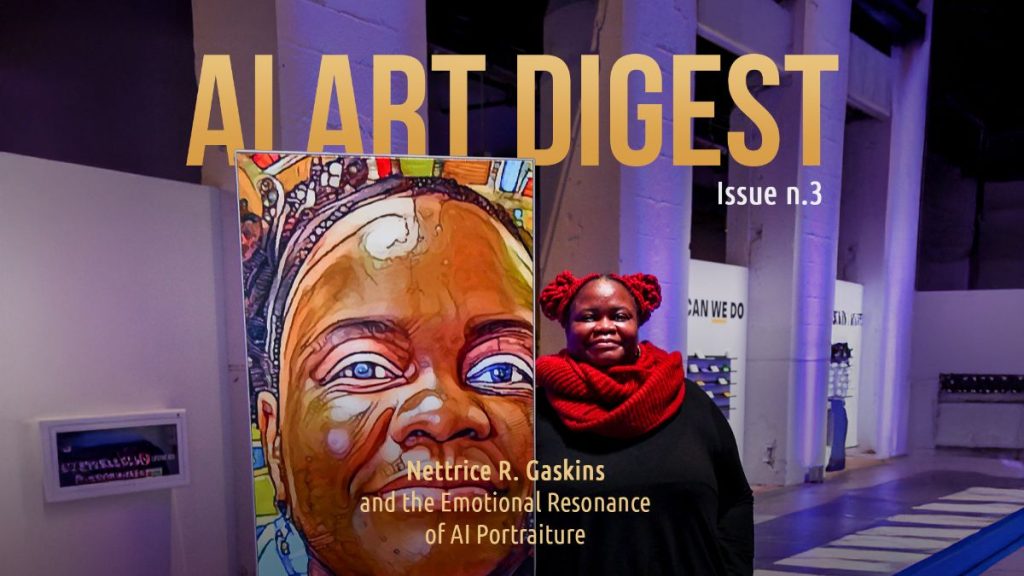
Gaskins faces the viewer directly, framed by a ring of coloured blocks that sits somewhere between stained glass and interface. Her braided hair and patterned scarf plug into this structure so that figure and background feel like one circuit. The self-portrait quietly states its position: an artist who inserts her own presence at the centre of the technological and cultural systems she works with, rather than at their margin.
Dr. Nettrice R. Gaskins is a digital artist, educator, and cultural critic whose practice bridges algorithmic art, Afrofuturism and STEAM learning. She holds a BFA in Computer Graphics (Pratt Institute, 1992), an MFA in Art & Technology (School of the Art Institute of Chicago, 1994) and a PhD in Digital Media (Georgia Tech, 2014). Her work includes AI‑generated portrait series exhibited at the Smithsonian Arts and Industries Building and large‑scale murals in Brooklyn.
In a AI market flooded by generative portraits, emotional rarity is the new blue chip. Nettrice R. Gaskins doesn’t generate faces—she constructs legacies. Each portrait she creates becomes a vessel of symbolic memory, not just an AI artifact.
When we look at a face—whether human or painted—we instinctively search for emotion. Yet many AI-generated portraits remain cold stylistic exercises. Gaskins treats the face as a vessel of memory, cultural echoes, and emotional presence, filtered through what I like to call an “algorithmic brush.” She does not simply apply filters or mimic painterly gestures. Rather, she constructs layered and recursive metaphorical and glyphic architectures that conjure an almost magical sense of presence. In this way, Gaskins extends the introspective impulse central to traditional portraiture into a generative dimension, but in a language entirely her own.

In profile against a pale, schematic backdrop, a young Black woman with twisted hair and a magenta headwrap appears as a sleek android: her deep blue skin is pierced by an orange-and-cyan circuit “ear”, while her shoulder-length garment is crowded with symbols, grids and tags. A teal-and-amber vessel cuts horizontally behind her, inscribed in a grey circle, so that body and background read as one continuous machine–world. The image condenses Gaskins’s Afrofuturist language into a single figure: a diva wired into vehicles, cities and data flows, carrying street style and ancestral signifiers into a resolutely future-facing silhouette.
Gaskins creates her portraits on a strong academic foundation and explains her method with clarity. She layers textures, symbols, and visual details not to mimic a face, but to rebuild it as a cultural and emotional artifact. She defines this approach as techno-vernacular creativity: blending everyday visual language with algorithmic tools.
Over time, she has moved from platforms like Deep Dream to MidJourney, searching for richer textures and more expressive results. She also explores new techniques like generative pan, which helps her give a sense of space and movement to the images.
At the same time, she returns to traditional digital tools like Photoshop, using manual editing and what she calls techno-riffing—a kind of visual improvisation inspired by music, performed in dialogue with AI.
In her Funky Androids series, for example, Gaskins mixes AI image generation, post-production editing, and symbolic layering to build portraits that are at once conceptual and emotional. In Gaskins’s creative process, the algorithm doesn’t just execute instructions—it responds, proposes, and evolves alongside her. She describes this as a call-and-response exchange: a back-and-forth where visual prompts and symbolic intentions shape each iteration. The result isn’t a machine-made image or a human-controlled output, but something co‑crafted, where meaning emerges through interaction. Her portraits become spaces where technology listens, and cultural symbolism takes form—not imposed, but revealed through dialogue.

Harriet Tubman sits frontally, hands resting on chair and lap, her brown dress and white collar rendered with the grain of an old photograph, while the world around her erupts into a red, pink and orange patchwork of stars, clouds and tiny geometric tiles. The background reads like a cosmic quilt: gold and blue stars, gridded squares and swirling lines turn the sky into a coded map, echoing both Black quilting traditions and the celestial navigation that shadows Tubman’s story. Her body remains almost monochrome at the centre of this saturated field, as if she were the fixed point by which all this colour and pattern orient themselves — a steady figure holding together memory, resistance and a future that refuses to dim.
Gaskins’s portraits emerge from meticulous control over every detail—color, motif, archival input, cultural reference—generated through a multitude of prompts that guide the generative tools in a rapid-fire, layered progression. In Beacon of Hope (2021), created for Ms. Magazine’s Harriet Tubman project, she layered symbolic ellipses inspired by African American quilting traditions.
The answer lies in how her algorithmic brush shapes psychological presence, not just visual resemblance. Gaskins adopts a distinctive set of visual techniques to build meaning into her portraits. She often incorporates small symbolic shapes—rings, ellipses, spirals—directly into the facial features. These are not just decorative: they serve as visual echoes of memory, suggesting a deeper cultural or emotional story beneath the surface. Instead of using shadow to create depth, she layers repeating patterns—almost like textural ripples or visual whispers—that give the face a sense of dimension through accumulation. She also plays with transparency, gently obscuring parts of the face with patterns while letting others remain visible. This contrast creates an emotional rhythm: a quiet tension between what is shown and what is withheld.

Martin Luther King Jr. is shown in close-up, eyes lowered in a quiet, almost private expression, while his face and suit are carved out of dense streams of color that curl across the surface like liquid relief. Around him, the background explodes into multicolored waves — reds, blues, yellows, greens — yet the modeling of his features stays surprisingly stable, holding his profile steady inside the movement. The work feels like a tension between noise and voice: history, media and memory swirling in all directions, and one grounded presence that still cuts through the pattern.

A young woman’s head and neck rise from the bottom of the canvas, eyes closed, as if caught between exhale and reverie; thick braids coil down her back and lash out to the left like smoke caught in a gust. Parts of her face and throat glow with cracked orange and gold, as though embers were burning just beneath the skin, while the rest of the figure dissolves into stains and washes on a bare, almost paper-white ground. The image holds a precise mood: not drama, but a slow, inward ignition, a sense that memory and fire are travelling through the same body.
Placing Gaskins alongside artists like Bisa Butler, Kerry James Marshall and Lorna Simpson helps clarify what is specific in her approach.
Like Butler, she treats pattern as narrative material: fabrics, tiles and motifs are never neutral decoration, but carriers of memory. Like Marshall, she insists on centring Black subjects in complex pictorial worlds rather than isolating them against emptiness. And like Simpson, she is attentive to how faces, hair and partial views of the body can operate as sites of reconstruction — places where the visual record of Black life is rewritten with care. Gaskins extends this lineage into the algorithmic domain, using generative tools not to erase that history, but to work inside it.
Within the growing world of generative portraiture, Gaskins stands out for the clarity of her voice and the depth of her cultural references. Her work draws powerfully from African American heritage and diasporic memory, which has led some to classify her as an Afrofuturist. But that label—while useful—is too narrow to capture the full complexity of her approach, which blends symbolic storytelling with digital experimentation.
Rather than mimicking traditional painting styles, she invents a new visual language for emotional presence, shaped by code, culture, and memory. You might call it neural romanticism or algorithmic intimacy—terms that reflect how her portraits connect deeply with viewers, not just through aesthetics, but through meaning. Gaskins’s academic training informs an artistic evolution that is clear, deliberate, and coherent. She documents this journey through writing—charting a path from realism to expressive abstraction. A practice I deeply admire is her openness in sharing prompts, archival sources, and symbolic motifs (such as quilts and cosmic ellipses), making the technical and conceptual framework behind the image visible and available. Thanks to the combination of technical control, cultural grounding, and conceptual rigor, Gaskins emerges as a generative portraitist with long-term value. Given her trajectory, she deserves the attention of collectors and curators alike. She is exactly the kind of artist to watch as generative portraiture evolves from a trend into a canonical language.
In a market increasingly saturated with surface-level generative aesthetics, Nettrice R. Gaskins offers rarity: conceptual depth, cultural weight, and emotional longevity. For those curating the future, hers is a name to acquire early and follow closely. Her work is not just collectible—it’s consequential. The kind of practice that doesn’t follow trends, but shapes trajectories. Her portraits don’t just appear—they linger like echoes…
Vito Di Bari | AI Art Curator | Former UNESCO IMI Executive Director
Nettirice Gaskins reminds me of Augusta Savage who reimagined sculpture as both visual pedagogy and a practice of self-determination in early 20th-century America. Both Augusta Savage and Nettirice R. Gaskins use portraiture as a platform for cultural emancipation, though across radically different media and centuries. Savage shaped Black identity into plaster and bronze at a time when institutional exclusion was the norm; Gaskins, working in the age of artificial intelligence, codes presence into neural patterns—training algorithms to remember what dominant archives have omitted. Their pedagogies, too, are acts of resistance. Savage founded open studios to train young Black artists when formal institutions shut them out. Gaskins continues that legacy through her framework of Techno-Vernacular Creativity: a STEAM-based approach grounded in community knowledge, cultural fluency, and computational agency. Technically, both artists treat form as a conduit of identity. Savage fused classical sculptural rigor with social symbolism. Gaskins fuses algorithmic aesthetics with Afrofuturist codes to produce not just visual outputs, but generative renderings of memory, survival, and invention.
I chose to feature Gaskins because her work aligns with the very mission of this Digest: to spotlight generative artists whose practice is not only technically sophisticated, but historically and emotionally grounded. She doesn’t just “use” AI—she choreographs it, guiding each output with curatorial precision and intention.
For collectors, curators, and institutions looking beyond trends, Gaskins represents the direction in which AI art must evolve: toward substance, resonance, and long-term significance.
Vito Di Bari I AI Art Digest Curator
Why Watch: She is redefining AI portraiture by transforming algorithms into co‑authors of memory, identity, and emotional presence—setting a new benchmark for culturally rooted generative art.
Gaskins fuses generative tools with Black cultural lineages, building portraits that feel emotionally resonant rather than merely stylised. She moves with ease between scholarship and studio practice, and her work is already circulating in educational, editorial and exhibition contexts. For serious collectors, she represents a rare combination of conceptual clarity, recognisable visual language and long-term research depth.
Depth over effect: in a moment when AI portraiture risks flooding feeds with one-click styles, Gaskins builds each image as a dense field of references: quilting, iconography, Afrofuturism, pedagogy. This slows the work down and gives it staying power.
Theory as ballast: her practice is anchored in years of research on techno-vernacular creativity. For high-level collectors, this reduces the risk that the work will age as a curiosity of a single AI season.
Market position: AI portraiture is a segment clearly subject to fashion, and there is always a danger that the genre will be read as merely decorative. In Gaskins’ case, the conceptual and historical grounding pushes back against that risk: even if the market’s taste shifts, the work has enough ballast to hold its own in a long-term collection.
Art is an extension of the creator… My toolkit is bigger.”(2016, Powering Imagination: An Interview with Nettrice Gaskins)
“I want to remix algorithms. I don’t want one, I want five. I want to test the limit.”(2023, lecture “Theory, Content and Style for the AI Revolution”)
“When I started to think about AI as a tool that we could use to look at the past and not to the future, it became such an approachable and human way to invigorate the imagination.” (2024, The Ethics of the Remix: GenAI in Public Space – Medium)
Gaskins, Nettrice R. Techno‑Vernacular Creativity and Innovation: Culturally Relevant Making Inside and Outside of the Classroom (Cambridge, MA: The MIT Press, August 2021)
Gaskins, Nettrice R. “Techno‑Vernacular Creativity and Innovation across the African Diaspora and Global South.” In Captivating Technology: Race, Carceral Technoscience, and Liberatory Imagination in Everyday Life, edited by Ruha Benjamin (Durham, NC: Duke University Press, June 2019)
Generative Art Conference – Art and AI. Casa delle Letterature, Rome (Italy) – Dates: December 16–18, 2025. Biblioteca Casa delle Letterature, Piazza dell’Orologio 3, 00186 Roma, Italy.
Ancient Wisdom for a Future Ecology: Trees, Time and Technology. Di Rosa Center for Contemporary Art, Napa (USA). Dates: January 22 – April 11, 2026 – Di Rosa Center for Contemporary Art, 5200 Sonoma Hwy, Napa, CA 94559, USA.




If you know artists, curators, or collectors who are trying to navigate AI art, feel free to forward this digest to them.
Join the Conversation: Is there a GenAI artist you think I should feature?
Is there a theme — authorship, archives, AI and the body — you’d like to see unpacked in a future issue?
Write to me at contact@aiartdigest.art


© 2026 – Vito Di Bari – AI Art Digest – Scouting Gen AI styles and blue-chip generative artists.