AI Art Digest is shared with a curated international network of 1,814 museum and 1,087 gallery leaders.
𝘊𝘰𝘷𝘦𝘳: 𝘈𝘪-𝘋𝘢 𝘗𝘳𝘰𝘫𝘦𝘤𝘵𝘴-𝘊𝘰𝘱𝘺𝘳𝘪𝘨𝘩𝘵 2025 © 𝘈𝘪-𝘋𝘢 𝘙𝘰𝘣𝘰𝘵 𝘚𝘵𝘶𝘥𝘪𝘰𝘴, 𝘸𝘸𝘸.𝘢𝘪-𝘥𝘢𝘳𝘰𝘣𝘰𝘵.𝘤𝘰𝘮
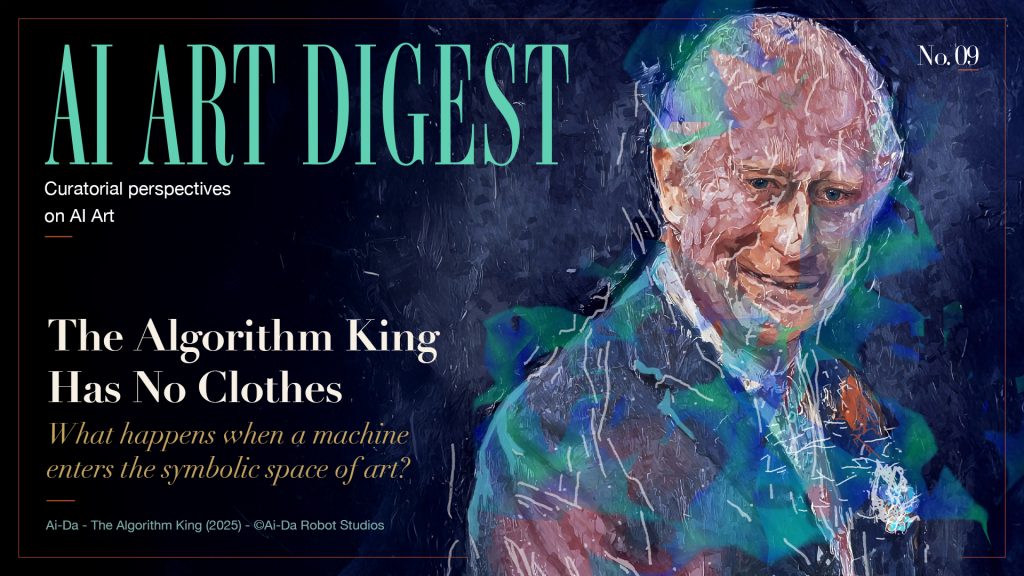
In 2025, in a room illuminated by cameras, a robot paints the portrait of a king. A mechanical arm moves slowly across the canvas as onlookers watch and the images travel around the world.
The scene seems drawn from science fiction, yet it has become one of the most widely shared images in the contemporary debate around AI and art.
Not every image generated using AI technologies is art.
And not everything that captures media attention truly represents what generative art can become. In hindsight, works such as Algorithm King will likely appear as documents of an early phase in AI’s visual culture. A moment when institutions, media, and audiences were still fascinated primarily by the idea that a machine could produce an image.
This issue begins with a specific curatorial concern: today the public perception of so-called “AI art” is being shaped by examples that function well as media events but far less as artistic research. In other words, the field risks being defined first by spectacle rather than by language.
For this reason, I use a highly visible case—the portrait Algorithm King, created by the robot Ai-Da—as a starting point. Not to dismiss it, but to understand what it reveals about the early phase we are currently living through, a phase in which the narrative of the machine artist often carries more weight than the image itself.

Watching Ai-Da at work means witnessing a scene perfectly constructed for our technological imagination: a humanoid robot before a canvas, a mechanical arm painting with calibrated slowness, cameras and spectators ready to document the moment.
The narrative that emerges is irresistible: a robot paints the king. Technology and monarchy meet in a symbolic image that seems to condense centuries of artistic tradition and technological innovation into a single gesture.
Yet this is precisely where an important distinction emerges. Some works function primarily as narrative devices: spectacular moments that draw attention to the fact that a machine is producing art. Other works use emerging technologies to expand the language of art itself.
The difference does not lie in the technology being used, but in the artistic intention the depth of inquiry behind it.

If we look at the painting Algorithm King apart from the narrative surrounding it, we encounter an image that reworks a fairly familiar visual vocabulary: fragmented planes recalling modernist traditions, expressive brushwork, and subtle visual interference suggesting digital aesthetics.
There is nothing inherently wrong with this language. Yet the image seems to function primarily as an illustration of its technological premise rather than as an autonomous visual inquiry.
The portrait is eloquent as a symbol—a robot painting a king—but more restrained as an aesthetic proposition. It does not truly challenge the idea of monarchy, nor the idea of art. Instead, it stages them.
From a curatorial perspective, one might say the work operates more as a performance around painting than as painting itself.
To better understand the phenomenon, it is useful to look at art history. The idea of a machine producing drawings or paintings did not begin today, nor with artificial intelligence.
In the 1960s, for example, artists such as Jean Tinguely built machines that produced drawings automatically in front of an audience. In those cases, however, the real focus of the work was not the sheet produced by the machine but the theatricality of automation itself.
From this perspective, Ai-Da seems to belong more to this lineage—machines as performers—than to the emerging tradition of generative art built around machine learning systems.
The final image becomes almost secondary. What audiences truly remember is the event: the machine painting.
Jean Tinguely – Meta-Matics Drawing Machine (1975) – © Museum Tinguely
Projects at https://www.tinguely.ch
This distinction between spectacle and inquiry becomes especially important now that “AI art” is emerging as a recognizable category in public discourse.
The question most often asked in the media is: “Can a robot be an artist?” It is a fascinating question—but perhaps no longer the most interesting one.
For a curator, the more important question may be different: what happens when human artists use generative systems as a medium to think, remember, critique, or imagine?
This is where what I call human-scale AI art comes into play.
By human-scale AI I do not mean smaller models or limited datasets. I mean an artistic approach in which the center of gravity remains human: intention, authorship, and vision.
In this context, the algorithm is not the artist. It is a tool—just as the brush, photography, and cinema once were.
The question then becomes: what do we choose to imagine with these tools?
When artists treat generative systems as artistic material, new languages emerge—languages that cannot be reduced to a simple technological demonstration.
AI becomes art not when a machine produces an image, but when an artist uses the machine to produce a question.
To begin navigating the field, it is useful to distinguish at least four broad approaches:
I. Robotic performance art: machines and robots acting as physical performers.
II. AI conceptual art: works that critically reflect on AI as a cultural phenomenon.
III. Generative AI art: artists using generative models as expressive tools.
IV. Simulation-based art: artistic practices built around evolving simulations.
These categories are often conflated in media coverage, yet they operate according to very different logics.
Ai-Da clearly belongs to the first. Many of the most artistically innovative contemporary practices belong to the third and fourth.
Ai-Da represents one of the ways artificial intelligence entered the public discourse around art—through the spectacle of the machine artist. Yet many other practices are developing far more complex and nuanced artistic languages.
To understand what AI can become once it moves beyond technological demonstration and becomes an artistic medium, it is useful to look at several distinct practices.
This selection does not claim to define a definitive canon. Rather, it offers a small curatorial map: six artists who occupy different territories within contemporary generative art—from dataset construction to data monumentalism, from cultural critique to evolving simulations.
Their diversity is precisely what defines the field. AI art is not a single aesthetic or a single method, but a complex domain where authorship, technology, and imagination intersect in radically different ways.
The following six artists map a set of distinct trajectories within contemporary AI art: dataset authorship, neural aesthetics, data monumentalism, critical AI practices, simulation-based art, and generative systems as artistic infrastructure.
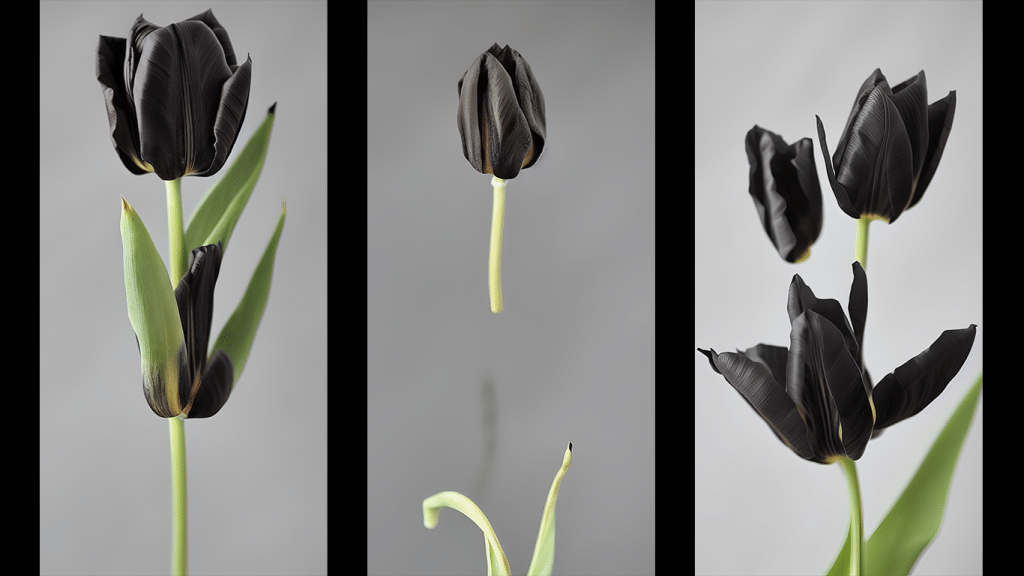
In Anna Ridler’s work, the creative act begins before the algorithm. The British artist constructs her own datasets, photographing and cataloguing hundreds of images before training generative models. It is a slow, almost archival process that restores a central role to the human gesture in the production of images.
Ridler builds author-driven datasets and uses generative models to reflect on value, rarity, and speculation. In her impossible tulips, AI becomes a conceptual tool linking economic history, imagined biology, and the dynamics of contemporary markets.
Her work represents an important canon within generative AI art—an approach we might describe as dataset authorship, in which the artist personally constructs the archive from which the AI learns. In this context, AI becomes a medium through which to interrogate memory, economics, and history, demonstrating how authorship can emerge through the design of the generative process itself.
AI Art Digest brings you curatorial analysis like this every week, exploring AI artists reshaping contemporary art.
Next issue: Beyond the Machine Artist. Signals of a Second Phase in AI Art.
Join my AI Art community: ➝ Subscribe on LinkedIn
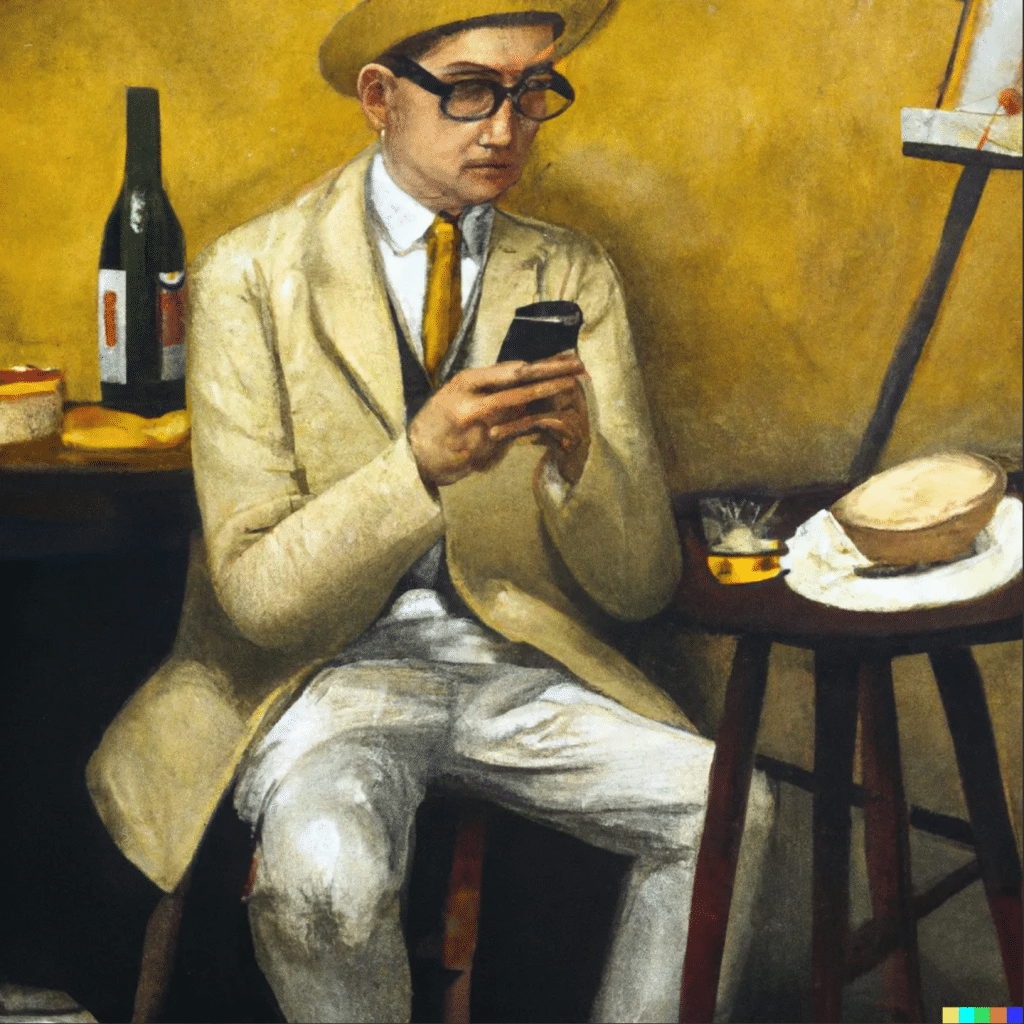
Mario Klingemann is among the first artists to treat neural networks not as tools to be controlled but as systems with which to enter into dialogue. In his works, faces and figures emerge and dissolve.
At times a face seems to form for a fleeting instant, as if the machine briefly remembered a human presence, only to dissolve again into unstable textures—as though the image revealed the machine’s unfinished thought while attempting to interpret the world.
Rather than imitating human painting, Klingemann explores the error zones of neural networks: the moments when a system attempts recognition yet produces unexpected forms—distortions, biases, and ambiguities that arise when a model tries to generate or interpret images.
His work represents a distinct canon within generative AI art: that of autonomous algorithmic aesthetics, in which images emerge not from painterly tradition but from the internal logic of computational systems themselves. In this perspective, the artist becomes a choreographer of processes, capable of transforming errors and imperfections into visual language.
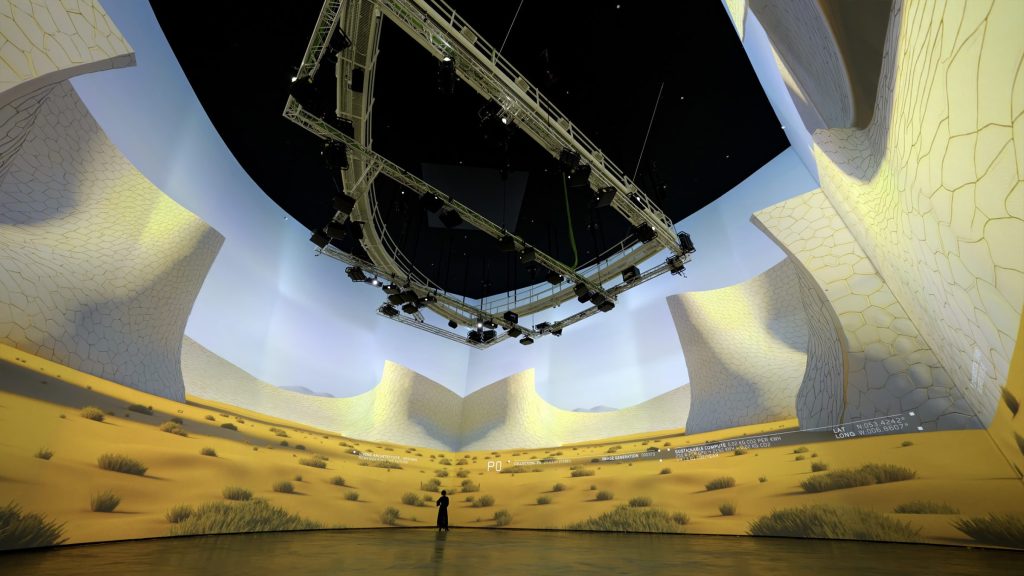
If Ridler works through authorial gesture and Klingemann explores the intimate interior of neural networks, Refik Anadol brings generative art onto a radically different scale.
His immersive installations transform vast archives of data—images, collective memories, museum collections—into visual environments in constant metamorphosis. Projects such as Unsupervised at MoMA employ generative models trained on the museum’s entire collection to produce streams of imagery resembling an artificial memory in motion.
Anadol represents the canon of data monumentalism, where AI becomes a means of visualizing the unconscious of datasets at architectural scale. In this practice, the algorithm is not simply an image generator but a device that transforms cultural archives into dynamic landscapes.The result is an art form operating somewhere between cinema, architecture, and digital sculpture, dramatically expanding the perceptual scale of algorithmic imagination.

Jake Elwes introduces another essential dimension of contemporary AI art: cultural critique.
In The Zizi Show, the artist trains GANs on drag performances to create a digital cabaret in which synthetic identities continually emerge and transform. The project exposes the biases embedded within datasets and demonstrates how generative technologies can reproduce—or subvert—the social norms governing gender and representation.
Elwes represents the canon of critical AI practices, in which generative art becomes not only an aesthetic medium but also a tool for interrogating the power structures embedded in algorithms.
The work unfolds as a performative space where technology and culture intersect, revealing how machine learning systems inevitably reflect the values—and omissions—of the societies that produce them.
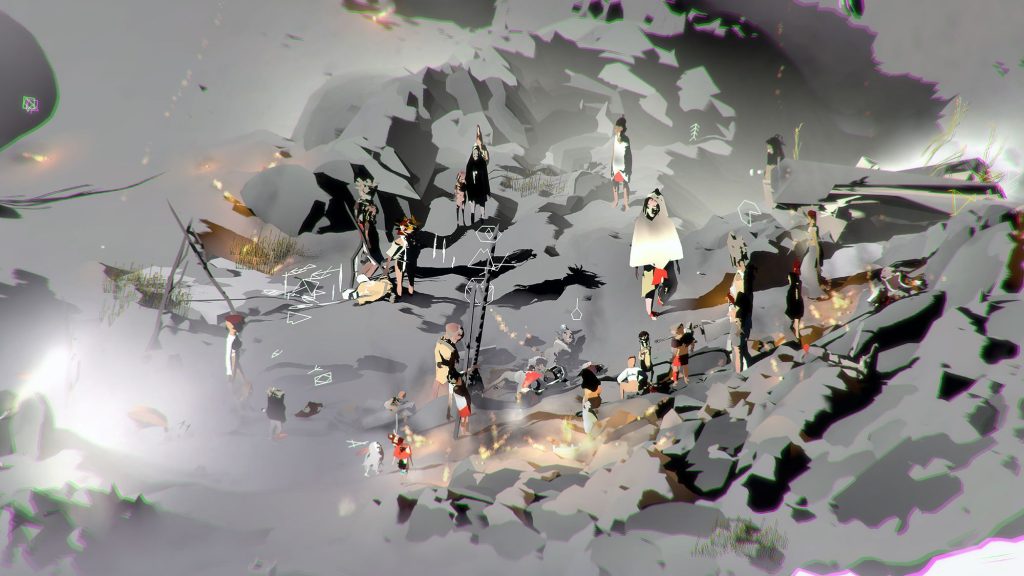
Ian Cheng occupies yet another territory: that of evolutionary simulation.
In his work, the artwork is not a finished image or video but an autonomous system unfolding over time. In BOB (Bag of Beliefs), a digital creature guided by behavioral models moves through shifting environments, developing new strategies and responses as it interacts with the simulated world.
Cheng represents the canon of simulation-based art, in which artificial intelligence becomes the infrastructure for constructing complex narrative ecosystems.
Here the artist does not control every detail of the work but designs the conditions within which it can evolve. AI does not produce static images but worlds that learn, mutate, and surprise.
From this perspective, generative art approaches the creation of artificial forms of life, opening radically new possibilities for the relationship between artist, machine, and audience.
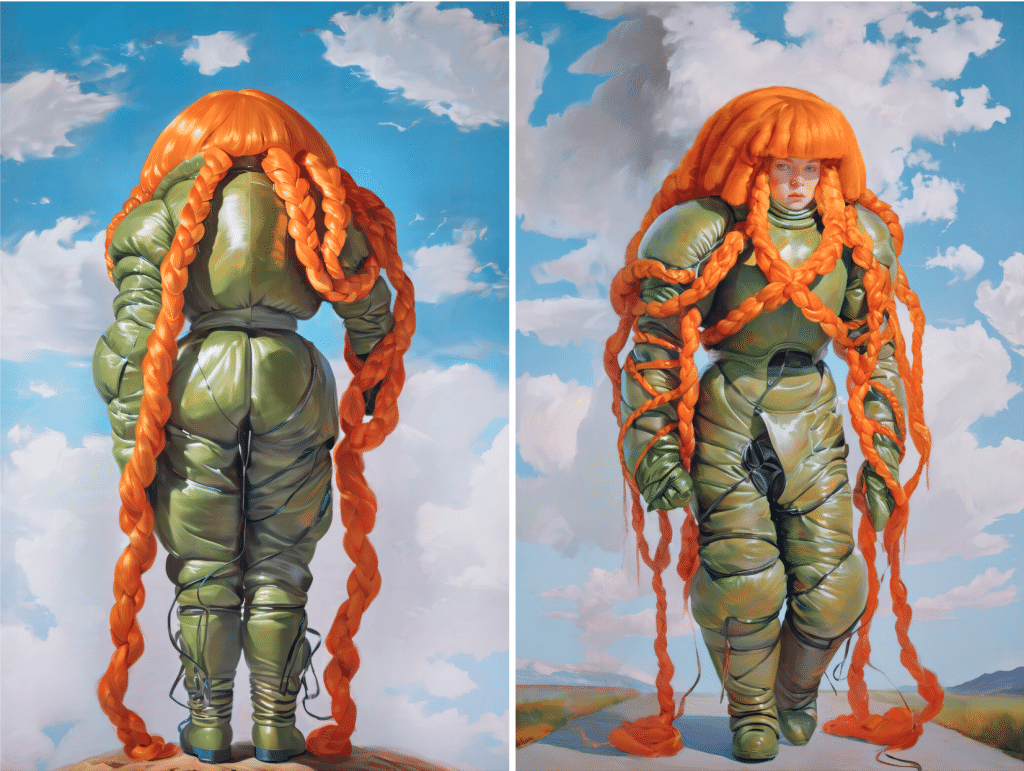
Their case is particularly instructive: generative models are not staged as autonomous agents but treated as components of a broader artistic ecosystem, one in which datasets, training processes, and cultural participation become part of the work’s authorship. Rather than presenting AI as spectacle, Herndon and Dryhurst explore how generative systems can produce new visual forms emerging from collaborative networks between artists, communities, and machine learning infrastructures.
In this sense, their work makes particularly clear the shift that the map proposes: from the narrative of the machine to the centrality of artistic language. The algorithm is not presented as a protagonist but as an infrastructural medium through which artists construct new cultural and aesthetic frameworks. It is precisely this kind of practice that clarifies the curatorial thesis of this issue: AI art is not converging toward a single style but unfolding into distinct artistic languages in which technology becomes infrastructure and artistic authorship returns to the center.
These six practices demonstrate how many different forms generative art can take: manually constructed archives, emerging neural aesthetics, monumental data landscapes, cultural critiques of datasets, and evolving simulations.
It is precisely this plurality that defines the field.
AI is not a single style nor merely a technological demonstration; it is an artistic language still in formation, capable of generating forms that range from memory to politics, from data architecture to artificial worlds.
Looking at these practices, a fundamental shift becomes clear.
The question is no longer whether a machine can imitate a human gesture. The real question is how artists can use algorithms to explore perception, memory, politics, and imagination.
What these practices suggest is that AI art is entering a second phase.
The early years were dominated by demonstrations—machines proving they could produce images.
The phase now emerging is different: artists are no longer asking whether algorithms can imitate human gestures, but what new forms of perception, narrative, and critique can emerge when AI becomes a medium in its own right.
In this sense, Ai-Da remains a powerful symbol of the meeting between technology and art, less as a definition of the language now emerging than as a cultural entry point into it.
The field of AI art is still in formation. Different traditions coexist and will continue to evolve.
AI Art Digest focuses primarily on practices in which generative systems become tools for artistic inquiry rather than simple technological demonstrations.
This does not invalidate other approaches. But it clarifies the curatorial lens through which this publication observes the field: one that prioritizes authorship, conceptual risk, and critical depth.
As the field continues to evolve, the task of curating AI art will not be to celebrate every technological novelty, but to recognize the practices that expand the language of art itself.
𝘝𝘪𝘵𝘰 𝘋𝘪 𝘉𝘢𝘳𝘪 𝘐 𝘍𝘰𝘳𝘮𝘦𝘳 𝘌𝘹𝘦𝘤𝘶𝘵𝘪𝘷𝘦 𝘋𝘪𝘳𝘦𝘤𝘵𝘰𝘳 𝘐𝘔𝘐 𝘜𝘕𝘌𝘚𝘊𝘖
AI-based art is still a field in formation. Its languages, criteria, and histories are only beginning to take shape.
This issue proposes one possible lens: distinguishing between technological spectacle and practices in which artists use AI as a genuine artistic medium.
But this conversation is far from settled.
Which artists, projects, or exhibitions do you think best demonstrate this emerging language of AI as a medium rather than a novelty?
I welcome suggestions, debates, and disagreements.
Write to me at vito@vitodibari.com
What should AI art dare to confront next?




If you know artists, curators, or collectors who are trying to navigate AI art, feel free to forward this digest to them.
Join the Conversation: Is there a GenAI artist you think I should feature?
Is there a theme — authorship, archives, AI and the body — you’d like to see unpacked in a future issue?
Write to me at contact@aiartdigest.art


© 2026 – Vito Di Bari – AI Art Digest – Scouting Gen AI styles and blue-chip generative artists.