AI Art Digest is shared with a curated international network of 2,126 museum and 1,291 gallery leaders.
In the case of AI art, that question carries even greater weight, because for years much of the public’s attention has been fixed on the same scene: the machine producing images, the robot painting, the algorithm seeming to cross a symbolic threshold once reserved for the human artist. It was a powerful narrative, almost inevitable. But it is no longer enough to ask whether the machine can make art. We need to ask what AI art is becoming, and above all how to read it without reducing it to a single dominant myth.
The curatorial thesis of this text is that AI art is not a movement. It is not a single style, not a compact tendency, not a homogeneous school. It is a technical condition that is making different movements, languages, and practices possible. To treat it as a single block is to make three mistakes at once: a stylistic confusion, in which very different images are mistaken for expressions of the same phenomenon; a technological confusion, in which the novelty of the medium is assumed to coincide with the identity of the work; and a historical confusion, in which AI art is imagined as emerging as a unified movement when it is, in fact, already articulating itself into distinct families and genealogies.
This is why the map accompanying this issue should not be read as a simple classification. It should be read as an interpretive curatorial tool: a visual demonstration of the fact that AI does not produce a single style, but rather an ecosystem of artistic practices.

This thesis appears to be confirmed by certain market signals, but this issue is not a commentary on the market. Quite the opposite.
Further along, a transitional zone appears: human–machine collaboration. Here the machine does not replace the author, but enters into a practice in which authorship remains legible. This is the threshold at which the discourse begins to shift: no longer the machine as autonomous marvel, but the machine as partner, instrument, extension of the human gesture. Then, on the right side of the map, practices emerge that are now clearly author-driven: dataset authorship, generative image art, critical AI practices, data monumentalism, simulation-based art. Here the center is no longer the machine. The center is the artist’s vision. The question is no longer whether the machine can be an artist, but what artists are able to do with this technology once it stops being a demonstration and becomes a language.
Put more directly: the early years of AI art were dominated by the narrative of the machine; the phase now emerging is dominated by the languages of the artist. In my view, this is the real historical difference that the map makes legible. Not a rigid chronology, but a cultural gradient moving from machine-centered narratives to artist-driven languages.
The first confusion is stylistic. Too often “AI art” is used as a flattening label that collapses everything into one category: robotics, generative image-making, installation, dataset critique, simulation, artificial landscape, symbolic portraiture. But these practices do not belong to the same canon. Some are built around the event, others around the image, others around the system, still others around the politics of data. To place them all in the same container is to prevent the field from becoming legible. The map is meant precisely to dissolve this confusion: not to rigidify the debate, but to show that a differentiation is already underway.
The second confusion is technological. A great deal of rhetoric around AI art continues to measure a work’s value by the degree of its technical novelty: more autonomy, more complexity, greater generative capacity. But technological primacy never coincides, on its own, with artistic value. This confusion was central to the first wave of public discourse around AI, and it continues to resurface every time a machine is presented as the subject of the work. The problem is not technology itself. The problem is the idea that technology alone is enough to produce language. And the response of the field—and, to some extent, of the market—seems to suggest that it no longer is.
The third confusion is historical. If we continue to speak of AI art as though it were a single movement, we lose sight of what is actually happening: the simultaneous emergence of different practices, with distinct historical references and different aims. Some look toward performance and historical machines; others toward painting, illustration, and portraiture; still others toward media theory, simulation, the archive, and the politics of representation. In this sense, AI art resembles a unified movement less than it does an infrastructural condition from which multiple movements are beginning to emerge.
Defining, distinguishing, and making legible the emerging artistic movements within the field of AI art is an integral part of the mission of AI Art Digest.
On a white studio floor covered in looping blue strokes, Sougwen Chung kneels in a black dress, brush in one hand and a pot of pigment in the other, while a small group of wheeled robots drag their own marks through the same pools of paint. Their compact bodies sit low to the ground, nudging through curves and spirals that echo her gestures, so that it becomes hard to separate what has been drawn by the artist and what has been laid down by the machines. It’s a small ecosystem of agents, each with a different body but sharing the same field of ink, movement and artistic decision-making.
They gave it a face, a scene, a story. The robot painting, the algorithm responding in real time, the system producing before an audience a gesture charged with cultural promise: all of this functioned as a symbolic threshold. The problem is not that these practices exist. The problem begins when they are mistaken for the field’s total definition.
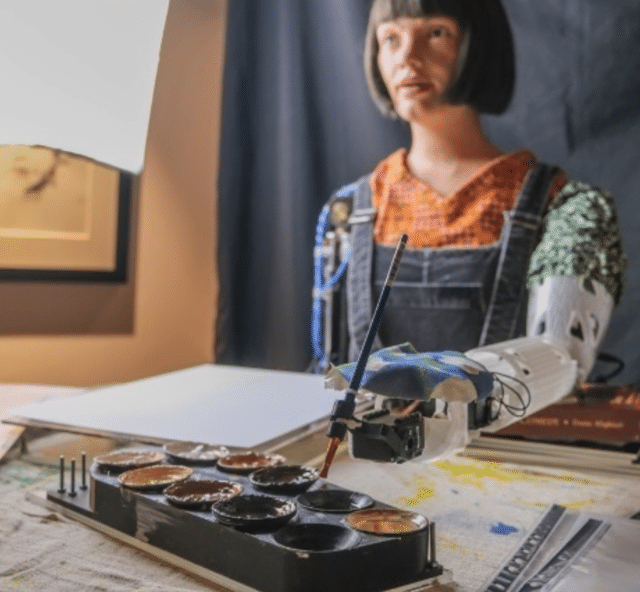
In this sense, the signals from Christie’s are interesting precisely as an indirect confirmation of the phenomenon. Alexander Reben’s lot, conceived as a real-time robotic performance designed to evolve with the dynamics of bidding, attracted considerable attention yet ultimately performed well below estimate.
Its cultural interest remains. But the result suggests that the spectacular device does not automatically convert into collector conviction. It is not definitive proof. It is a clue consistent with the thesis: the machine-centered narrative continues to attract attention, but it appears less solid when measured as a durable artistic proposition.
Alexander Reben, Untitled Robot Painting (2025) – © Alexander Reben – All rights reserved. Projects at https://areben.com/
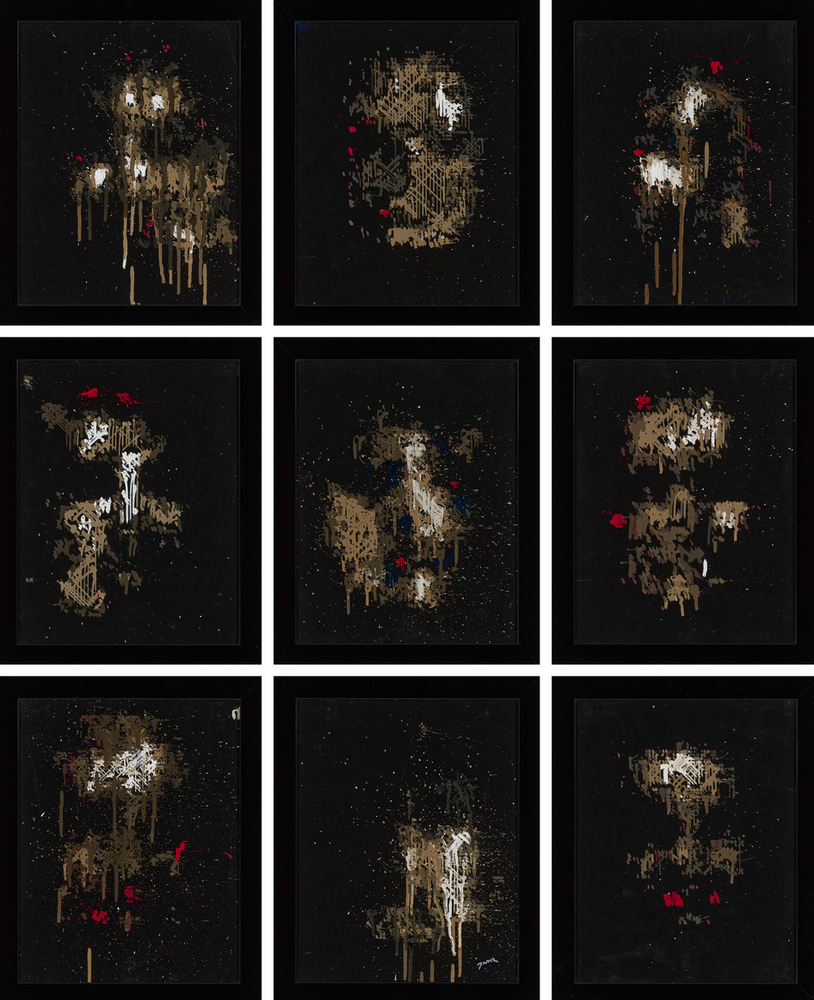
The category of human–machine collaboration is central because it shows the point at which the discourse truly begins to change. Here the machine is not denied, but repositioned. It is no longer the marvel to be displayed, but a tool through which the author constructs a language of their own.
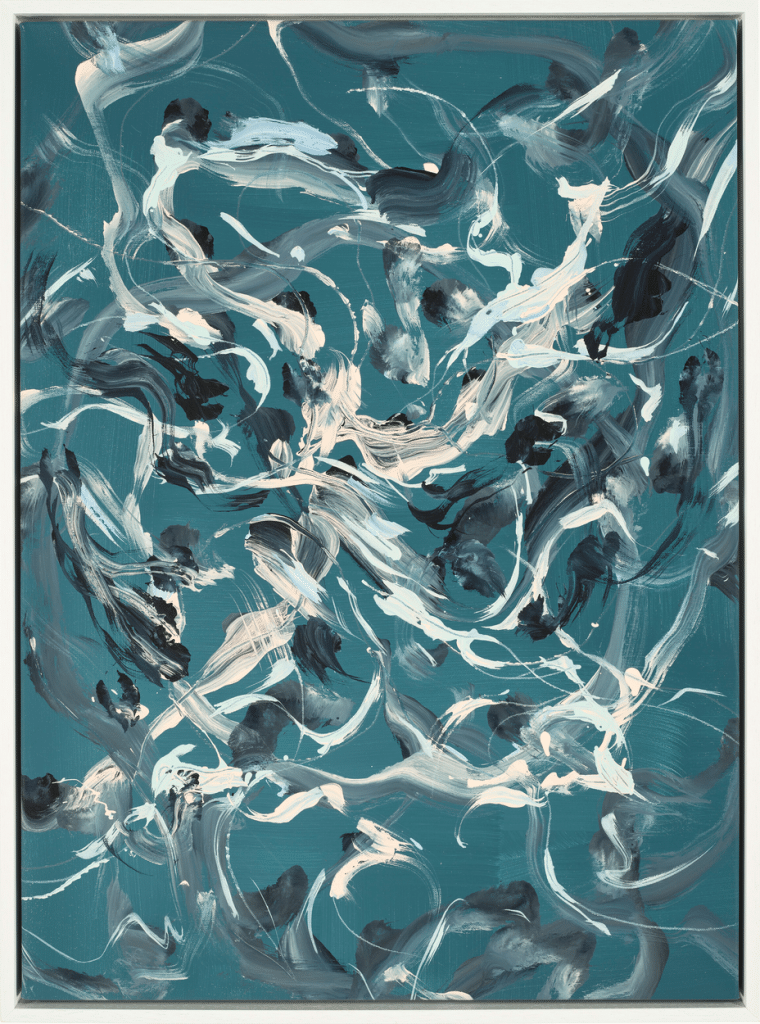
It is in this space that works such as those of Sougwen Chung acquire exemplary value. Study 33 performed comfortably within estimate, and that stability is significant: it does not speak of speculation, but of legibility. The market seems to understand what it is buying when the relationship between human and machine is articulated as artistic research rather than as special effect.
This transitional zone also matters because it makes visible a shift in the public question itself. No longer: can the machine make art? But rather: what form of artistic thought emerges from a hybrid practice? This is where the concept of human-scale AI remains useful: not as a rejection of technology, but as an affirmation that the center of gravity of the work remains human. Intention, authorship, vision.
The right side of the map is where the field truly opens up. Here AI is no longer merely a demonstration; it becomes medium, material, structure, language. And it is precisely here that it became necessary to introduce a category often overlooked by museums and top-tier galleries, even though it is essential today: Generative Image Art.
This family encompasses many of the works the public encounters most often—new surrealisms, generative portraiture, artificial landscapes, symbolic figuration, imagined AI painting—yet far too rarely are they treated as a true curatorial family. And yet that is exactly what they are. They belong neither to the spectacular device nor solely to dataset critique. They belong to the construction of new visual iconographies. Here the machine does not occupy the stage; the image does. AI becomes a tool through which the artist develops a recognizable figurative language, often in open dialogue with the history of painting, illustration, and photography. Contenido del artículo
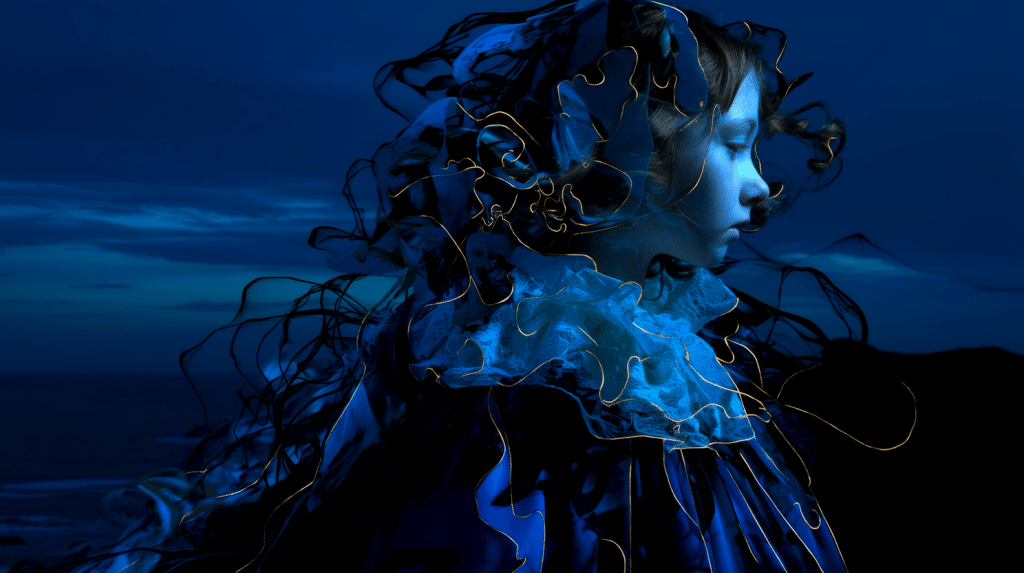
This is precisely why Claire Silver’s case matters in this issue. In the same Christie’s sale, Daughter (2025) performed solidly within estimate. More important than the market result, however, is the exemplary function of the work: not robotics, not a pure technical milestone, not a data installation, but generative imagery as language. It is exactly the kind of presence that confirms the map’s thesis: the field is no longer legible as a single AI block, but as a set of families in which generative figuration now carries a clear weight of its own.
Alongside this category, the map includes dataset authorship, critical AI practices, data monumentalism, and simulation-based art. Each of these families shows a different way of shifting the discourse from technology to language. In dataset authorship, the archive itself becomes an authorial gesture; in critical AI practices, AI serves to interrogate bias, identity, and power; in data monumentalism, datasets become immersive, institutionally legible landscapes; in simulation-based art, the work approaches the system, the ecosystem, the evolving artificial world. These are not variants of the same style. They are different practices made possible by the same technical condition.
It is at this point that the market becomes useful again, but only as confirmation. Christie’s Augmented Intelligence sale achieved a strong sell-through rate while attracting new registrants and a notably active Millennial and Gen Z audience. These figures do not prove that the market has “understood” AI art. But they reinforce the idea that the field has now become visible enough to enter a phase of internal selection.
That is why the central methodological statement remains the same: auctions do not determine artistic value, but they sometimes reveal which narratives a culture is beginning to question. Read in this way, Christie’s results do not tell us what is worth more. They tell us something more interesting: that the field of AI art is beginning to stop appearing as a single phenomenon.
If I had to condense the thesis of this text into a single formula, I would put it this way: AI art is moving from machine-centered narratives toward artist-driven languages. This is the real historical trajectory made legible by the map. Not a perfectly linear succession, but a clear cultural orientation.
The first phase was dominated by demonstration: machines proving they could produce images, systems imitating styles, gestures, and procedures, robots painting. The center of the scene was occupied by the technical threshold. The phase now emerging is different. It asks what images, what systems, what worlds, what questions artists can construct with this technology once it ceases to be mere novelty.
In this sense, AI Art Digest’s ninth issue, Beyond the Machine Artist, is not a rejection of the machine. 7It is the affirmation that the myth of the machine artist is no longer sufficient to contain the field. The real stakes today lie elsewhere: in understanding how AI is becoming a medium through which plural artistic languages are being articulated.
The field of AI art is still in formation. Its genealogies, its criteria, and its values remain open. But for precisely that reason, now is the right time to stop treating it as a single block. AI Art Digest continues to focus above all on practices in which generative systems function as tools of artistic inquiry rather than as mere technological demonstrations. This does not invalidate other trajectories. But it does clarify the curatorial lens through which we observe the field: one that privileges authorship, conceptual risk, and critical depth.
For a certain period, the story of AI art was the story of a machine proving it could make images. The chapter now opening may be different. Artists are no longer asking only whether algorithms can imitate us. They are asking what new ways of seeing may emerge when those algorithms become part of the language of art. And perhaps it is precisely here that the map stops being a classification and becomes something more useful: a reading of the present, and at the same time an indication of direction.
𝘝𝘪𝘵𝘰 𝘋𝘪 𝘉𝘢𝘳𝘪 𝘐 𝘍𝘰𝘳𝘮𝘦𝘳 𝘌𝘹𝘦𝘤𝘶𝘵𝘪𝘷𝘦 𝘋𝘪𝘳𝘦𝘤𝘵𝘰𝘳 𝘐𝘔𝘐 𝘜𝘕𝘌𝘚𝘊𝘖
AI art is increasingly described as if it were a single movement.
This issue proposes a different reading: that what we call “AI art” may actually be an emerging ecosystem of distinct artistic languages.
The map presented here is not meant as a definitive classification, but as a curatorial hypothesis — a way to think about how practices may be moving from machine-centered narratives toward artist-driven languages.
But this conversation is only beginning
Which artists, works, or exhibitions do you think best represent these emerging languages of AI art?
Are there practices missing from this map?
I welcome suggestions, debates, and disagreements.
Write to me at contact@aiartdigest.art
What should AI art dare to confront next?



© 2026 – Vito Di Bari – AI Art Digest – Scouting Gen AI styles and blue-chip generative artists.