When data becomes a cathedral and the screen behaves like a public square, does this work belong to the history of painting or to the history of infrastructure? Or to something in between?
Refik Anadol (Turkish-American, based in Los Angeles) has spent the last decade turning datasets into monumental projections and what he likes to call ‘data paintings’. His work has moved from the studio wall to the scale the lobby of MoMA and buildings, and along the way it has become one of the images most people now associate with AI art: large, cinematic, technically dazzling.
In this edition of AI Art Digest I am less interested in the press-release story and more in a slower question: in twenty years, when today’s LED walls are obsolete and immersive environments are routine, what — if anything — from this body of work will still feel meaningful?
Anadol is a transitional giant: a figure who has normalised AI at architectural scale, but also shows us where spectacle begins to eclipse inquiry.
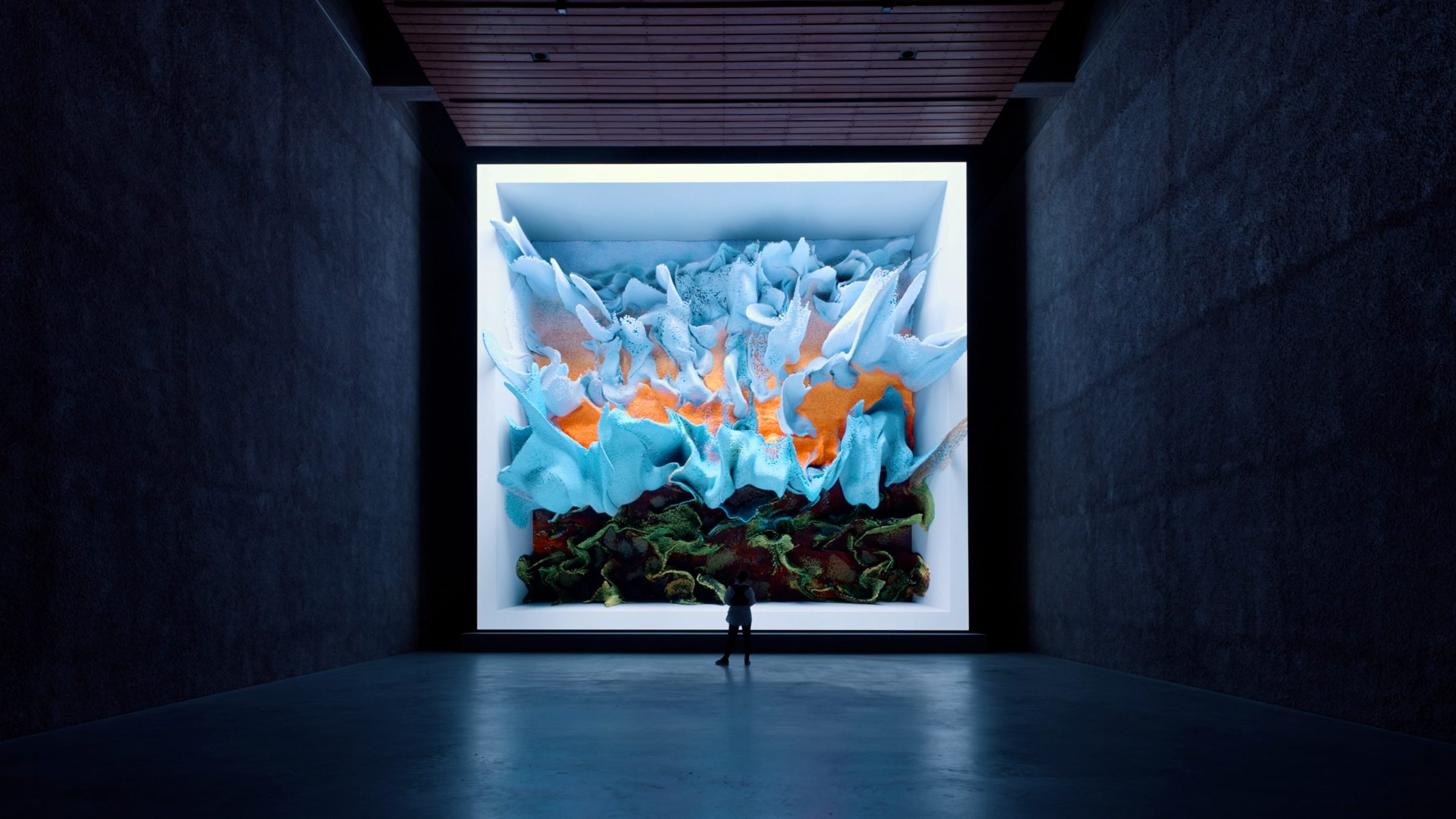
A three-storey LED wall at König Galerie in Berlin becomes a slow loop of colour and data: folds of light bloom, crumble, and re-form like a molten relief painting. Trained on a dataset of more than 300 million images, the work recomposes these recordings of the natural world into a continuous “nature dream”, asking what it means when our shared images of the planet return to us as an endlessly looping environment.
Link to Project – https://refikanadol.com/works/machine-hallucinations-nature-dreams/
From façade to “machine hallucination”
At König Galerie in Berlin, a three-storey LED wall loops folds of colour and data: blues and greens blooming, crumbling and re-forming like a molten relief painting. Trained on more than 300 million images, the system recomposes recordings of the natural world into a continuous “nature dream”.
Conceptually, the piece proposes a simple but powerful idea: what happens when our shared images of nature return to us not as individual photographs but as an endless flow, a synthetic memory of the planet? The viewer doesn’t see photographs; they inhabit their after-image. Yet the work also marks the entry point of a risk that will follow Anadol throughout his career: the risk that the “dream” remains purely atmospheric. After a few minutes, the surprise of scale and motion can flatten into ambience. The visual language stabilises into a beautiful, frictionless loop.
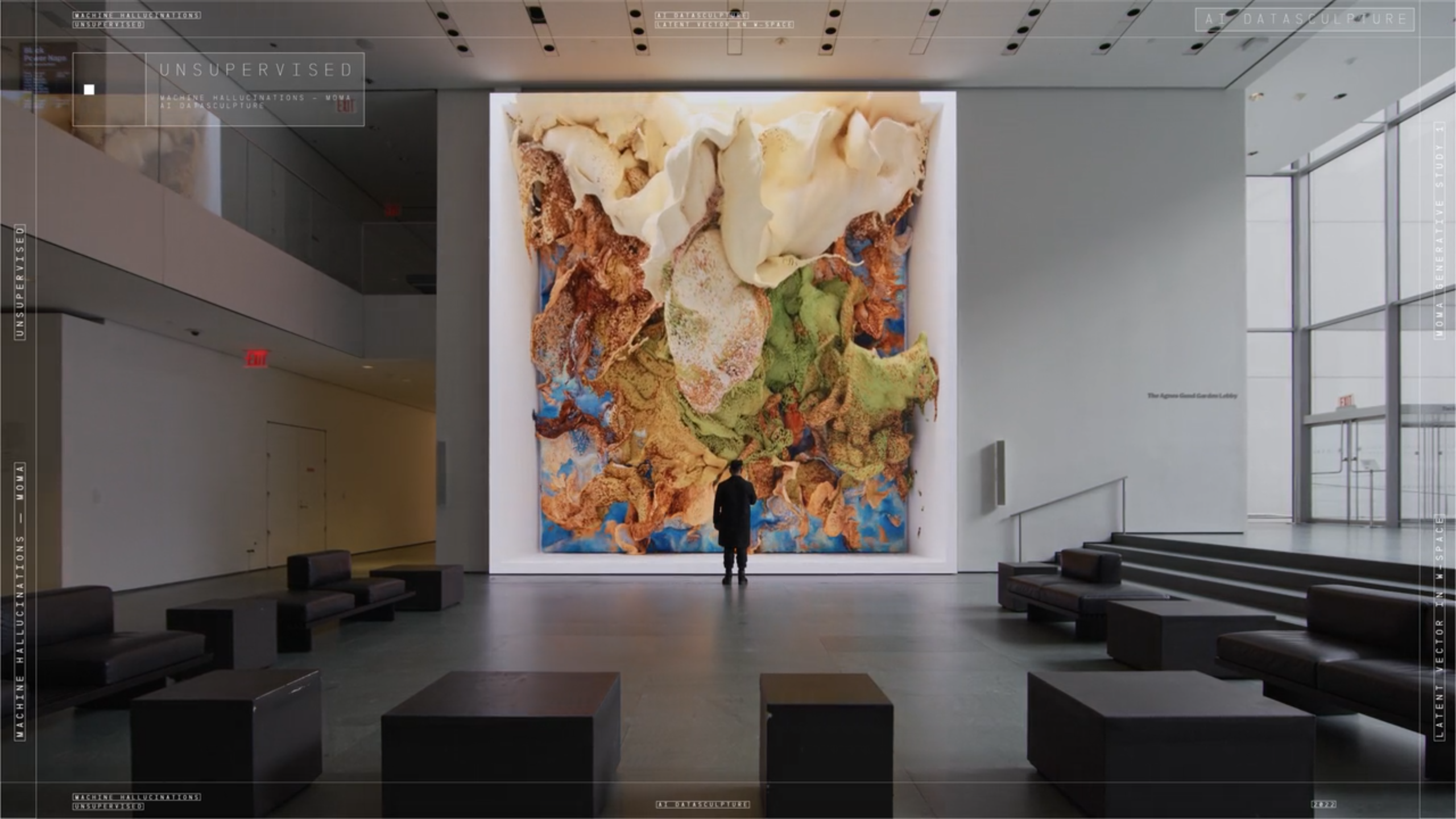
Commissioned for the Agnes Gund Garden Lobby at MoMA, Unsupervised is a LED “data sculpture” driven by a custom machine-learning model trained on more than 138,000 records from the museum’s collection. On screen, those metadata traces, like titles, makers, dates, materials, reappear as slow, eruptive weather: creams and coppers blooming over dense blues, then collapsing into new formations that never repeat. The viewer stands at the threshold between lobby and image, watching the museum’s own history liquefy into a single, continuously re-written surface. What you’re really watching is not so much a sequence of masterpieces as the institution’s own memory being constantly rewritten in public.
Link to Project – https://refikanadol.com/works/unsupervised/
MoMA’s lobby and the weight of recognition
Commissioned for the Agnes Gund Garden Lobby at MoMA, Unsupervised is an LED “data sculpture” driven by a custom machine-learning model trained on more than 138,000 records from the museum’s collection. Titles, makers, dates and materials reappear as slow, eruptive weather: creams and coppers blooming over dense blues, collapsing into new formations that never repeat.
The curatorial premise is elegant: invite a machine to “dream” of the museum’s own holdings and place that dream at the threshold where every visitor passes. For many audiences, Unsupervised became shorthand for a new institutional sentence: “AI has entered the museum’s self-image.” Spend longer with the work, though, and another reading emerges. The conceptual move of a collection becoming latent landscape is quickly legible. After that, the experience can settle into what some critics have described as a “half-million-dollar screensaver”: a surface that keeps shifting while the underlying question remains static.
This doesn’t make the work insignificant. It makes it symptomatic. Unsupervised condenses a moment when institutions embraced AI as image and atmosphere rather than as a tool for asking harder questions about authorship, labour and classification.
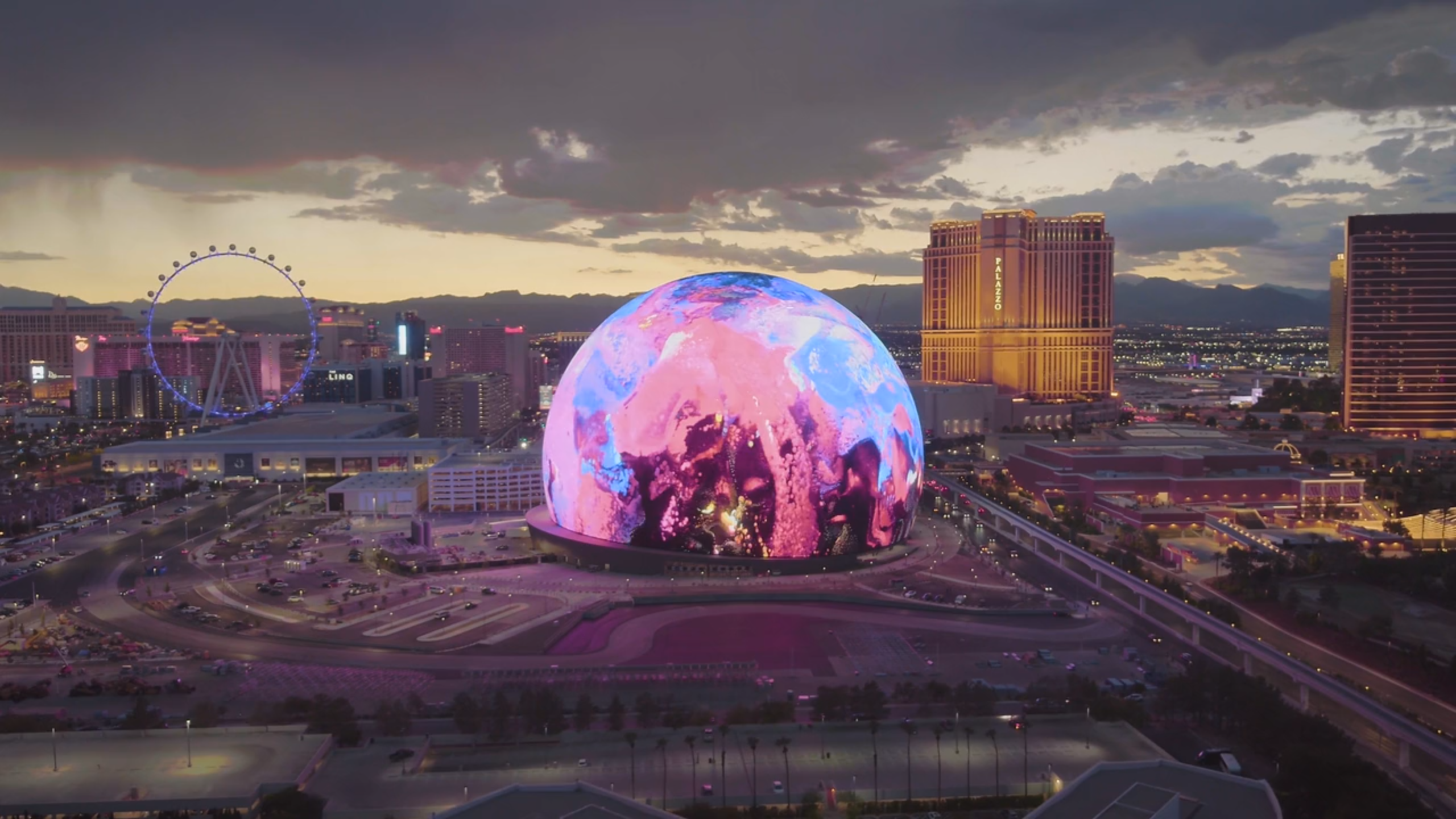
Projected across the 580,000-square-foot LED “exosphere” of Sphere in Las Vegas, “Machine Hallucinations: Sphere” turns the venue into an AI-driven planet that never quite settles into one image. Trained on vast archives of space photographs and satellite views of terrestrial landscapes, the work cycles through two chapters: Space and Nature. Glacial blues, eroded cliffs, cloud systems and mineral swirls fold over each other as if a new geology were being written in light. Seen against the casino skyline, the piece stops behaving like a billboard and starts to register as a temporary celestial body: a monumental data sculpture that asks what it means for a city of spectacle to orbit an artificial, continuously re-imagined Earth.
Link to Project – https://refikanadol.com/works/machine-hallucinations-sphere/
The Sphere moment: spectacle at planetary scale
If MoMA gave Anadol institutional gravitas, Sphere in Las Vegas gave him planetary visibility. In 2023 he was among the first artists commissioned to create content for the 16K LED exterior of Sphere — a curved screen that has effectively become part of the city skyline.
Machine Hallucinations: Sphere pushes his vocabulary into pure infrastructure: data storms, swirling colour fields and planetary textures wash over a building that reads like a dropped moon. Trained on archives of space photography and satellite views of terrestrial landscapes, the work cycles through two chapters (Space and Nature) turning the venue into an AI-driven, never-settled planet.
Seen from the Strip, the piece stops behaving like a billboard and starts to register as a temporary celestial body fallen on heart. Technically, it is impressive; culturally, it tests what happens when AI-generated imagery fuses completely with entertainment architecture. For the history of AI art, this is both milestone and warning. Anadol shows that AI can operate at the scale of civic spectacle. At the same time, his presence on Sphere ties his image tightly to branded entertainment and sponsorship — fields where attention, not reflection, is the primary currency.
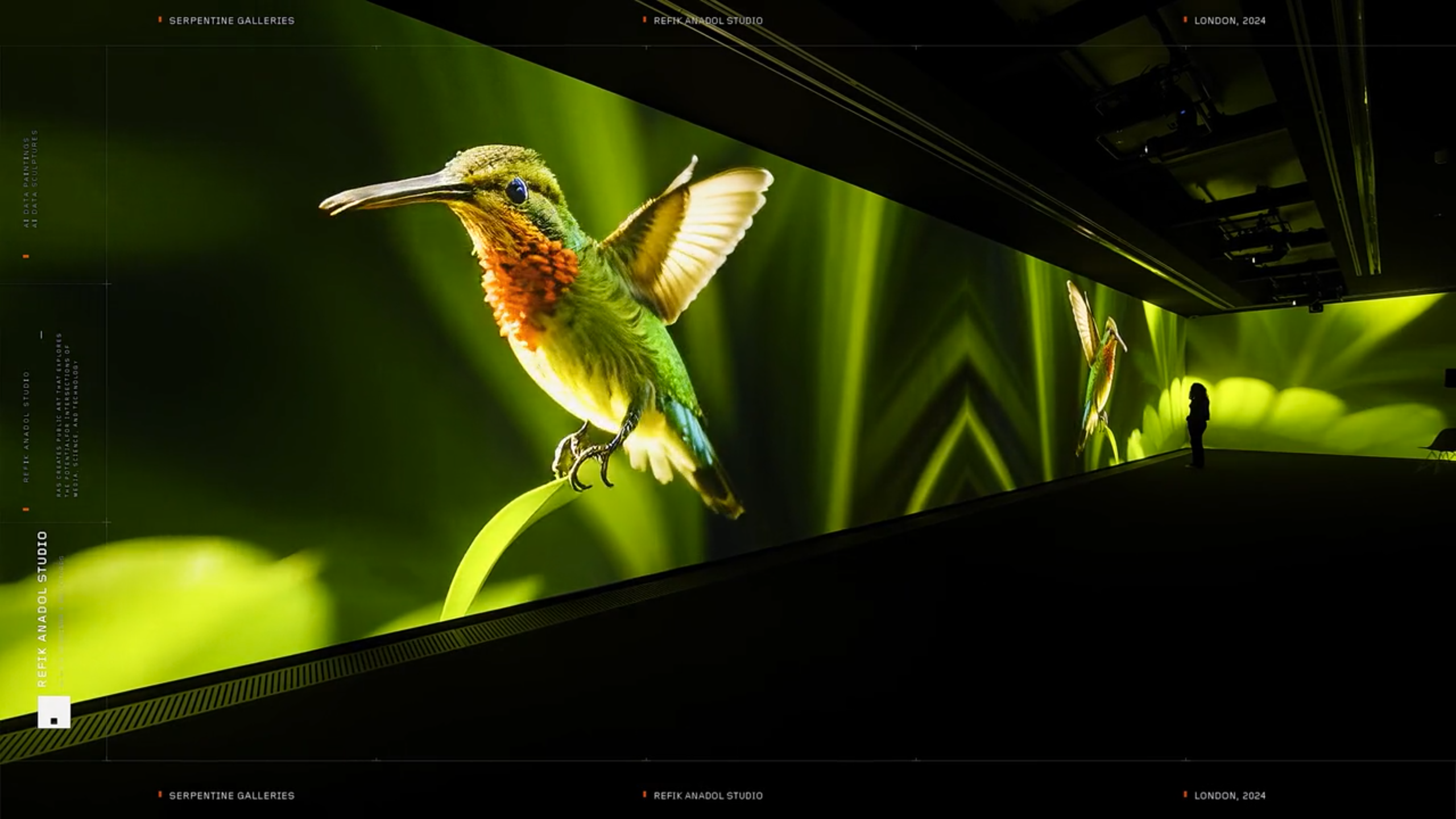
In Echoes of the Earth: Living Archive, Refik Anadol turns Serpentine North into a panoramic, data-driven rainforest. Floor-to-ceiling screens wrap the visitor in AI-generated waterfalls, flowers and birds, all produced with the Large Nature Model, a generative system trained on millions of images and sounds of ecosystems from institutions such as the Natural History Museum and the Smithsonian. Walking through the space feels like moving inside a synthetic memory of the planet: hyper-lush, frictionless, impossible to locate in real geography. The work quietly stages a question that runs through Anadol’s recent practice: how far archives of environmental data can stand in for lived contact with landscapes?
Link to Project – [https://refikanadol.com/works/echoes-of-the-earth-living-archive/](https://refikanadol.com/works/echoes-of-the-earth-living-archive/)
Echoes of the Earth: lushness and its limits
Here the tension between beauty and critique becomes sharper. On one hand, the piece makes visible the scale of scientific archives and the possibility of “data as living pigment.” On the other, it risks offering a frictionless substitute for environmental anxiety: a rainforest you can exit in three minutes, with no mud, no humidity, no politics.
To his credit, Anadol has begun to foreground process and ethics more explicitly in works like this one: wall texts detailing data sources, emphasis on authorised or “open” datasets, visible scientific partnerships. When process and context share the stage with spectacle, his practice moves closer to what AI art will need if it is to remain more than luminous décor.
Data politics: what disappears in the glow?
A recurring criticism of Anadol’s work concerns its relationship to data. Many of his projects depend on vast archives supplied by institutions or corporate partners. Yet, in the gallery, the experience often foregrounds the aesthetic of the output rather than the messy politics of the datasets themselves: whose images, whose labour, whose consent.
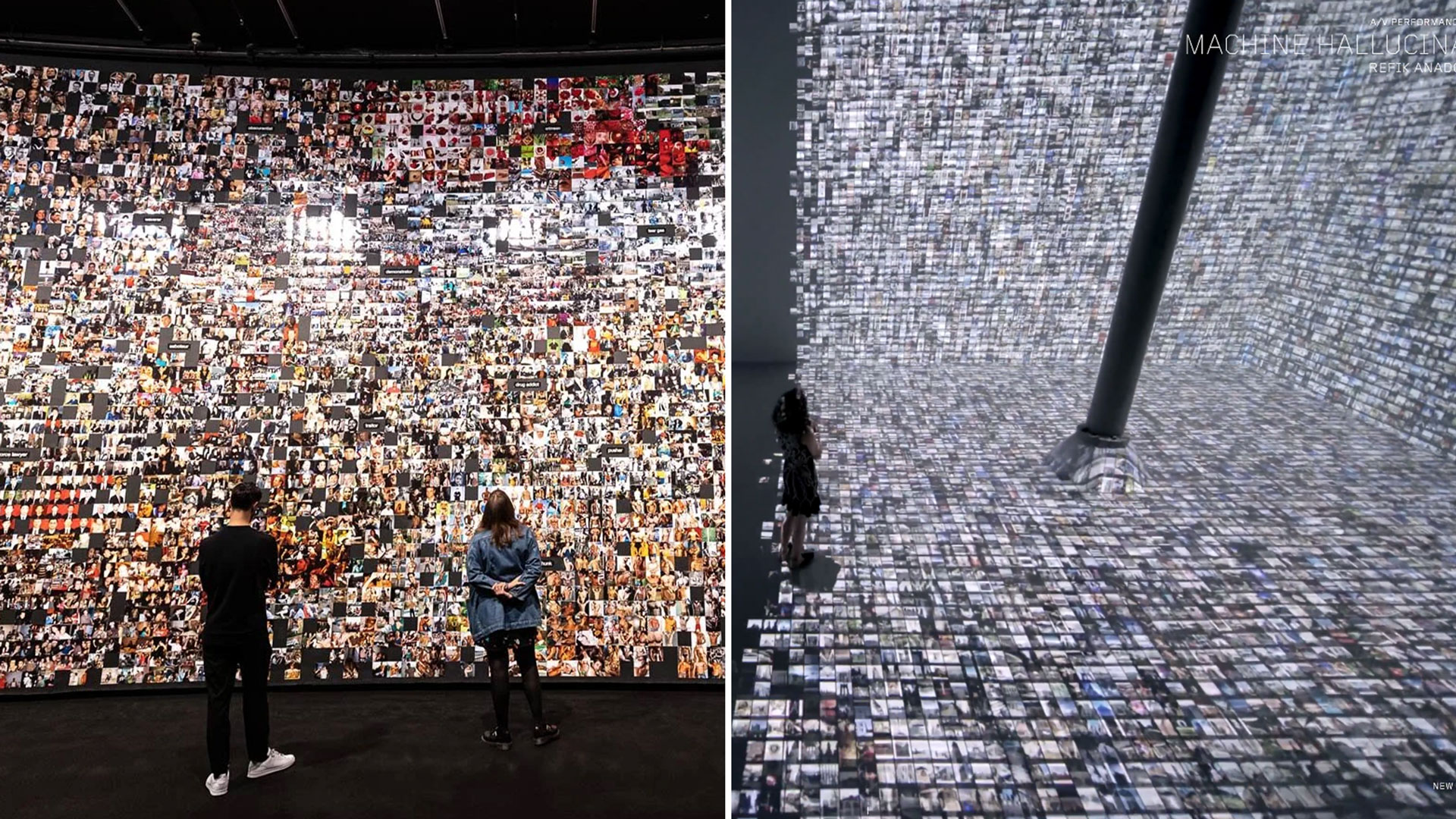
Seen together, the two installations stage a tension within image culture: Paglen foregrounds the politics and potential harm embedded in datasets, while Anadol transforms data into an immersive spectacle, inviting viewers to inhabit the inside of the archive rather than stand outside it in critique.
Comparative lens: Trevor Paglen and critical data aesthetics
To understand the stakes, it helps to place Anadol next to artists like Trevor Paglen. In From “Apple” to “Anomaly” (Pictures and Labels) (2019–20), Paglen stretches a training dataset across the wall as a dense grid of photographs, each tied to machine labels such as “wrongdoer” or “alcoholic”. From afar the work shimmers like an abstract field; up close, it reveals individual faces sorted into blunt, sometimes violent categories.
Anadol’s Machine Hallucinations takes similarly vast image archives and dissolves them into atmospheric flows that pour across floors and walls. Both approaches are legitimate; they simply put pressure in radically different places. Paglen forces viewers to confront how AI systems see and name the world. Anadol invites viewers to inhabit the inside of the archive, where the labels — and the people behind them — largely vanish.
Seen from a “human-scale AI” perspective, this distinction matters. If we want AI art that remains answerable to lived experience rather than just to resolution and scale, then the politics of data cannot stay offstage.
Towards a more human AI sublime
Why, then, take Refik Anadol seriously as a curator or collector in 2026?
Because his work concentrates, in a single practice, both the promise and the risk of AI’s mainstreaming in visual culture.
On the side of promise:
- He has normalised the idea that AI can be a material for architecture and public space, not just for laptop screens.
- He has given tangible form to concepts like “data as pigment” and “machine hallucination”, ideas that will remain reference points even as technologies change.
- In projects that foreground process, ethical sourcing and scientific collaboration, he shows that large-scale AI environments can be more than empty spectacle.
On the side of risk:
- The visual language of immersive screens ages quickly. What feels visionary in 8K may feel nostalgic once display technologies shift.
- When data politics remain invisible, the work can slide into what we might call aestheticised amnesia: we are surrounded by information without being asked to think about how it was gathered, sorted, or monetised.
- The very scale that secures institutional commissions can flatten nuance: the work must function as constant ambience for passers-by, which discourages discomfort, slowness, or genuine difficulty.
From a human-centred curatorial standpoint, Anadol is most compelling when he leans into the first set and resists the second — when he lets questions of data provenance, collaboration and ecological responsibility sit alongside spectacle, not behind it.
For museums, festivals and collectors, engaging with Anadol’s work now means engaging with the infrastructure of AI art as much as with individual images. Rather than asking “Is Anadol a safe long-term bet?”, a more productive curatorial question might be: “What does collecting this work say about how we want AI to appear in public space?” If the answer is “as a thoughtful, accountable infrastructure”, then the commission or acquisition should be framed, and documented, accordingly.
Vito Di Bari – AI Art Curator | Former Executive Director, UNESCO IMI