When the natural history archive starts dreaming
Imagine a natural history archive that doesn’t record what is, but rehearses what might have been.
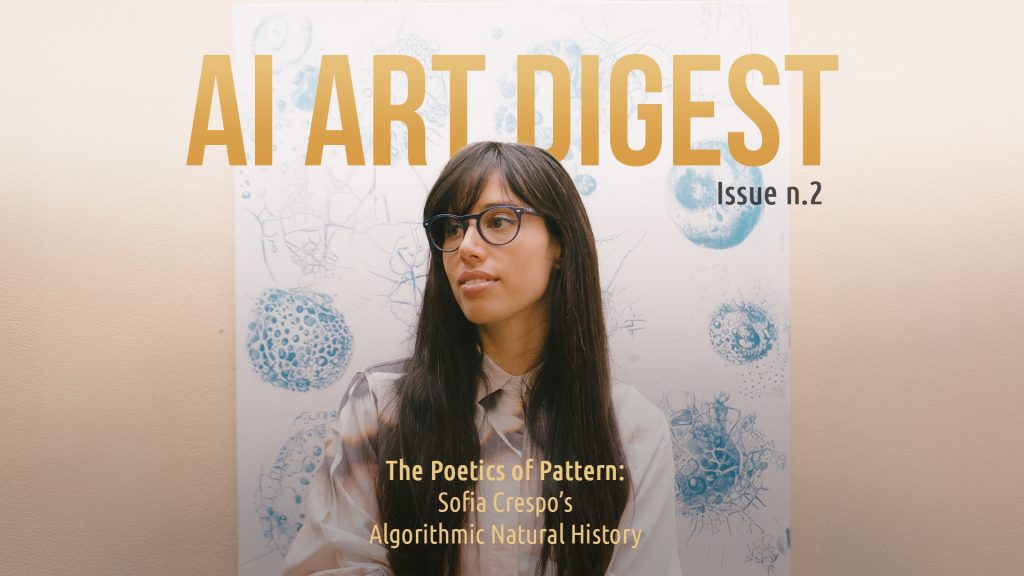
Based in Berlin, Sofia Crespo is one of the first artists to treat deep learning as a way of thinking with nature rather than just a clever effect. Coming out of speculative biology and digital art, she started working with convolutional neural networks in the mid-2010s, before “GenAI” became a buzzword. Over the years, her practice has settled into something very specific: algorithmic re-tellings of evolutionary form, where datasets and neural nets behave like sketchbooks and brushes.

A dense field of colour stretches from edge to edge: lemon yellows, tomato reds and deep greens cluster into bulbous fruits, sliced segments and seeds that seem to grow directly out of layered foliage. At a second glance, the still life begins to slip—skins carry traces of insect wings, stems merge into animal textures, and a butterfly wing appears where you would expect the shadow of a leaf. Water, leaves and pulp are woven together in a single, almost overwhelming surface. Rather than presenting a tidy botanical plate, Crespo lets the AI generate a kind of overgrown ecosystem of edibility and decay, where every element hints at several species at once and the idea of a stable specimen quietly dissolves.
Archiving the Unclassifiable
Her long-running project Artificial Natural History looks like a series, but behaves like a fictional taxonomy engine. Since 2020, Crespo has been constructing what she calls a “natural history book that never was”: a compendium of organisms that borrow from real anatomy, then quietly slip away from anything a biologist could actually label.
You recognise the visual language immediately. The symmetry of wings, the delicacy of tendrils, shell-like textures, all echo 18th–19th-century scientific plates. Stay a little longer and something feels off. Fins weave into petals. Feathers sink into coral logic. Plant forms begin to think like insects. These aren’t reconstructions of lost species; they are thought experiments about classification itself.
In her hands, the archive stops being a place of certainty and turns into a threshold. It’s where memory and invention overlap, where specimen and hallucination share the same page.
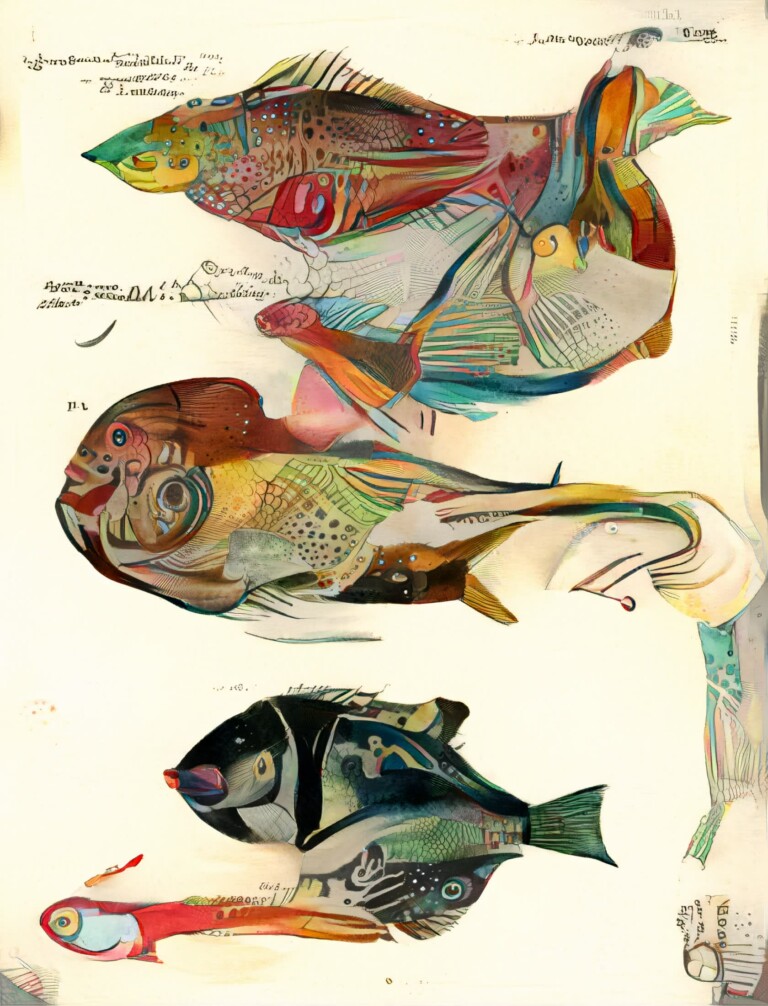
On an archival background, four elongated fish are lined up as if on a scientific plate, each one built from fragments of different species. Scales become grids, fins turn into layered membranes, and patches of bright colour sit next to diagram-like textures that resemble circuitry or topographic maps. Handwritten notations float around the bodies without resolving into legible language, underlining that this is a taxonomy the viewer cannot fully decode. Crespo lets the AI splice together anatomical memories of marine life into single “composite” creatures, so that what initially reads as an ordered study of specimens gradually reveals itself as a catalogue of things that exist only in the space between data, pattern and imagination.
Pattern Beyond DNA
Take Composite Specimen (fish_4532) as a concrete example. At a glance, your eye files it under “school of fish”. Look again and the illusion loosens: the body plan is slightly wrong, the repetition feels too insistent, the “shoal” behaves more like a diagram than a scene.
Crespo isn’t simply inventing another exotic creature. She’s pointing at the recipe for species-making. The neural network doesn’t know gills or vertebrae; it knows edges, clusters, textures. That mismatch between how life works and how the machine sees is where the image lives.
Instead of rewarding our habit of naming and shelving, she stalls it. Pattern becomes the main character, drifting across scale and morphology, sticking around even when anatomy gives up. What’s on the screen feels less like a zoological study and more like a stanza about what life would look like if it were written in weights and activations instead of DNA.
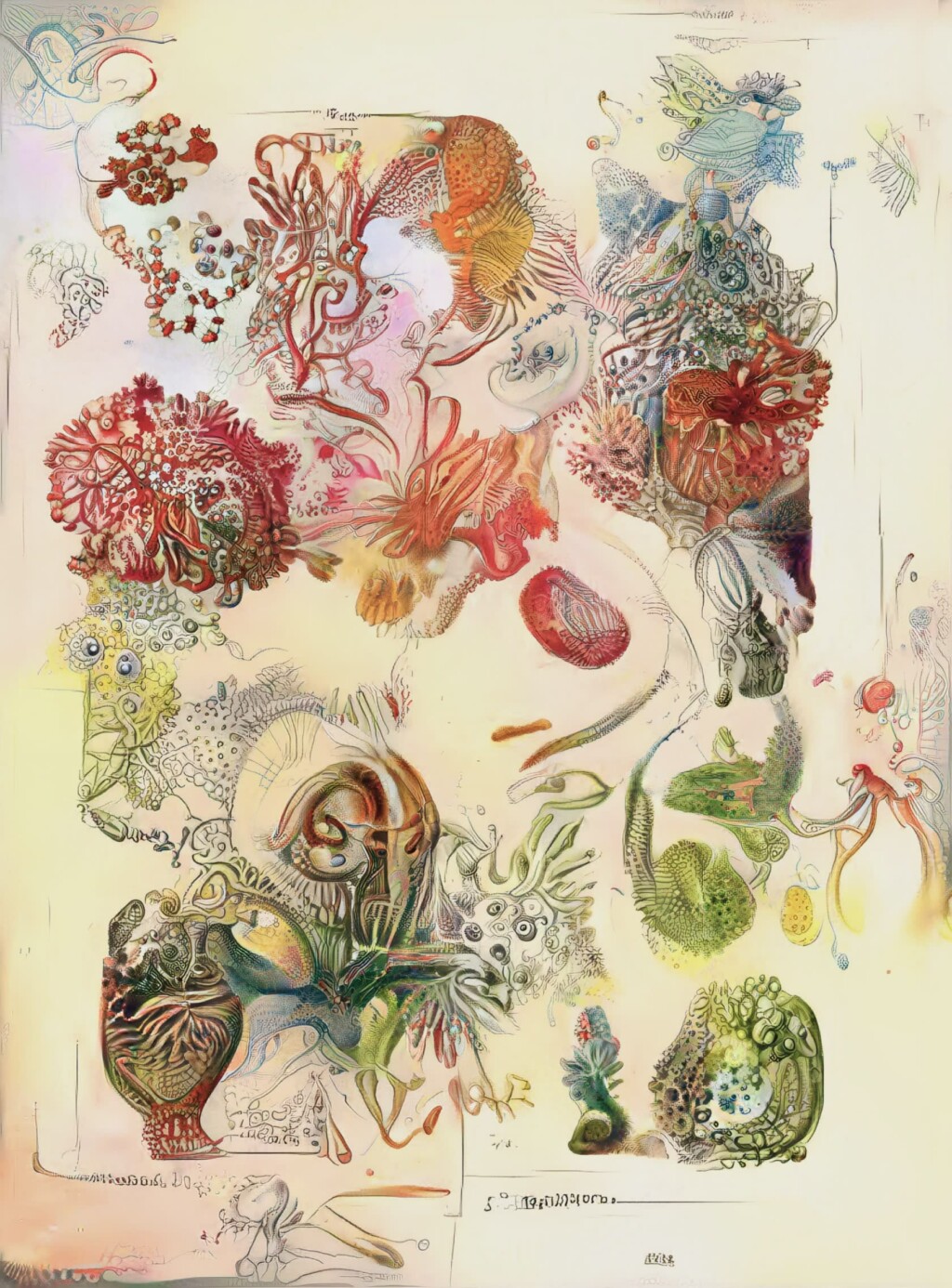
Against a light, parchment-like ground, clusters of coral, polyps and anemone-like forms drift across the page in reds, oranges and soft greens. Some passages are densely packed, almost baroque, while others fade into fine pencil lines and ghostly outlines, as if half of the reef were still in the process of being imagined. The structures look plausible at first, but closer in their filaments, pores and tendrils collapse several species into one, mixing reef biology with hints of spores, insects and plant organs. Crespo’s AI-generated “coral” behaves less like a fixed specimen and more like a memory of underwater life, recomposed from countless images into an ecosystem that is beautiful, fragile and slightly unstable.
Coral that remembers, not represents
In Coral_7867, the shift from documentation to speculation becomes even clearer. From a distance, the structure reads as reef: branching forms, porous surfaces, familiar repetition. Up close, it starts to behave like lace, or mycelium, or the after-image of a reef you’ve seen once and can’t quite recall.
Crespo isn’t using chaos to dodge classification. The form is calm, composed, held together by its own internal logic—just not by ours. It’s persuasive enough to feel alive, but refuses to sit neatly in any known category. It looks like an ecosystem imagined by a machine that has studied a lot of coral and then dreamed about it all night.
Where natural history once chased control and precision, Crespo leans into poetic ambiguity. The question shifts from “What is this?” to “What kind of life could we picture if our tools were allowed to dream alongside us?”
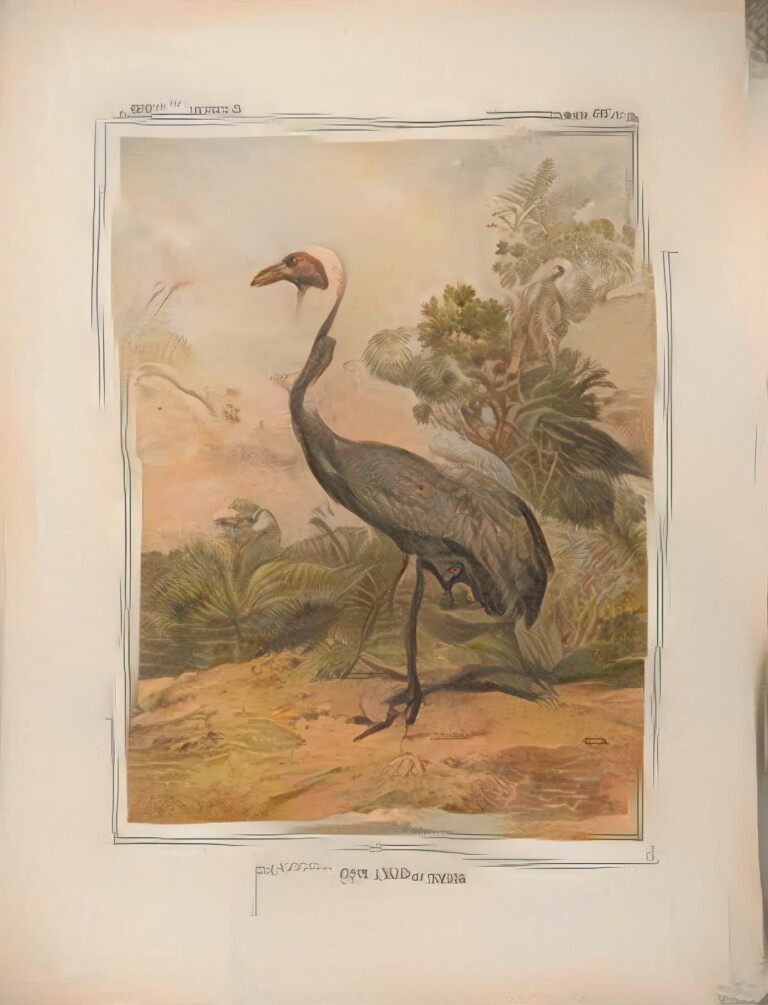
A solitary wading bird stands in profile on one leg, framed by a landscape that could have come from a 19th-century ornithology book: soft pink sky, distant hills, dense foliage. At first glance the plate looks almost conventional, but the longer you stay with it the more the strangeness accumulates. The neck stretches a touch too far, the beak and head don’t quite match any known species, and the vegetation behind the bird slips into painterly blurs and half-resolved forms. Along the margins, upside-down and broken text undermines the authority of the page as a scientific document. Crespo uses AI to re-compose the memory of a field illustration into a scene where the bird appears both precise and invented, standing at the threshold between natural history and a taxonomy that only exists inside the model.
Algorithmic Intimacy
The same tension runs through Bird_3617. There’s a clear trace of “birdness”: a beak-like point, wing-like curves, some sense of feathers. Yet the body never fully resolves into a species you could look up in a field guide.
You’re not looking at a zoological plate. You’re looking at a symbol built from bird-images. The neural network has digested countless examples and is now speaking its own half-abstract, half-familiar language. Crespo uses that gap to create a different kind of closeness: not “I know exactly what this is,” but “I recognise something here and still don’t have the right word.”
These works behave less like “outputs” and more like meditations on seeing through a machine’s eye. They don’t shout about technology. They invite you into a slower, stranger way of looking.
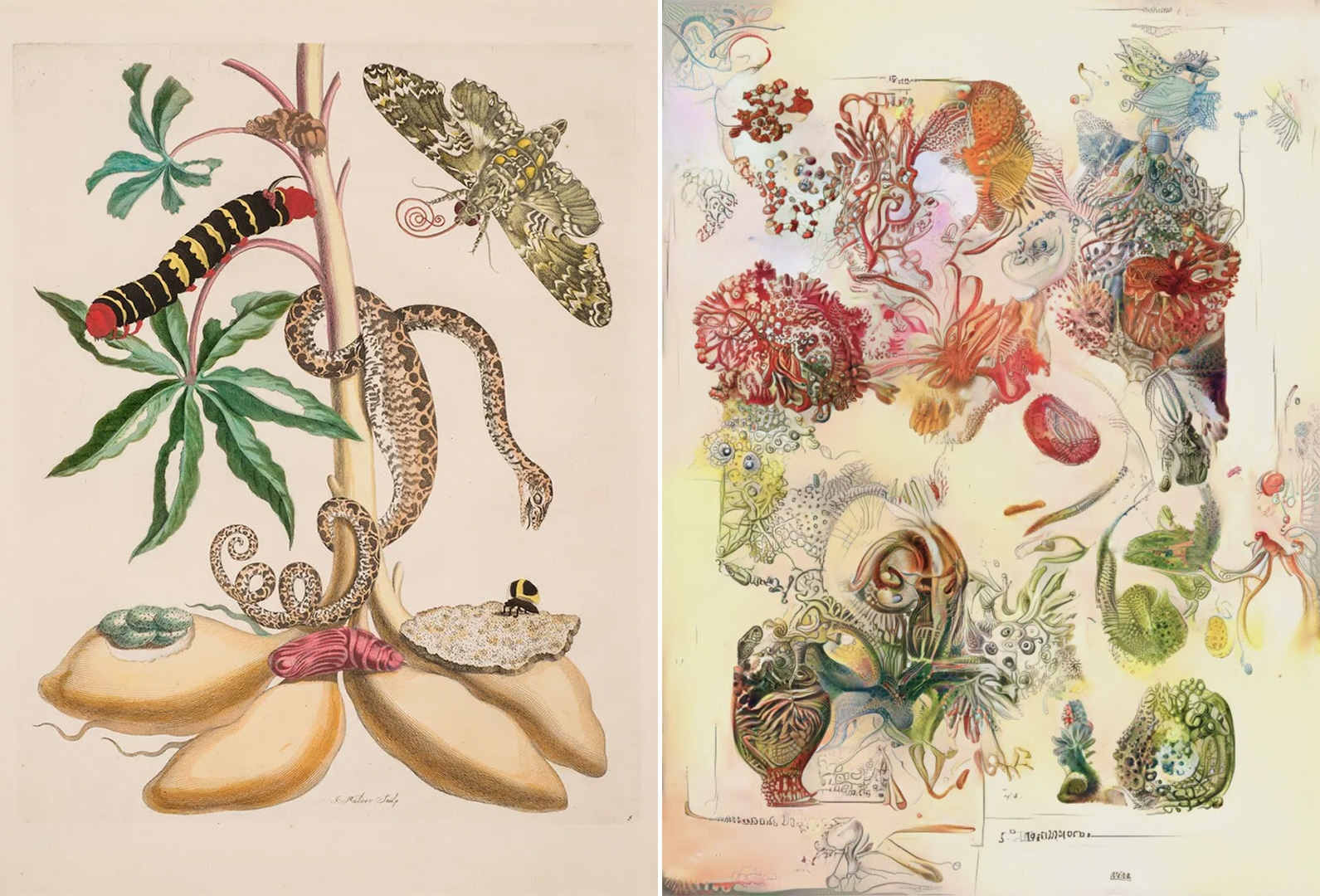
On the left, Merian’s plate arranges plant, caterpillar, chrysalis, moth, snake and bee around a single stem, each phase of metamorphosis clearly staged and named. The scene is didactic and theatrical at once: a compact drama of who eats whom, and how life cycles unfold. On the right, Crespo’s AI-generated field explodes that clarity into a swarm of coral-like, insectoid and plant forms spreading across the page, with no central stem to organise them. The historical plate proposes a world where nature can be broken down into legible sequences; the contemporary one shows a nature reassembled from overlapping datasets, where boundaries between species and even kingdoms blur. Together they map a shift from observing specimens in order to classify them, to training machines on archives of images and asking what kinds of living imaginaries emerge in return.
Comparative lens: Crespo & Merian
To place Crespo in a longer story, it helps to stand her next to Maria Sibylla Merian. In the early 18th century, Merian’s hand-coloured engravings wove close observation and narrative together: snakes, caterpillars, chrysalises and moths staged as small dramas of metamorphosis.
Crespo’s images echo that spirit, but invert the tools. Merian worked with pigments, paper and direct contact with specimens; Crespo works with datasets, training regimes and synthetic morphology. Both treat natural history as something more than evidence—they turn it into a narrative field.
Seen side by side, a Merian plate and an image from Artificial Natural History feel related. The question isn’t “Which species is this?” but “How do we picture life when life is too complex to pin down on a page?”