
When robots remember the hand that taught them.
When a robot learns to follow the memory of a human gesture, are we still talking about drawing, or something closer to a ritual?
Sougwen Chung (Chinese-Canadian, based between London and New York) has spent more than a decade redefining what “gesture” means in the age of AI. Long before the current obsession with text-to-image tools, she was already teaching machines to draw. Not as obedient assistants, but as partners with their own kind of memory.
A former researcher at the MIT Media Lab and Artist-in-Residence at Bell Labs, Chung founded Studio Scilicet, an experimental studio in London focused on human–nonhuman collaboration. In 2023 she was named one of TIME100 AI’s Impact Award recipients. Her work moves with ease between lab, museum, and performance stage: the series Drawing Operations Unit is part of the Victoria & Albert Museum collection, the first AI-driven drawing system ever acquired as a cultural artifact.
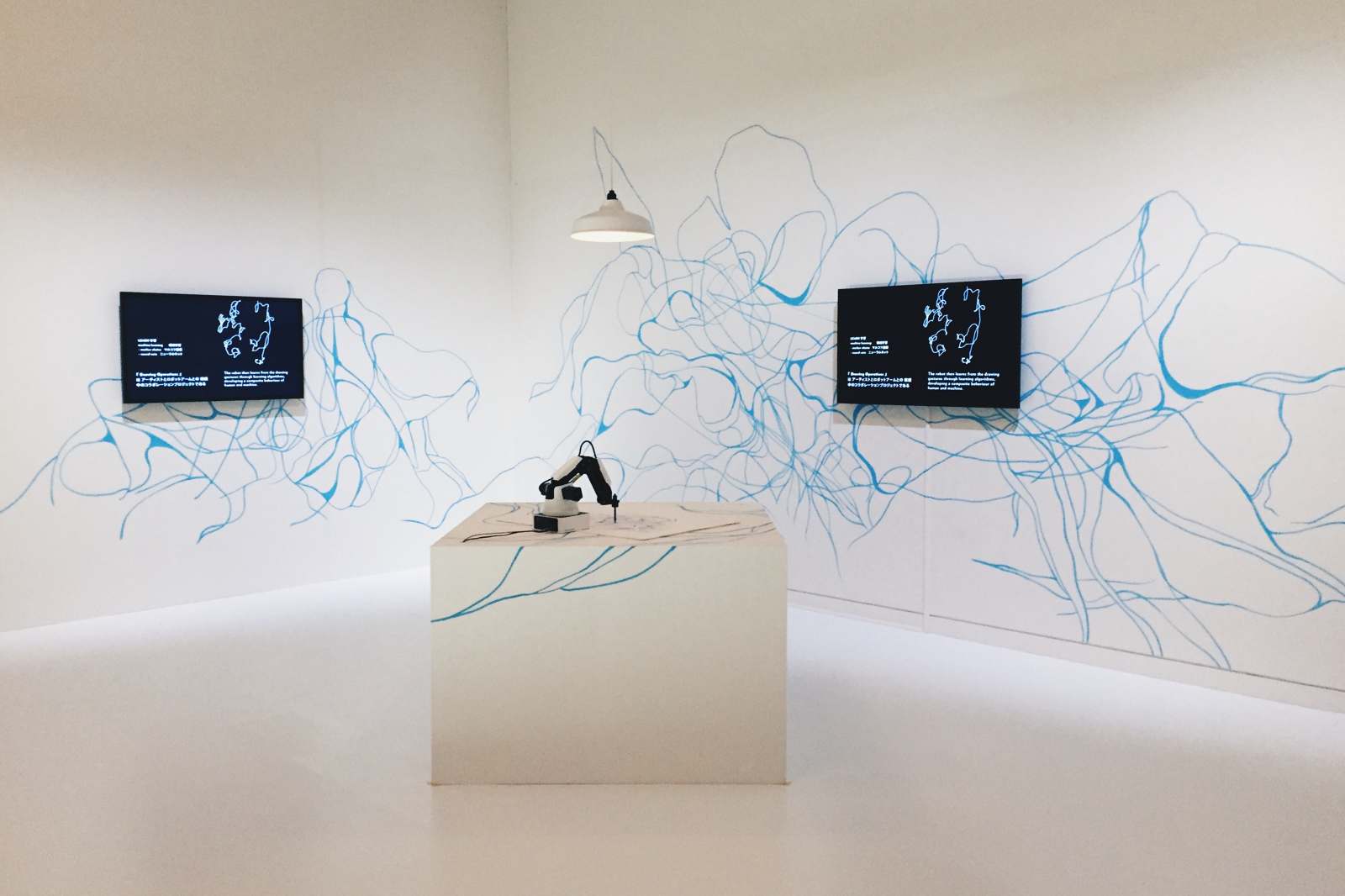
A small robotic arm sits on a white plinth in the centre of the gallery, drawing looping blue lines on paper while similar marks spill off the edges of the cube and across the surrounding walls. Two black screens on either side display white diagrams and text, like fragments of a score for the machine’s gestures. The room feels like a laboratory for remembering: the blue strokes repeat and evolve from surface to surface, as the system replays traces of the artist’s hand.
Memory as a drawing partner
The turning point in Chung’s practice is Drawing Operations Unit: Generation 2 (Memory). For this project, she trained a custom system on her own archive of drawings: years of ink studies, line experiments, and performative sketches digitised and fed into a neural network.
Rather than being trained on the endless, anonymous mass of images online, the system looks inward. Its data comes from one place only: the artist’s hand. The machine doesn’t “hallucinate” from the internet; it remembers her habits, hesitations, and favourite gestures.
For a collector, this gives each output an archival quality. Every new drawing produced with the system carries, inside its code, the sediment of an entire drawing practice. Concept and material are tightly bound: the soft hum of the motors, the paper, the ink, and the slight jitter of a robot that is, in its own way, recollecting.
On a raised platform covered in pale ink washes, Sougwen Chung moves between four white robotic arms that each hold a brush. At times she sits cross-legged in a long white dress while the robots paint around her; at others she kneels on the paper, offering bowls of ink and bundles of brushes to a single arm, as if teaching it how to begin. A slim black band across her forehead links her body back into the system while the ink spreads in slow storms across the surface. As the sequence unfolds, the roles shift: first she calibrates and demonstrates, then she paints in unison with the robots, and finally she steps back and watches them continue alone, their strokes echoing the calligraphic gestures she has already inscribed.
From mimicry to shared choreography
If Memory is an archive, Drawing Operations Unit: Generation 1 (Mimicry) is the first liturgy, the moment where human and machine begin to move together.
In these performances, Chung paints alongside a robotic arm that mirrors her gestures in real time. She has described this as a “shared choreography”: the brushstroke appears first in her hand, then echoes a fraction of a second later in the robot’s movement.
That delay creates a rhythm of its own. Watching the performance, you don’t feel that a machine is “copying” an artist. You sense two presences learning to keep time together. The duet has a quiet tension: who is leading, and who is following, becomes less important than the way their gestures intertwine.
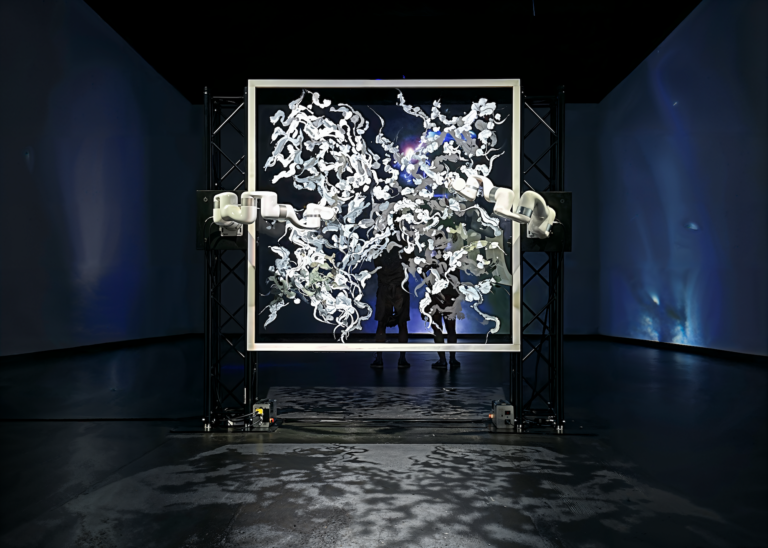
A large square frame stands in the middle of a darkened gallery, held up by black truss towers, with two white robotic arms mounted on either side drawing across a vertical pane. The surface is crowded with pale, ribbon-like marks that twist and overlap until they form a dense, almost clouded structure, catching the light so that reflections spill onto the floor below. Through gaps in the drawing you glimpse visitors on the other side, their bodies folded into the composition as moving shadows. The work turns the robots into both performers and framing devices: they do not hide the mechanism of inscription, but stage it, inviting the viewer to stand inside the field of marks and light that their repeated gestures create.
Brainwaves, biofeedback, and post-human calligraphy
In later works such as Spectral (2024), Chung extends this duet into a more intimate feedback loop. She connects her brainwaves (EEG data) to the robotic system, allowing changes in her cognitive state to influence the behaviour of the machine.
When her alpha waves — often associated with calm concentration — increase, the robot’s mark-making becomes more fluid. The drawing session turns into a form of biofeedback painting: cognition, code, and gesture respond to one another in real time.
What we see here is not automation, but co-presence. The artwork sits in the relational space between human breath, mechanical tempo, and the shared gesture that emerges from both. The result feels less like a “digital piece” and more like a post-human calligraphy: technical, yes, but also surprisingly meditative, almost devotional.
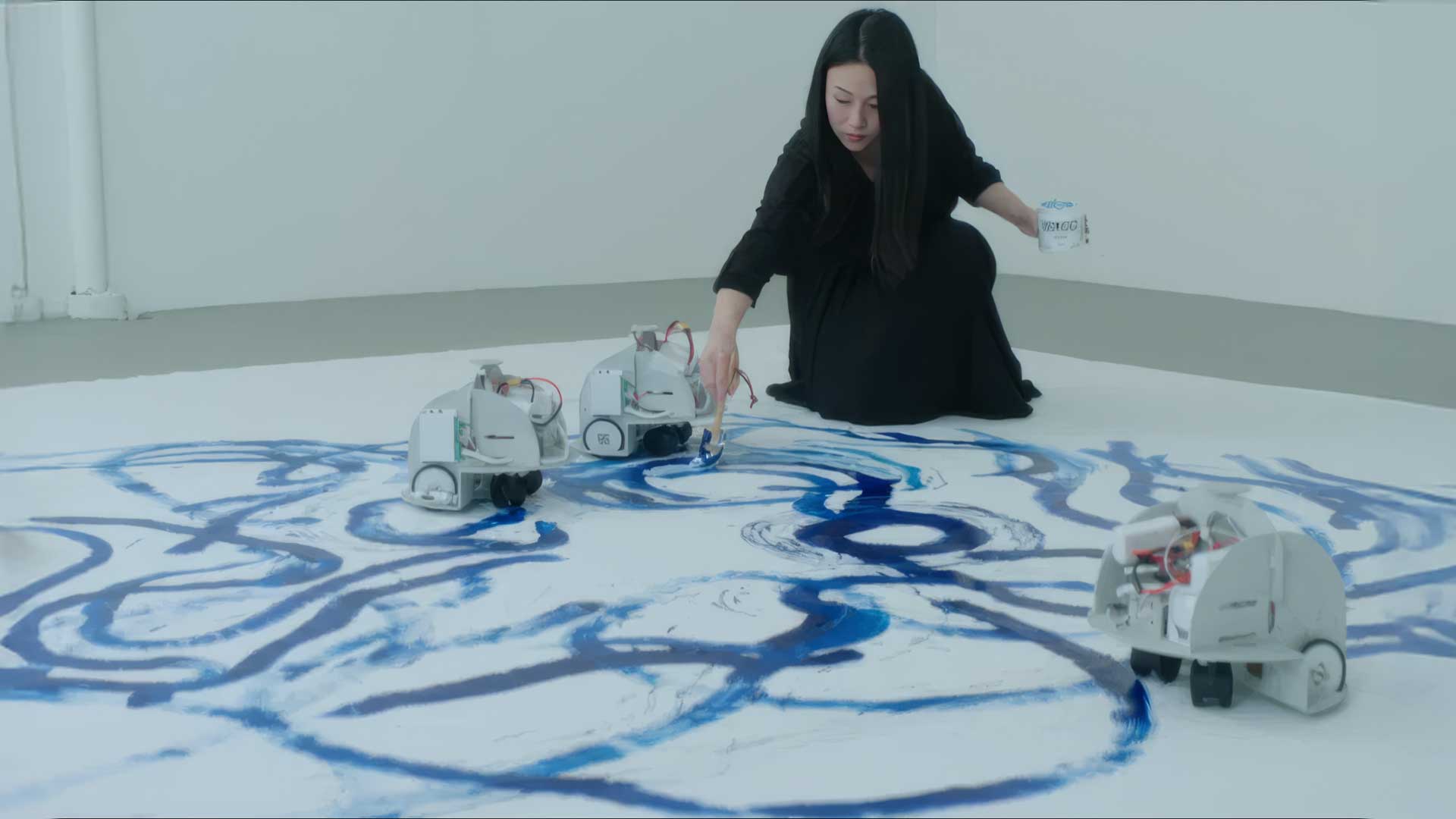
On a white studio floor covered in looping blue strokes, Sougwen Chung kneels in a black dress, brush in one hand and a pot of pigment in the other, while a small group of wheeled robots drag their own marks through the same pools of paint. Their compact bodies sit low to the ground, nudging through curves and spirals that echo her gestures, so that it becomes hard to separate what has been drawn by the artist and what has been laid down by the machines. It’s a small ecosystem of agents, each with a different body but sharing the same field of ink, movement and artistic decision-making.
Ecologies of Becoming: A broader ecosystem
Chung’s 2024 monograph Ecologies of Becoming (Anteism Books) widens the frame. The book doesn’t simply document projects; it proposes an ecological way of thinking about creativity in a world of algorithms, networks, and living systems.
Essays, drawings, performance stills, and process notes sit side by side. Across these materials, Chung argues that AI should not be seen as an alien force, but as part of a continuum of tools and intelligences humans have always worked with. The future, in her view, doesn’t belong to artists “controlling” machines, but to practices that accept entanglement — with code, with climate, with other minds, human and nonhuman.
The monograph has already become a touchstone for curators and collectors who follow AI-driven practices. It reads like a hybrid between a research paper and a studio diary: rigorous, but always close to the material reality of making work.
Why am I Curating Sougwen Chung?
Because in twenty years, when AI art history is written, her name will not appear in a footnote — it will define the chapter on embodied co-creation. Collectors who understand this now are not speculating; they are safeguarding a cornerstone of cultural evolution.
Why Sougwen Chung matters for the AI art market
Chung’s position is not speculative; it is already structurally recognised. Her work has been presented by institutions such as the Victoria & Albert Museum and the Serpentine, and in high-visibility contexts like the World Economic Forum in Davos. She is represented by HOFA Gallery and regularly discussed in outlets including TIME, The Art Newspaper, and The Washington Post.
From a market perspective, she occupies a rare intersection:
- She belongs to the first wave of AI art (active with machine collaboration since around 2016).
- Her projects are conceptually precise yet visually accessible;
- She is already in museum collections, yet her market pricing still lags behind that institutional recognition.
Her practice touches three key themes shaping the next phase of the AI art market:
- Authorship ethics – Her training data is rooted in her own archive. This makes questions of authorship and provenance unusually clear.
- Performative AI – The work often unfolds live, with the machine visible on stage. The system is not hidden “behind” an image; it is part of the performance.
- Embodied computation – Code is always tied back to gesture, body, and sensor data rather than floating as a pure abstraction.
- As collectors become increasingly attentive to provenance and intentionality, Chung’s hand-to-machine archive offers an early, strong model of traceable authorship in AI art.
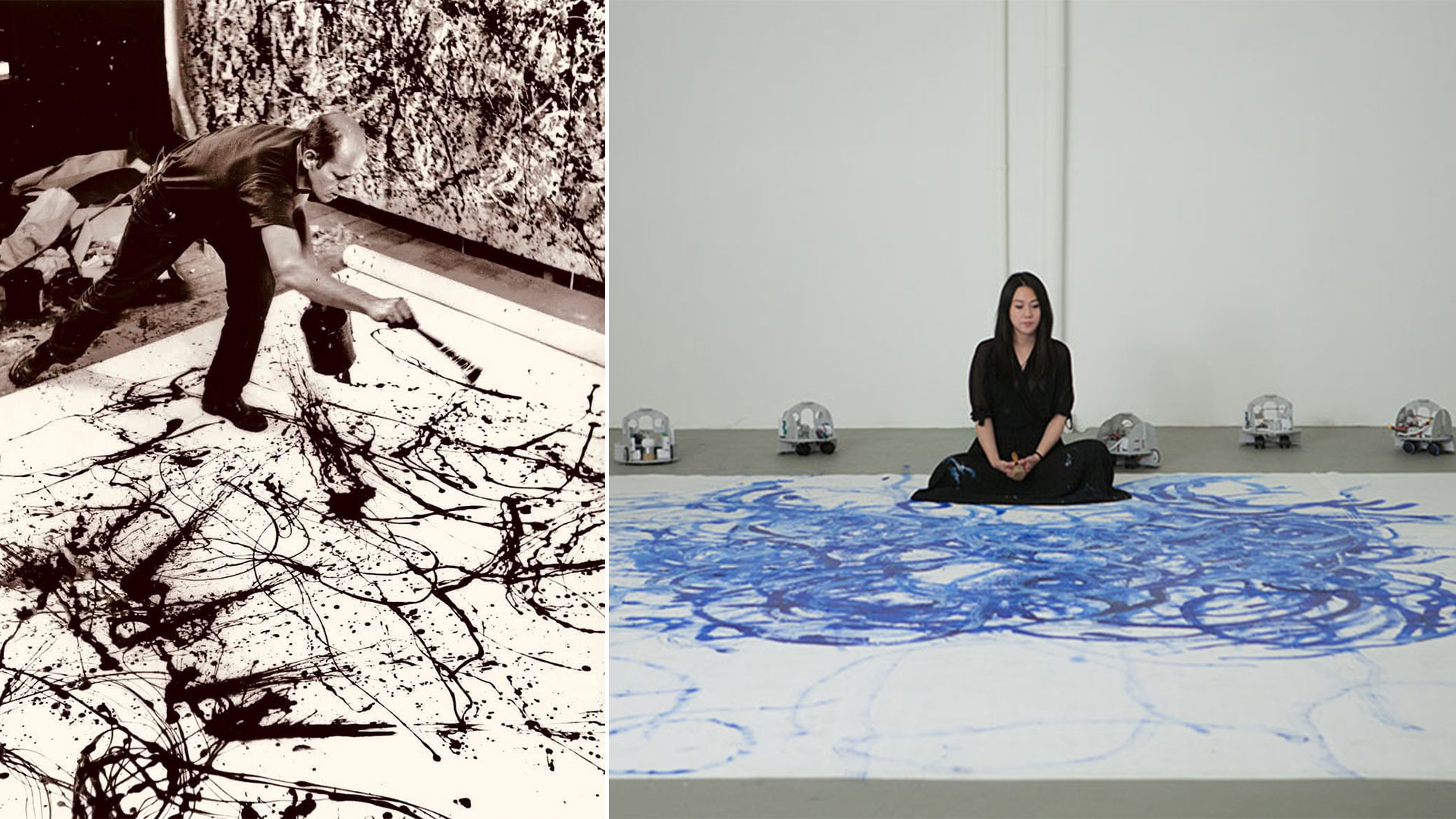
Comparative lens: Pollock, presence, and relation
There is a useful historical echo here. Think of Jackson Pollock in 1950: the canvas as a field where gesture registers the psyche, the ego, the physical act of painting. Pollock’s works are evidence of presence.
Now place one of Chung’s robot-assisted pieces next to a Pollock. Her canvas is not only recording her own motion; it is also recording the behaviour of a machine trained on her past gestures and sometimes on her brain activity.
Pollock’s stage was the singular subject — the artist in action. Chung’s stage becomes a site of relation between intelligences. Where Pollock pushed towards catharsis through chaos, Chung aims for a form of fragile communion through computation.
The pairing shifts the question of gesture: from a single body inscribing itself in space to a hybrid system in which movement is remembered, replayed and modulated through algorithmic memory.