What happens when an artist asks a generative system to remember the past, unlearn the future, and render it through nostalgia-tinged femininity?
In Emi Kusano’s artworks pop mythology returns slightly over-lit, faintly unstable, less retro more residue. She builds hyperfeminine avatars from idol culture, corporate scripts, magazine glamour, and tech optimism, then leaves just enough friction for the viewer to feel the seams. This isn’t nostalgia as decoration, it’s critique delivered through seduction. Kusano’s AI does not predict a future; it misremembers a present. And in that misremembering, a tension becomes hard to ignore: if models are trained on an archive of what women are supposed to be, what do they learn to desire and what do they learn to discard?
Kusano deserves a distinctive place in the canon of generative art. Not because her work is technically impressive (it is), but because it reclaims AI art as cultural critique, cross-wiring it with future-and-retro technologies, then dressing it in neon-pink eyeliner and corporate uniforms. Her work fuses pop culture and myth, algorithm and emotion.
Working at the intersection of machine learning, pop nostalgia, and hyperfemininity, Kusano treats AI as a memory glitch. Here, femininity reads less as identity than as a coded aesthetic, it’s an interface built from idol culture, corporate scripts, and media memory. Her avatars are mesmerizing and unsettling at once. Cyborg secretaries, digital saints, bewitched influencers: Kusano’s worlds are saturated with a femininity that is realistic fiction and quiet provocation.
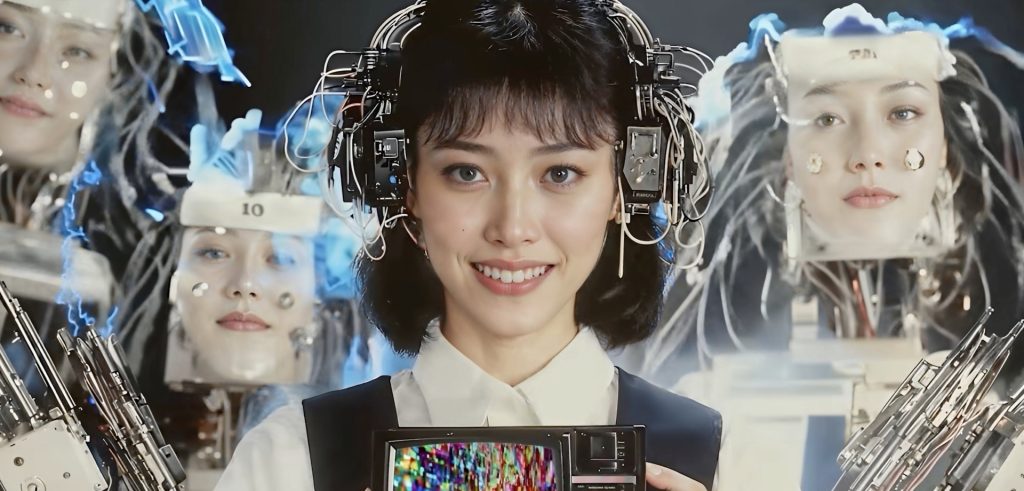
A calm face held steady while an entire weather system of cables, masks, and borrowed expressions swirls overhead. The image reads like a diagram of identity where femininity is mediated, and reassembled through devices that promise connection while producing overload. The cassette player in her hand lands like a small, human anchor: an object from the recent past, tactile and private, pressed against a head that has become a public interface.
The artist
Emi Kusano (Tokyo, b. 1990) is a multidisciplinary artist working across AI-generated images, installation, music, and Web3 projects. She began photographing street fashion in Tokyo and later performed as the lead vocalist of the synthwave unit Satellite Young. Her recent practice braids Japanese pop aesthetics, retrofuturism, and collective memory, with a focus on how AI reshapes the visual grammar of femininity. Kusano has been involved in the Christie’s x Gucci AAA Generative Art initiative, and her work has been presented in institutional contexts including the 21st Century Museum of Contemporary Art, Kanazawa (DXP2). She has also created a major AI project in collaboration with LG Labs / LG Art Lab (“Advertising Humanity”).
At the artist’s instruction, the generative model draws on its statistical memory of the collective imagination. In this context, the unconscious dear to the Symbolists remains human: it is the spark that guides with a steady hand the model rather than the brush. It is the pressure of deep emotions that pushes the artist to insist, to rephrase, to regenerate, until the model begins to return landscapes in which they recognize themselves—rarely assembled in quite this way in pre-existing paintings or photographs. The Symbolist gesture moves from the brush to the process: it is no longer only the hand that paints, but the series of instructions and decisions through which the artist presses the model into articulating an inner world.
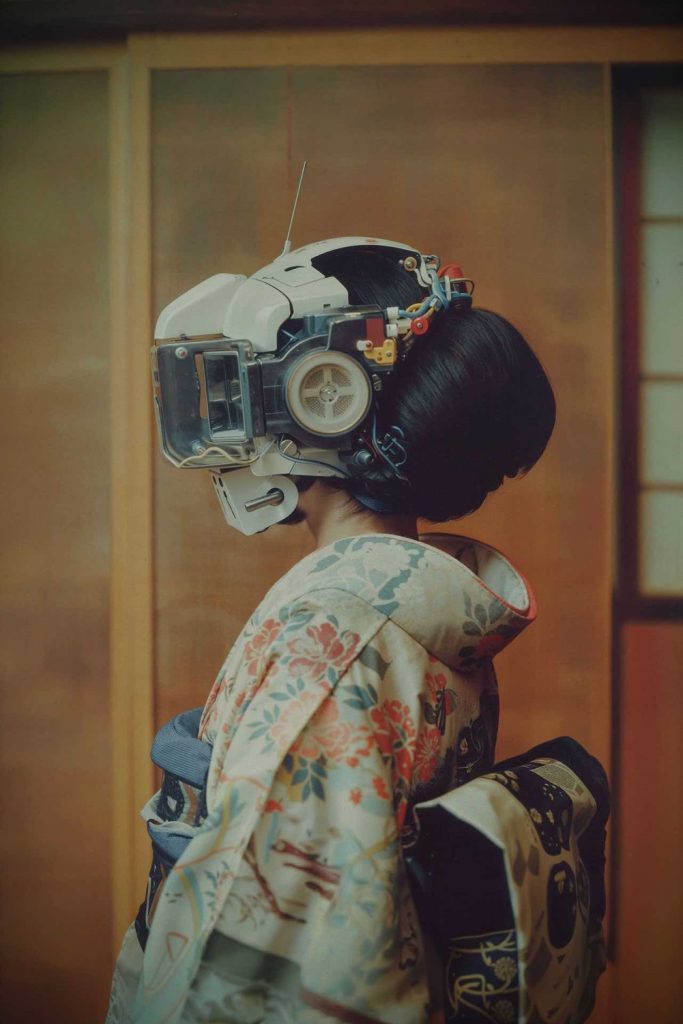
In Cognitive Chaos, Kusano turns the familiar sci-fi promise of “enhanced perception” into something quieter—and more unsettling. A figure in a floral kimono kneels in a traditional interior, yet her head is enclosed by a bulky apparatus that looks part visor, part cassette-era machinery, part improvised laboratory. The image stages a collision of temporalities: heritage as a lived texture, technology as an invasive shell, cognition as a site under renovation. What I love here is the restraint. Kusano doesn’t dramatize the moment with spectacle; she lets the weight of the device do the talking. The body remains composed, ceremonial even, while the headset suggests an internal storm.
Cognitive Chaos
Kusano “reprograms” femininity through a plausible realism that is, in fact, stylized exaggeration and implied provocation. They look like portraits, but they are projections of doubts and warnings. Echoes of a possible, unsettling reality. In Cognitive Chaos, Kusano uses Stable Diffusion XL with recursive prompt layering to explore what happens when AI is asked to depict “thinking,” filtered through culturally gendered generalizations such as “office lady,” “Asian businesswoman,” “overworked beauty.” The result is a vortex. Confused, yet radiantly nostalgic: faces soften into noise, the headset becomes altar, and the room reads like a stage set for the ‘thinking’ the prompt demands. The series doesn’t confront recurring biases head-on; instead, it aestheticizes them: the women are beautiful, but exhausted. That exhaustion becomes the point, beauty pushed past its limit until the stereotype reveals its violence.
Kusano borrows the visual grammar of the commercial (bright smile, clean lighting, product-forward framing) and quietly sabotages it from the inside. The central figure performs friendliness with near-perfect calibration, but the scene around her is populated by replicas: faces suspended like prototypes, hands that look engineered to serve, bodies that become modular parts of a pitch. The rupture suggests that our most intimate traits (care, sweetness, optimism) are now being formatted and scaled.
Advertising Humanity
Advertising Humanity confronts the paradox of asking AI to define “the human soul.” Kusano feeds the machine prompts loaded with human ideals like “dignity,” “grace,” “truth” and receives in return glittering renders of mannequins, mascots, and digital saints. Everything is lit like a product launch: spotless surfaces, perfect gradients, and a devotional symmetry that feels borrowed from icons and ads alike. Is it parody, or homage? Kusano challenges AI to generate a fever dream. “I wanted to see what would happen if AI had to sell humanity back to us,” she said in a 2024 interview to Expanded Art . The answer was angels in soft light with cold smiles.
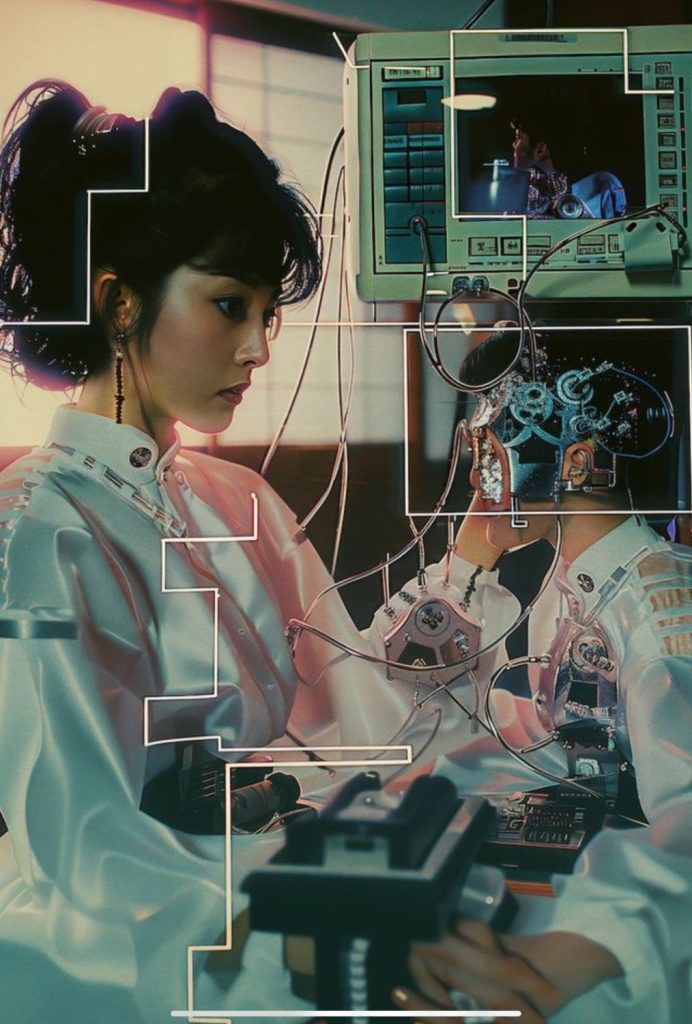
A satirical love letter to Japan’s rigid corporate gender roles, Office Ladies is Kusano’s most politically coded work. The characters are templates: assistants, receptionists, data-entry angels. Their individuality is intentionally unstable. Each image is generated with slight prompt drift and input noise leading to micro-variations in gesture and emotion.
Technically, Kusano mixes subject-specific training, latent recombination, and post-gen grading to land in a zone between luxury advertising and devotional icon. The message can read as cynical or tragicomic, inspired or disturbing. The key is in how you read it, and it isprobably different for each of us. That’s Kusano’s specificity: she doesn’t close the circle, she lets each viewer close it in their own way.
In this sense, the landscapes of Enchanted Grounds can offer a luminous path of introspection into how we inhabit our inner landscapes in the age of artificial intelligence.
Emi Kusano has already reshaped the visual language of AI art, but I think that her trajectory suggests far more than stylistic authorship. She is laying the groundwork for a new kind of immersive mythology. Kusano is an explorer: her story says so, her collections say so.And, honestly, I expect her to soon handle signified and signifier through unpredictable retro-futurist experiences.
In this sense, the landscapes of Enchanted Grounds can offer a luminous path of introspection into how we inhabit our inner landscapes in the age of artificial intelligence.
As Kusano’s worlds grow more complex, the next natural step is expansion into new spaces, languages, and dimensions. Imagine an installation where holographic images of her Office Ladies repeat endlessly in motion-triggered mirages, and you can walk among them; or a retro-futurist chapel of algorithmic saints, rendered in light and latency, leading us—sign by sign—toward the questions we don’t dare to ask. Because this, for me, is Emi Kusano’s art: an unpredictable sequence of ritual figures from a post-human folklore, freeing from our subconscious the questions we buried there.What matters is the emotional architecture: Kusano builds myths that feel familiar because they’re made from our own media memory. And she leaves the final meaning, deliberately, unfinished.
Vito Di Bari | AI Art Curator | Former UNESCO IMI Executive Director
Comparative Lens: Emi Kusano and Paulina Olowska
When I first started following Emi Kusano, I kept circling back to a feeling I couldn’t quite place. It wasn’t just “nostalgia,” and it wasn’t just the slickness of the images. It was the way memory shows up in her work: slightly overlit, slightly unstable, like a scene you half-remember from a screen you watched too long.That sensation led me, unexpectedly, to Paulina Olowska. Different geography, different materials, a different tempo, yet the same instinct: to treat visual history as something you can handle, re-stage, and test. Kusano builds with prompts, pipelines, and synthetic skin; Olowska works with pigment, costume, and the physical intelligence of display. In both cases, femininity is something performed, archived, and repeated until it starts to reveal its seams.
In this sense, the landscapes of Enchanted Grounds can offer a luminous path of introspection into how we inhabit our inner landscapes in the age of artificial intelligence.
Where Kusano conjures retro-futures through generative AI, Olowska rebuilds cultural memory through tableaux that feel pulled from theatre, fashion editorials, and forgotten ephemera. Both artists use nostalgia as a working method. Kusano’s versions arrive wrapped in VHS haze and corporate gloss; Olowska’s come through as staged scenes carefully lit, slightly too composed, poised between desire and disappearance. Each artist, in her own language, produces icons of a synthetic feminine: Kusano by letting the network exaggerate; Olowska by reenacting modernity’s myths with quiet precision.
𝑾𝒉𝒚 𝒂𝒎 𝑰 𝒄𝒖𝒓𝒂𝒕𝒊𝒏𝒈 𝑬𝒎𝒊 𝑲𝒖𝒔𝒂𝒏𝒐?
Because her work dances on the edge of nostalgia, spectacle and symbolism. For collectors and galleries, her work sits exactly where contemporary viewers are most intrigued, at the intersection of desire and nostalgia. And she makes that intersection visible without turning it into a lecture; she keeps the images beautiful enough to seduce you, then unstable enough to make you think. Kusano represents a rare alchemy: technical fluency, conceptual depth, and cultural relevance. That’s the kind of signature we look for at AI Art Digest.
[Vito Di Bari, AI Art Digest Curator 2026]
AI Artist to Watch
Name: Emi Kusano
Based: Tokyo, Japan
Practice: Generative AI, retrofuturist aesthetics, techno-animism, visual culture remixing
Why Watch: Kusano is one of the few artists transforming generative AI into a poetic language of memory, femininity, and synthetic nostalgia.
Why Emi Kusano matters for the AI art market
Emi Kusano matters because she sits in a commercially powerful zone: pop nostalgia, hyperfemininity, and retrofuturist design. Her visual language is recognisable, one that collectors can identify across series, formats, and years, even when the characters change. She matters because the premium in the AI market is shifting from “who can generate” to “who can author”, and Kusano’s advantage is authorship.
From a market-structure perspective, I see Kusano’s practice as expandable. Her imagery already behaves like a franchise ecosystem: characters, iconography, seriality, and variations that can support editions, drops, prints, installations, video, even collaborations without diluting the core “Kusano signature” That scalability is exactly what institutions and high-end collectors look for when they bet on an artist early.
Artists aphorisms
“I’m not trying to make AI realistic. I want it to be wrong in beautiful ways. That’s where the soul leaks in.” [Emi Kusano, TED Talk 2024]
“Nostalgia is dangerous. It’s easy to manipulate. But it’s also tender. I’m trying to rescue it, not parody it.” [Emi Kusano, interview with Bright Moments]
Artists aphorisms
- The Generative Museum at KADIST × ICA Pittsburgh – ICA Pittsburgh, 5000 Forbes Ave, Pittsburgh, PA 15213. Dates: Until Feb 13, 2026. [KADIST, 2025]
- Sasha Stiles: A LIVING POEM at MoMA (New York) – 11 West 53 Street, New York, NY 10019. Dates: Until Spring 2026.
- Artificial Intelligence: Your Mind & The Machine at Science Center of Iowa (Des Moines) – 401 W Martin Luther King Jr. Parkway, Des Moines, IA 50309. Dates: Opening January 2026