
AI Art Digest is shared with a curated international network of 3,109 museum and 1,947 gallery leaders.
Gifted with extraordinary ingenuity and an imagination that often pressed close to excess, Giuseppe Arcimboldo, in the second half of the sixteenth century, invented one of the strangest and most durable forms in European art: the composite head. In these portraits, the sitter’s physiognomy is not merely framed by fruit, flowers, and vegetables, but built from them. Flesh becomes pear, cheek becomes apple, brow becomes leaf, hair becomes blossom, beard becomes root. The result is not simply decorative wit. It is a genuine shift in pictorial thinking: a face assembled out of edible and vegetal matter, a human identity produced through the logic of natural abundance.
That invention remains startling because it does several things at once. Arcimboldo’s images are visual riddles, half portrait and half still life, half scientific observation and half courtly theater. They belong fully to the Mannerist imagination, with its appetite for artifice, difficulty, surprise, and virtuoso transformation. But they also feel curiously modern, because they refuse to keep categories stable. Food is no longer only something to be eaten, displayed, or symbolically placed beside the body. It becomes the body. It enters the domain of identity.
This is why Arcimboldo still matters. He gives form to an intuition that later centuries would never quite abandon: that what nourishes us can also describe us, construct us, classify us, and even expose us. His edible portraits are not eccentricities floating outside the history of art. They are the starting point of a long and surprisingly elastic lineage in which food becomes allegory, physiognomy, adornment, and cultural memory.
Arcimboldo’s composite heads did not emerge from pure fantasy alone. They were shaped by a culture in which scientific curiosity, natural observation, court spectacle, and visual experimentation often overlapped. During his formative years in mid-sixteenth-century Milan, he encountered an artistic climate still animated by the legacy of Leonardo da Vinci, especially Leonardo’s investigations into physiognomy, analogy, and the unstable relationship between seen form and inferred character. Arcimboldo’s later contact with Ulisse Aldrovandi, one of the great naturalists of the sixteenth century, further deepened his attention to the natural world. This matters because the fruits and vegetables in his works are not generic. They are observed, differentiated, and rendered with a precision that gives the paintings their peculiar authority.
The produce that composes these heads cannot be dismissed as ornamental excess. It is specific, studied, and often seasonally charged. Arcimboldo’s images are persuasive precisely because they stage a fusion between empirical attention and imaginative transformation. The objects are believable enough to be recognized individually, yet unstable enough to become something else. Their power depends on that threshold.
The principle underlying these paintings is what we would now call pareidolia: the tendency to recognize meaningful forms, especially faces, in otherwise ambiguous visual arrangements. Arcimboldo makes that perceptual tendency visible and theatrical. His art does not merely depict a face; it dramatizes the act by which the face is mentally assembled. Vision becomes part of the subject. We do not simply look at the painting. We feel ourselves constructing it.
One of his best-known reversible images, The Vegetable Gardener, is exemplary in this respect. Upright, it shows a gardener-like figure composed of vegetables. Turned upside down, it becomes a basket overflowing with produce. Cucumbers, cabbages, carrots, onions, and leaves are painted with convincing realism, but the work is more than a clever visual game. It asks what separates person from provision, body from harvest, face from still life. The answer, disturbingly, may be less secure than it first appears.
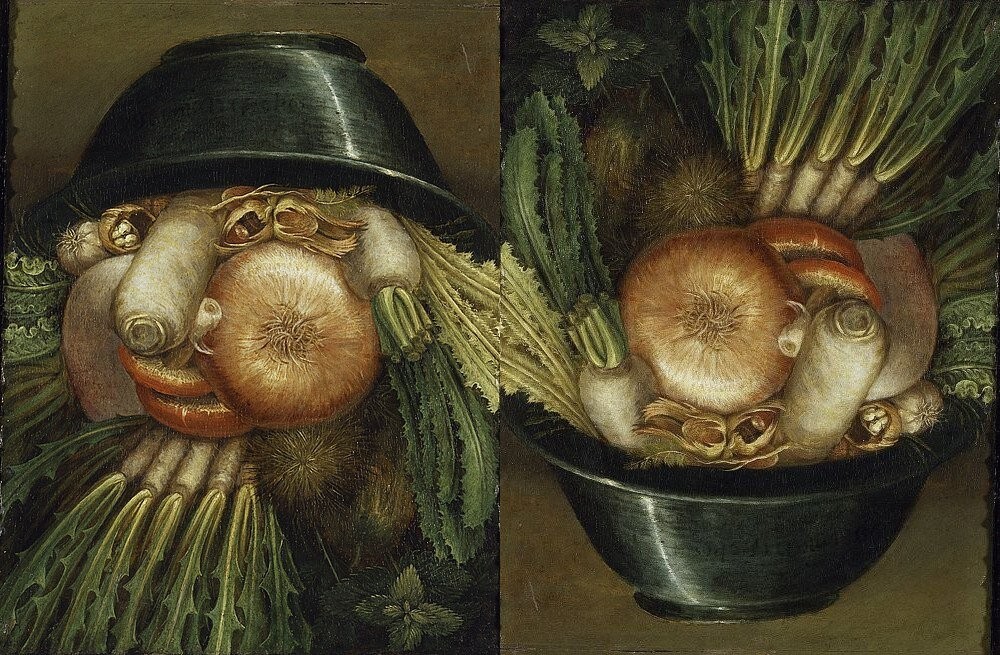
The reversible structure also introduces a deeper meditation on mutability. The gardeneris not immortal, nor are the vegetables that compose him. The picture is playful, but not innocent. Human life and edible matter are bound by the same conditions of ripeness, use, and decay.
The image carries humor, but it also carries fragility.
Arcimboldo’s most famous allegorical portrait, Vertumnus, makes the symbolic stakes even clearer. Here Emperor Rudolf II is transformed into the Roman god of seasonal change and agricultural abundance. This is not merely a likeness disguised as a fantasy. It is allegory at full intensity: imperial image, natural order, dynastic ambition, and cultivated artifice fused into a single body. Apples, pears, grapes, cucumbers, flowers, and grains form the emperor’s face and hair, and each carries seasonal and symbolic resonance. Rudolf appears not just as a ruler surrounded by abundance, but as a figure who governs its cycles, contains its variety, and embodies its continuity.

Every element in Arcimboldo speaks. This is why Roland Barthes would later describe him as a visual rhetorician. His composite heads operate like figures of speech translated into paint: metaphor, metonymy, emblem, personification. The image means by accumulation. It persuades by excess. It builds identity out of substitution.
For a long time, modern criticism was tempted to isolate Arcimboldo as an eccentric singularity, a brilliant oddity on the margins of seriousness. But that reading is no longer convincing. Seen within the context of late sixteenth-century court culture and Mannerist invention, his work does not appear as anomaly yet as a concentrated and highly influential solution to a broader appetite for wonder, complexity, and symbolic ingenuity. His composite heads circulated widely, especially in Central European courts. They were admired, imitated, transformed, and remembered. Their afterlife matters.
Arcimboldo’s lesson did not survive through simple repetition. It survived because later artists understood that his edible physiognomies could be pushed in different directions. Among the figures who absorbed and reworked his legacy, Giovanni Paolo Castelli, known as Lo Spadino, is especially important. A Roman master of late seventeenth-century still life, Lo Spadino combined the Arcimboldesque model with the sumptuous realism of Flemish painting, particularly the floral and fruit-laden worlds associated with Brueghel. But what makes him crucial is not influence alone. It is expansion.
His composite subjects often extend beyond the face and into the whole body. Flowers, fruits, and vegetables no longer merely articulate a profile; they fill the figure, clothing it in seasonal abundance. Just as significantly, the backgrounds open out. The monochrome grounds and ornamental framing devices of earlier works give way to populated landscapes and architectural settings, making the compositions more theatrical and expansive. Allegory becomes fuller, more socially staged, more bodily.
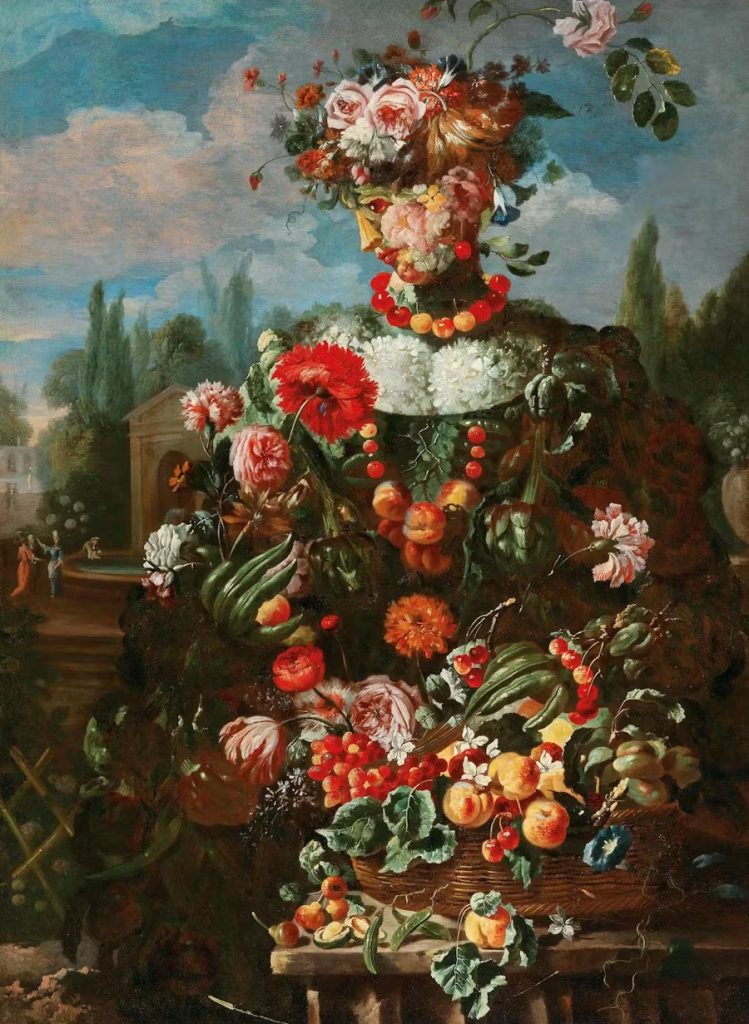
In Lo Spadino’s Spring, the body glitters with blossoms and ripeness. A necklace of ripe cherries marks the throat; a basket of fruit rests on a marble ledge below, almost like a distant homage to Caravaggio’s Basket of Fruit. But the key innovation lies elsewhere. The Arcimboldesque transformation has moved outward, toward dress, ornament, and social display. Food and floral matter no longer only build a face. They help produce a total figure. This is a decisive step toward many contemporary generative images, where edible form migrates into costume, accessories, and identity performance.
Giovanni Stanchi offers a revealing variation. His season allegories, often paired by critics against those of Lo Spadino, retain much of the same compositional logic, yet they feel more restrained and more frontal. The backgrounds are less elaborately scenic, the skies more muted, the drama more compressed. The key point, however, is not difference for its own sake. It is that Arcimboldo’s logic had become adaptable enough to sustain multiple tonalities: lush and expansive in Lo Spadino, more concentrated and atmospheric in Stanchi.
The invention had entered circulation.
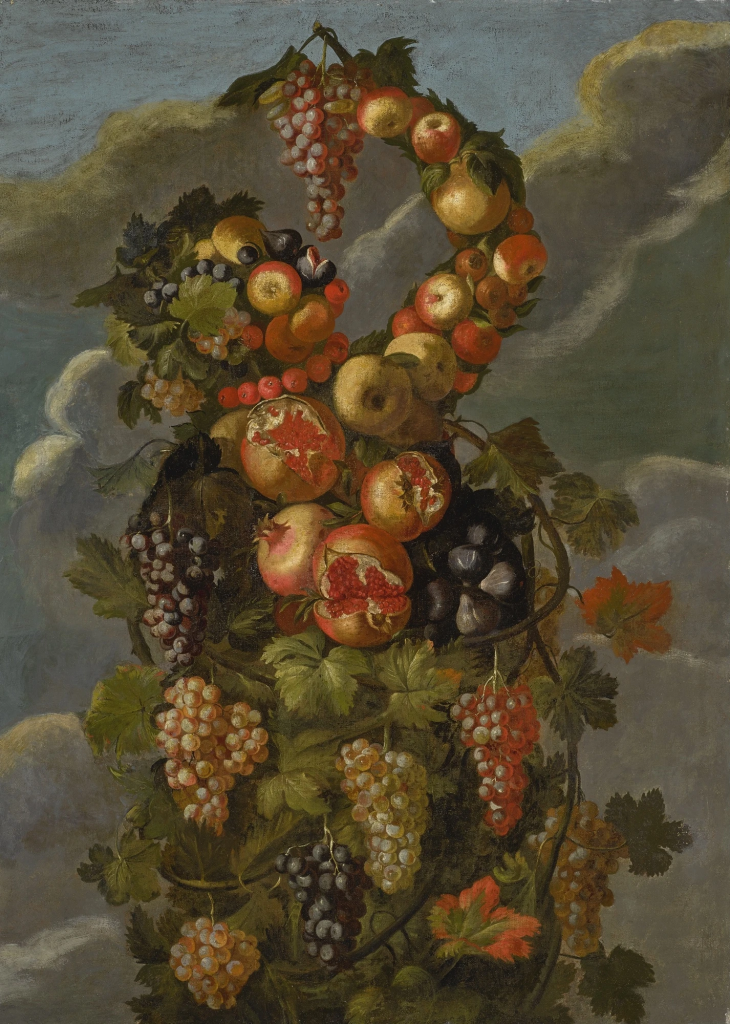
Antonio Rasio, by contrast, shows how dramatically the register could shift. His cycle of the seasons, still preserved in its original carved frames, gives the figures a stronger material presence and a more robust, luminous treatment. They recline like ancient divinities, half monumental and half theatrical, surrounded by carefully rendered landscapes populated by animals. In these works, food, season, animal life, and human body all belong to the same cyclical order. Birth, growth, plenty, decline, and stillness are distributed across the world as a shared condition.

But Rasio’s Anthropomorphic Figure with Game, Charcuterie and Poultry pushes the Arcimboldesque tradition into a much darker zone. Here the body is built not from fruits and flowers, but from flesh, game, sausages, and butchered birds. The figure no longer evokes seasonal wit or courtly allegory so much as baroque grotesque. The materials cling to the body with a tactile insistence that feels almost brutal. A chicken becomes the nose. Birds define the jawline. Sausages become a necklace. The image is immediate, coarse, and unsettling in a way Arcimboldo usually is not.
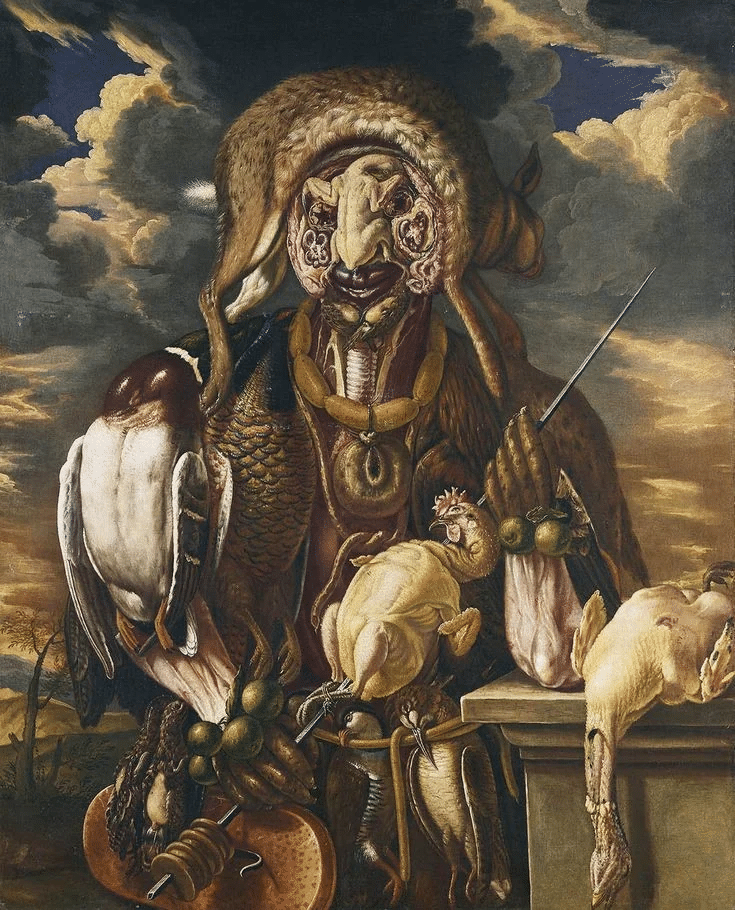
This matters for the present essay because it reveals the elasticity of the tradition. Once food begins to construct the body, many emotional registers become possible: cultivated wit, luxuriant abundance, ornamental display, grotesque carnality, even near-demonic distortion.
Arcimboldo did not leave behind a style so much as a generative principle.
That principle reappears with unexpected vitality in generative art. Contemporary artists working with AI do not usually quote Arcimboldo literally. What they inherit is subtler and, in some ways, more interesting.
They inherit his central intuition: that food can be more than subject matter. It can become identity structure.
The fit between Arcimboldo and the generative image is not accidental. His works already rely on dense visual memory, high-definition surface recognition, the assembly of wholes from fragments, and the suspense between object and face. These are all dynamics that speak powerfully to the current image regime. Artists working with AI respond to different parts of his legacy. Some pursue metamorphosis and bodily unease. Others move toward identity and consumer image. Others still explore illusionism, ornament, and stylized abundance.
Wenhui Lim, aka Niceaunties, is one of the clearest and most compelling heirs to this tradition, though she relocates it completely. Her work begins with a figure easy to underestimate and almost impossible to forget: the auntie. In her hands, the auntie is not a comic type, nor a quaint stereotype, nor a relic of domestic life. She becomes a dense social presence: matriarchal, excessive, affectionate, judgmental, laboring, persistent.
Niceaunties often describes her world through the language of “aunties, freedom, joy, cats, food & other happy things,” but food does much more here than decorate the image. It becomes social commentary, emotional architecture, and a visual grammar of identity.
This is what places Lim so naturally within Food as Allegory. Like Arcimboldo, she understands that food can construct the human figure rather than merely accompany it. But in her work the transformation no longer belongs to seasons, imperial wit, or courtly display. It belongs to domestic life — to memory, kinship, caregiving, inheritance, and the strange pressure of familial love. Her figures are made of what they cook, prepare, insist on serving, and press upon others. The Arcimboldesque operation remains, but it has changed tone.
Food becomes not only physiognomy, but belonging.

Projects at https://arte.bio/niceaunties
In The Waiter (2023), thin cucumber slices become eyes, ears, and hair, while grains of rice form the skin of an auntie-like waiter. The image is playful, but not slight. It stages a body assembled from the materials of hospitality, repetition, effort, and care. The face is not embellished with food. It is built from it. Food becomes identity-matter: what the auntie handles, offers, circulates, and therefore, within the image, what she becomes.
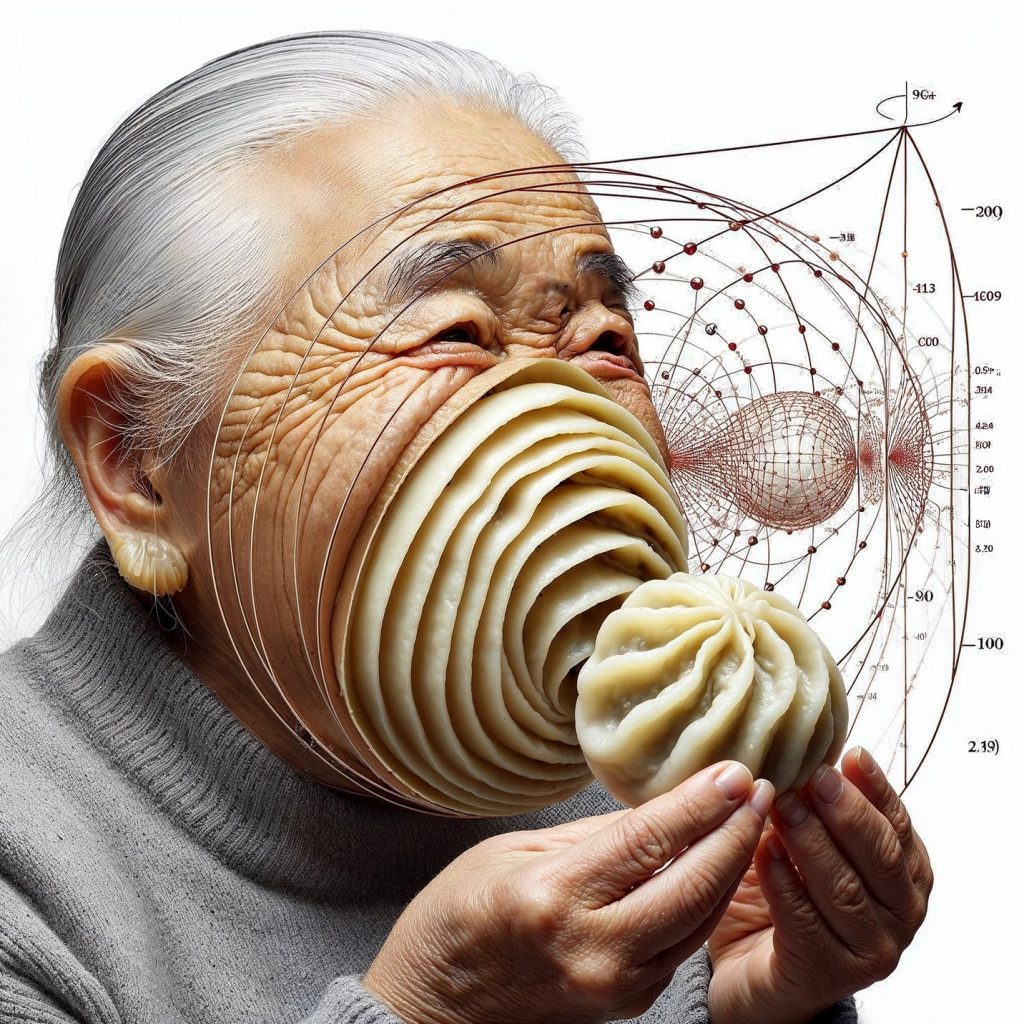
This logic deepens in Astronomical Dumplings Superposition with Onion (2024), one of Niceaunties’ strongest series. Dumplings and onion layers are arranged almost like anatomical sections, while diagrams inspired by astronomy and scientific imaging introduce an unexpected visual register of orbit, mapping, and calculation.
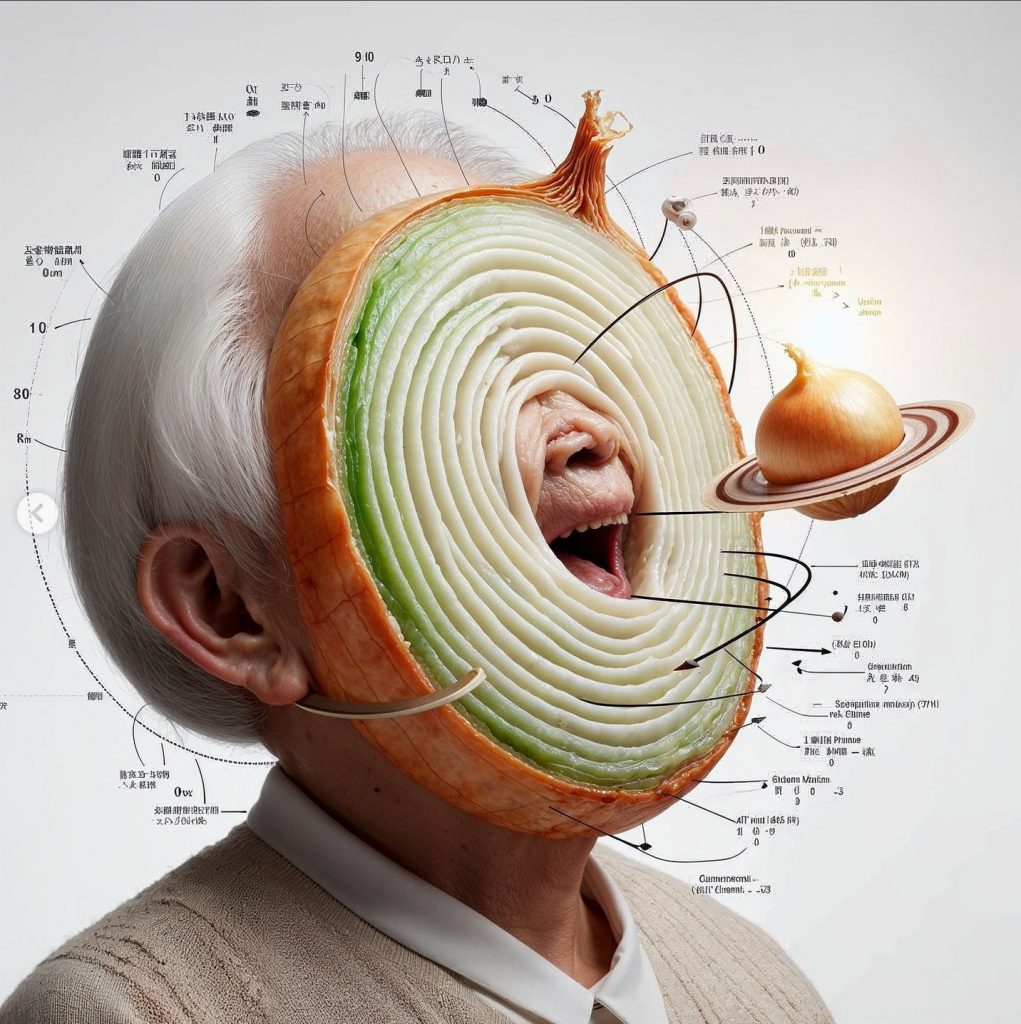
The result is funny, but also strangely exact. The face becomes meal, memory, and system at once. As in Arcimboldo, food becomes physiognomy. But here it also becomes emotional residue, cultural inheritance, and familial attachment that has passed through the kitchen before settling into the body. The slight unease of these works matters. They imply, with both humor and force, that we are made — socially, emotionally, visually — of what we are fed.
Lim’s imagination then moves beyond the face and into dress, accessories, and self-presentation. The aunties are still made of food, but now they wear it. Food no longer functions only as nourishment or symbolic likeness. It becomes adornment, performance, and stylized excess.
That is the core of the project. In Niceaunties, food is never only abundance, decoration, or visual wit. It is a language of relationships. Her aunties care too much, feed too much, insist too much, prepare too much, decorate too much. Their love arrives textured by overstatement. It can feel invasive, funny, tender, exhausting, and utterly familiar.
What emerges is not merely an aesthetic of plenty, but a domestic allegory built from the emotional labor of feeding.
This is why Niceaunties belongs so naturally within Food as Allegory. She does not simply update Arcimboldo through AI. She relocates his lesson into another emotional and cultural world. Her figures are not emblems of seasons or princely wit, but of matriarchal authority, familial performance, diasporic memory, and care made visible through food. In her universe, food is not only what fills the table. It is what builds the person.
An additional branch of this allegorical line emerges when the world of Niceaunties meets the more pop, luminous, and design-conscious imagination of Barbara Fumarola. In that encounter, the auntieverse does not lose its emotional core; it is restaged through color, ornament, and a more openly theatrical pleasure in surface.
From the collaboration between Wenhui Lim, aka Niceaunties, and the Italian artist Barbara Fumarola, aka Candydesign, comes the seven-part allegorical portrait series Aunties Photoshoot 2050. The project does more than transpose the auntieverse into a brighter visual key. It tests what happens when a culturally dense, emotionally charged figure is reimagined through Mediterranean fruit, fashion stylization, and a deliberately heightened pleasure in display. The aunties, dressed in Eastern garments, adorned with jewelry, and accessorized with eccentric glasses, are not simply relocated into another setting; they are joyfully reformulated by it. The result is a small, likely unique collection of singular, effervescent, playful figures suspended between fashion image, allegory, and visual fantasy.

Projects at https://www.instagram.com/candydesignai/?hl=en
Fumarola’s work often develops a distinctly pop visual language built from saturated color, clean geometry, and a fluid hybridization of fashion concept, design object, AI, and computer-generated imagery. Her architectural training can be felt in the way each image is treated not as decoration alone, but as a construction of form, silhouette, and visual balance.
What she brings to this collaboration is not simply brightness or stylistic lift. She brings a world in which the edible becomes ornamental, the ornamental becomes identity, and surface itself becomes a mode of allegorical rewriting. Her most recognizable quality is an energetic lightness — immediately seductive, and also unmistakably brand-aware — which in this series meets the emotional structure of Lim’s auntieverse and recasts it through fruity excess, display, and the pleasure of stylized abundance.
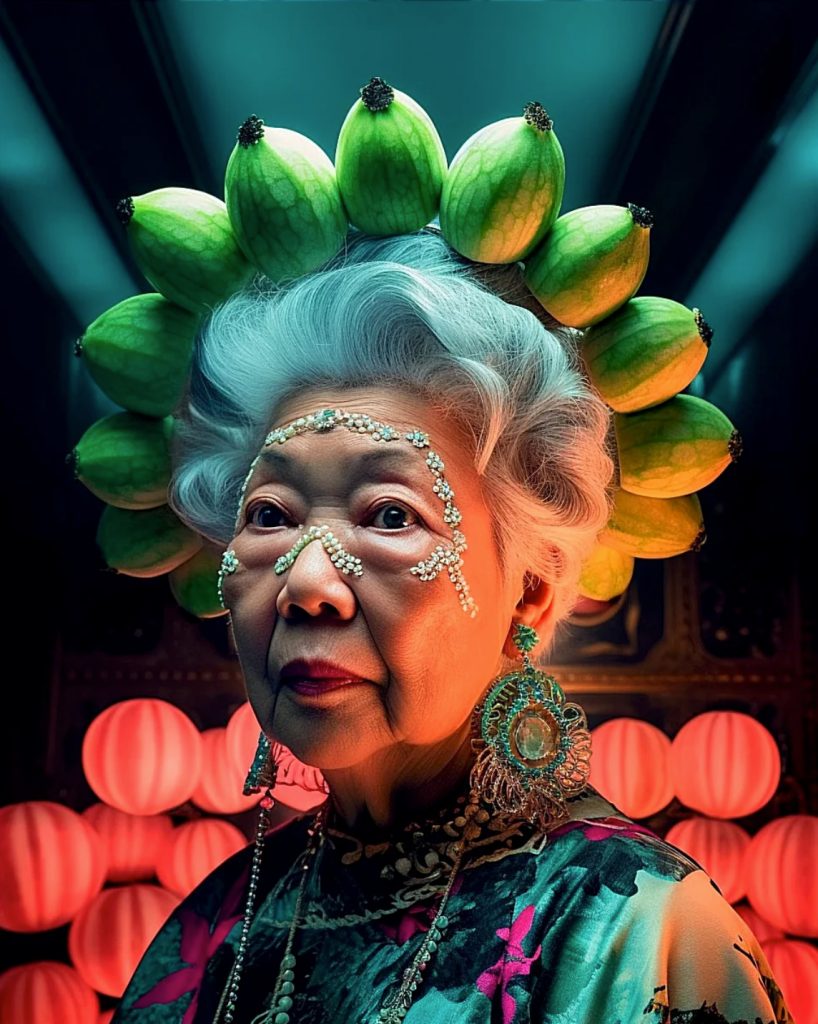
Here allegory moves away from anatomical unease and more intimate domestic metamorphosis, taking on instead the form of a brighter, more spectacular reinvention in which identity is assembled through ornament, excess, and the staged joy of surface.

Projects at https://www.instagram.com/davidszauder
Szauder is probably the generative artist most explicitly aligned with the Arcimboldesque tradition. One especially revealing case is his collaboration in Budapest with collage artist Hellogarlic. The project begins with Hellogarlic’s geometric food collages, in which fruits, vegetables, and other edible elements are decomposed into essential modules and recomposed into rigorous, almost minimalist structures. Szauder then pushes that research outward through a live AI performance, transforming those geometric arrangements into anthropomorphic faces.
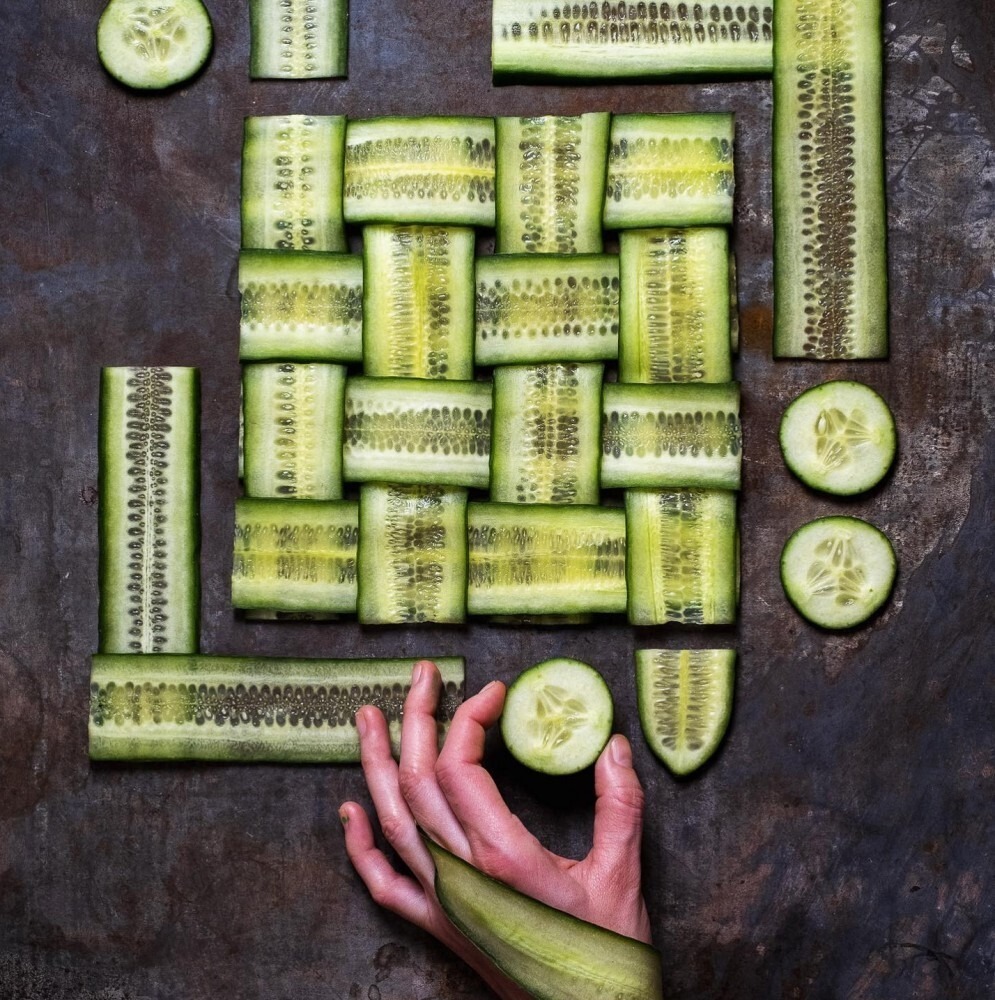
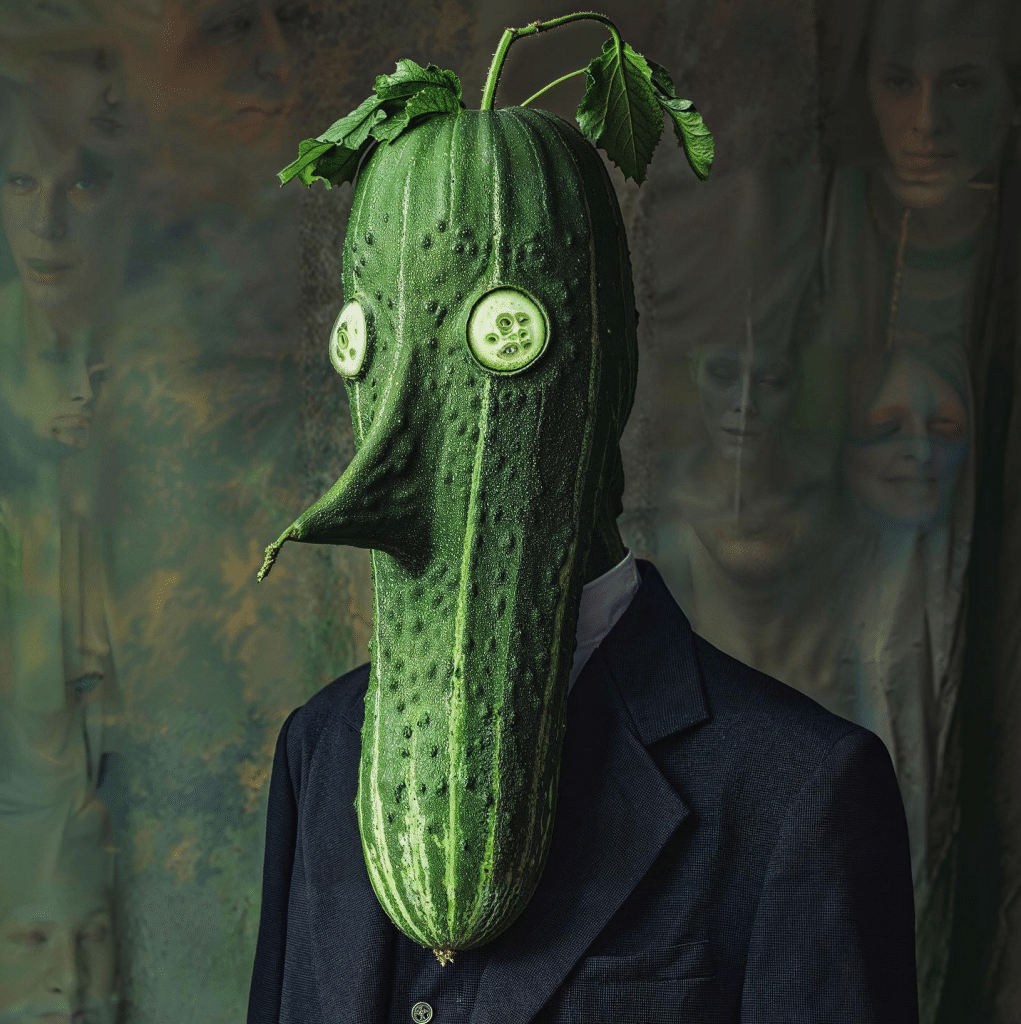
What makes this important is not simply the final image, but the mode of its making. The live-performance format introduces an unusually fertile way of using AI: not as a machine for static output alone, but as a temporal, relational instrument that brings artisanal cutting and algorithmic generation into the same field. The operation begins to feel demiurgic, as if a possible life were being coaxed out of geometric still life. Szauder’s work matters because it renews, in generative form, the old Arcimboldesque game between nature and face without reducing it to homage.
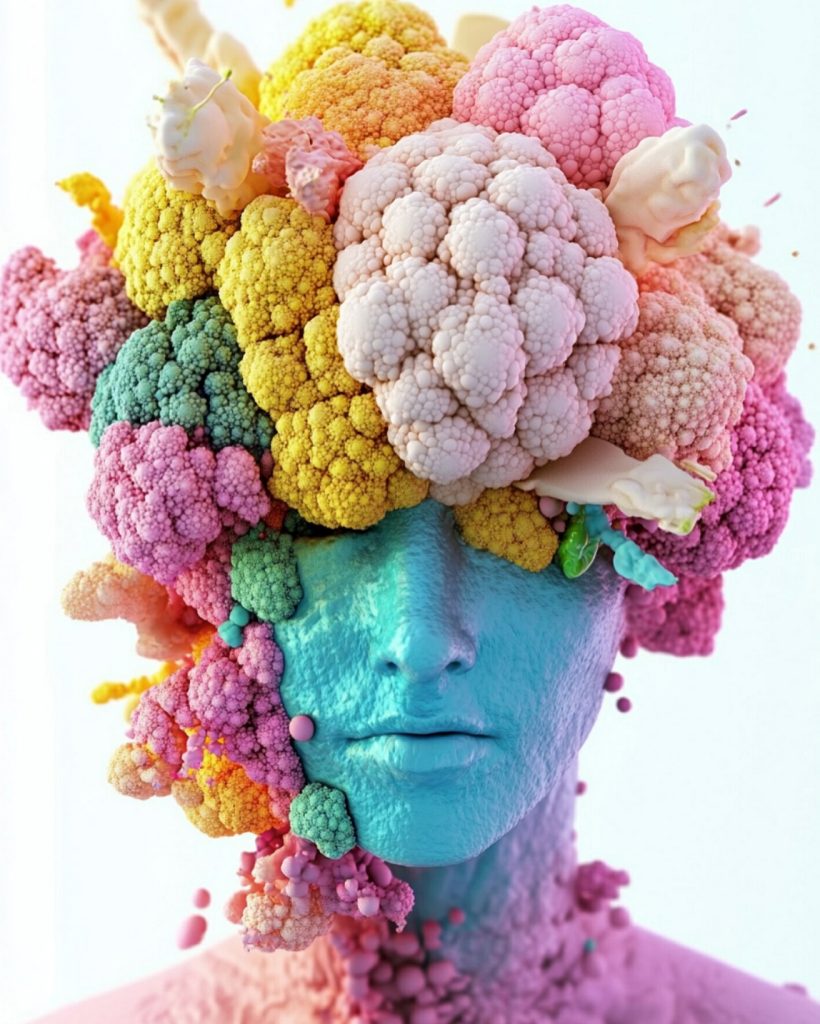
Projects at https://www.instagram.com/thisisioland/
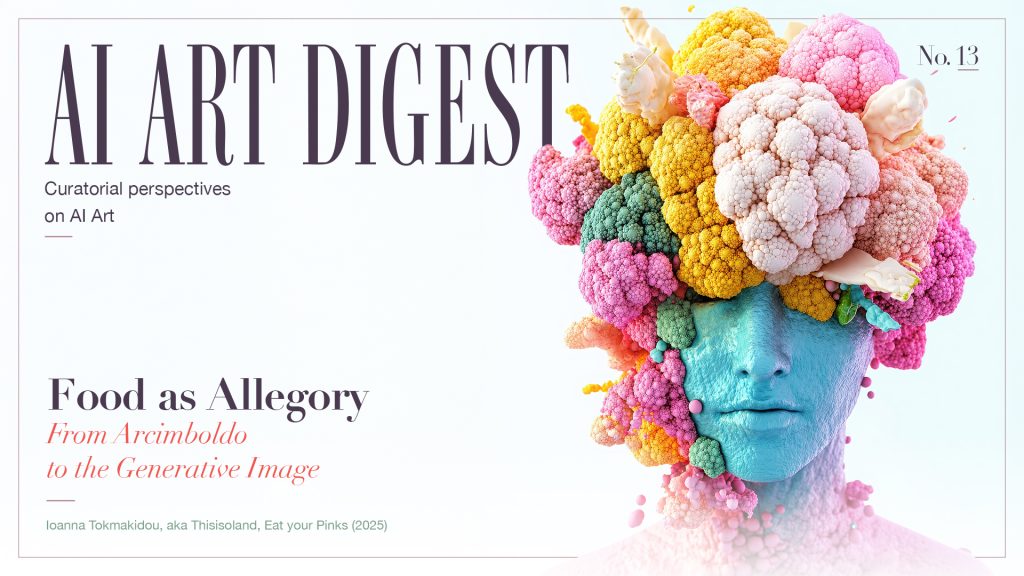
Tokmakidou is fundamentally a conceptual artist, and the work is framed by a provocative caption: “Tell me the truth: would you eat more cauliflower if it were pink?” The question matters because it shifts Arcimboldesque transformation into the terrain of contemporary persuasion. What begins as pop wit opens onto a sharper reflection on food marketing, aesthetic conditioning, and the commercial redesign of appetite. The work still echoes Arcimboldo in its edible physiognomy, but its deeper subject is not likeness. It is the visual manufacturing of desire.
Many generative experiments, while remaining rooted in food, shift from portrait to full-bodied figure, recalling the path opened by Lo Spadino and Rasio, where edible matter migrates into clothing, ornament, and bodily display.
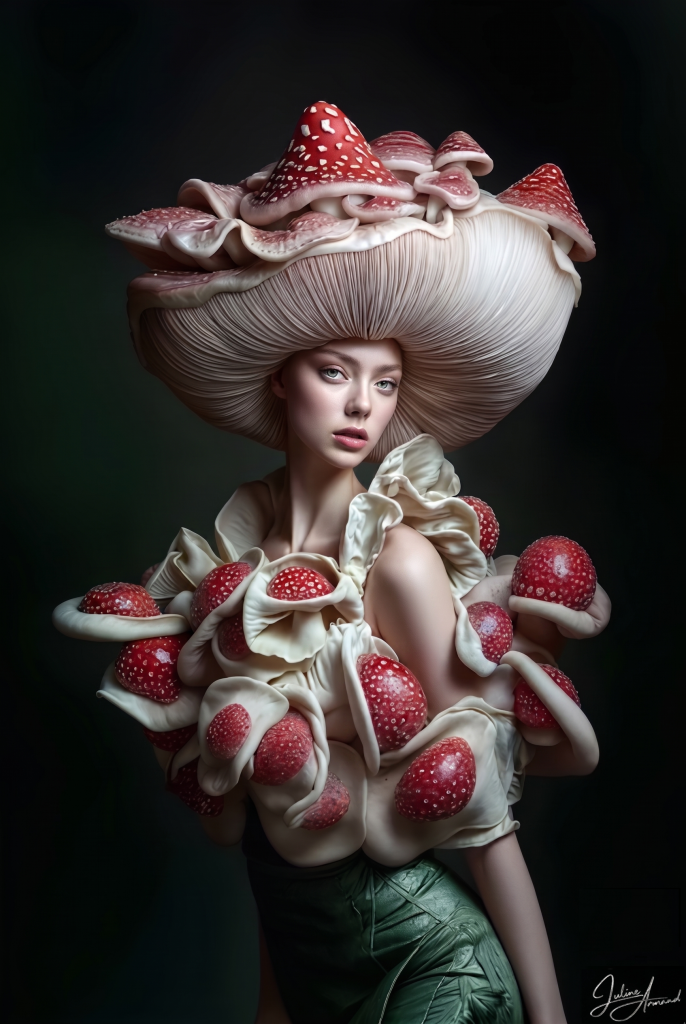
Projects at https://www.instagram.com/julinearmandphotoia/
The result is a contemporary mode of edible allegory in which the codes of aristocratic portraiture, couture display, and generative metamorphosis converge. What matters is not simply the strangeness of women turning into mushrooms, but the fact that beauty survives the transformation. Armand’s figures remain poised, composed, and faintly untouchable.
The edible element does not degrade them; it rewrites their symbolic aura.
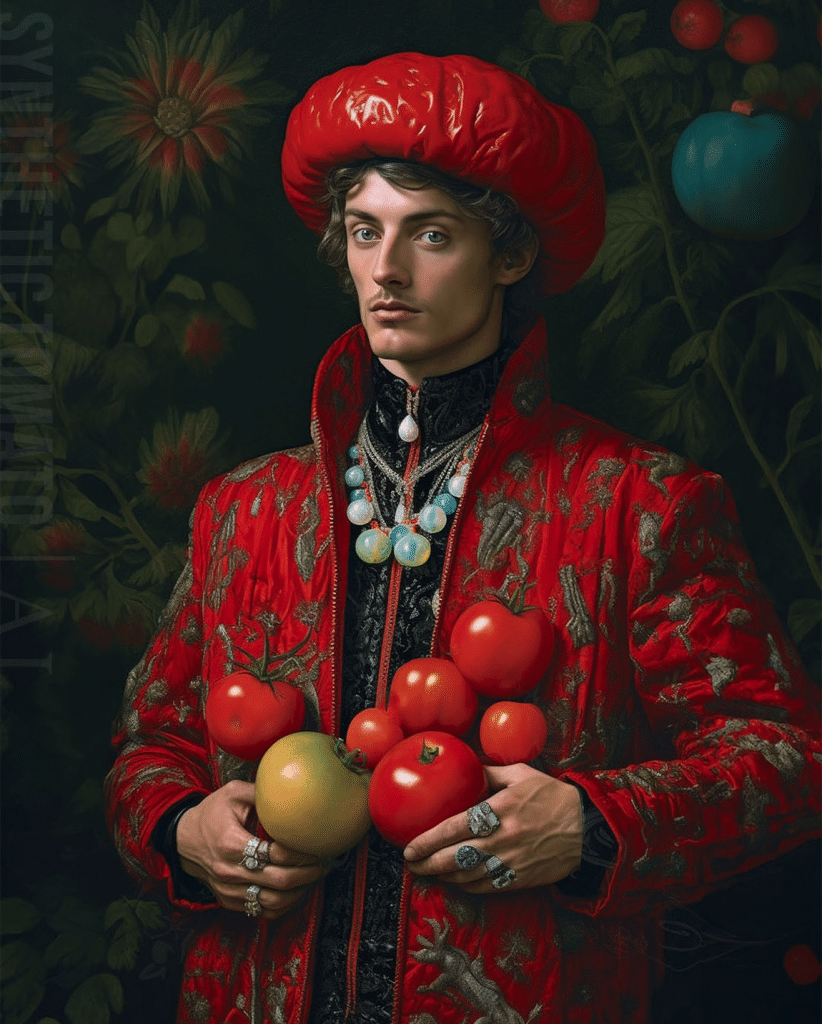
Projects at https://www.instagram.com/synthetictomato
In Tomato Trend, the reference to Renaissance portraiture is clear, but the gesture is not simply parodic. The tomato appears where status, emblem, and adornment traditionally meet. Food here becomes neither body nor still life proper, but symbolic attire: a small, precise sign placed at the threshold between historical portrait language and edible absurdity.
What these satellite cases share is not a single style, but a common permission: the permission to let food leave the table and enter the symbolic body by whatever route the image now requires — through critique, couture, disguise, or conceptual wit.
Arcimboldo’s legacy, after dispersing for centuries into echoes, mutations, and minor survivals, has returned today as a living source of invention for artists working with artificial intelligence. It returns not only through quotation, but through a renewed desire to think about the relationship between body and nourishment.
Food is no longer simply something to represent. It becomes a means of constructing the person.
That is why this lineage still matters. The edible image allows artists to think about identity through matter that is never neutral. Food carries culture, class, labor, pleasure, memory, health, stigma, ritual, and desire. It belongs to intimacy and to display. It is among the few materials that can move so easily between still life, allegory, ornament, grotesque, and social type.
In contemporary generative art, this old Arcimboldesque intuition acquires a new charge. The body is increasingly imagined as something shaped by what it ingests, what it consumes, what it is sold, what it desires, and what it performs. Edible matter becomes a way of speaking about selfhood in an era defined by ecological anxiety, sustainability discourse, food politics, wellness culture, and the endless redesign of appetite.
From this perspective, food is no longer merely an object of representation. It becomes a metaphor for identity itself. What we eat becomes us — materially, symbolically, socially, imaginatively. It shapes bodies, conditions self-image, and enters memory. Arcimboldo’s old intuition returns, but not as a Renaissance curiosity. It returns as a contemporary truth, still strange and still exact: we are, in a profound and uneasy sense, made of what we eat.
𝘝𝘪𝘵𝘰 𝘋𝘪 𝘉𝘢𝘳𝘪 𝘐 𝘍𝘰𝘳𝘮𝘦𝘳 𝘌𝘹𝘦𝘤𝘶𝘵𝘪𝘷𝘦 𝘋𝘪𝘳𝘦𝘤𝘵𝘰𝘳 𝘐𝘔𝘐 𝘜𝘕𝘌𝘚𝘊𝘖



© 2026 – Vito Di Bari – AI Art Digest – Scouting Gen AI styles and blue-chip generative artists.