AI Art Digest is shared with a curated international network of 2,781 museum and 1,712 gallery leaders.
Between 1597 and 1600, Michelangelo Merisi, known as Caravaggio, painted a life-size wicker basket filled with apples, pears, grapes, figs, and leaves already touched by time. The painting is small, but its significance is immense. With the Basket of Fruit, also known as the Fiscella, fruit steps out of the supporting role it had so often played in sacred painting and moves decisively to the center. It is no longer an attribute, a decorative flourish, or a symbolic accessory. It becomes the subject itself.

What makes the Basket so extraordinary is not only its realism, but the way that realism opens onto time. Light rests delicately on the grapes, lingers on the skins, and defines the textures of fruit and leaves with almost tactile precision. At first, the painting dazzles through sheer presence. Then the details begin to trouble that clarity: a worm-eaten apple, grapes on the verge of overripeness, leaves curling and drying at the edges. Beauty remains, but it has been made vulnerable.
This is where still life truly begins: not only as the depiction of food, but as a way of holding together presence and transience. The fruit is no longer a promise of eternity, nor simply a cluster of theological hints. It exists fully in the present and is already beginning to disappear. That tension gives the painting its force. Caravaggio turns still life into a laboratory of looking: a place where painting tests what beauty, matter, and time can mean once stripped of every larger narrative frame.
What appears in Caravaggio as an isolated breakthrough becomes, in the seventeenth-century Low Countries, a full visual language. In Flemish and Dutch painting, still life expands into one of the most distinctive genres of European art: banquet tables, elegant breakfasts, oysters, lemons, lobsters, pies, silverware, porcelain, bread, goblets, pastries. Food enters painting not simply as evidence of abundance, but as a way of thinking through the material world.
One of the great inventions of Flemish still life is its sense of suspended time. These paintings are still, but they never feel inert. A knife has been left behind. A tablecloth has been shifted. A lemon peel falls over the table’s edge. An oyster sits open. Someone was clearly here a moment ago, even if no one appears. The human figure is absent, but that absence is charged. The table becomes the residue of an action, the afterimage of a meal, the stage of a pleasure already passing.
This quality is one reason still life flourished so fully in the Low Countries. It drew on a long northern tradition of minute observation, from Jan van Eyck to Rogier van der Weyden to Hans Memling, where the rendering of surfaces, reflections, metals, fabrics, and botanical detail had already reached remarkable sophistication. It also resonated with a culture of collecting, display, and curiosity: the world gathered in miniature, classified, possessed, contemplated. Still life, in this sense, truly was a laboratory. It tested painterly technique, but also the desire to know the world through things.
Just as important was the broader context of mercantile culture. The seventeenth-century Low Countries were shaped by trade, urban prosperity, and a powerful new bourgeois class that bought art not as courtly display or institutional devotion, but as part of everyday life. In this setting, objects were never neutral. They spoke of wealth, class, labor, taste, and status. A laid table was never just a table.
And yet these paintings are not simply celebrations of prosperity. Protestant culture, especially in its Calvinist climate, introduced an undertone of moral unease. Wealth appears, but never without tension. Beauty shines, but often with visible fractures. Vanitas is not a separate theme added onto the genre; it is one of its internal engines. Pleasure is acknowledged, but shadowed by the knowledge that everything visible is already moving toward decline.
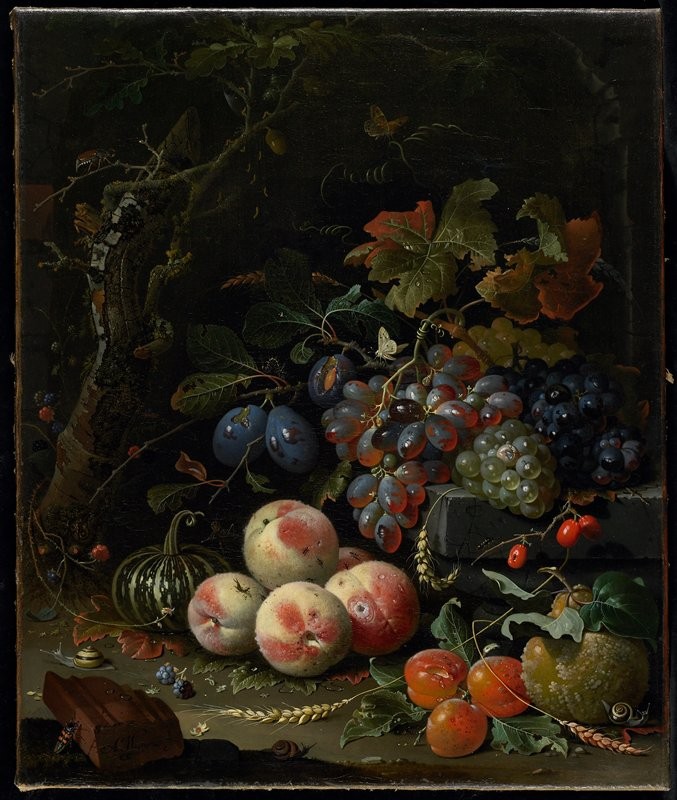
That tension becomes almost biological in Abraham Mignon’s Still life with fruits, foliage and insects (1669), where insects swarm across the composition and decomposition is no longer implied but fully active.
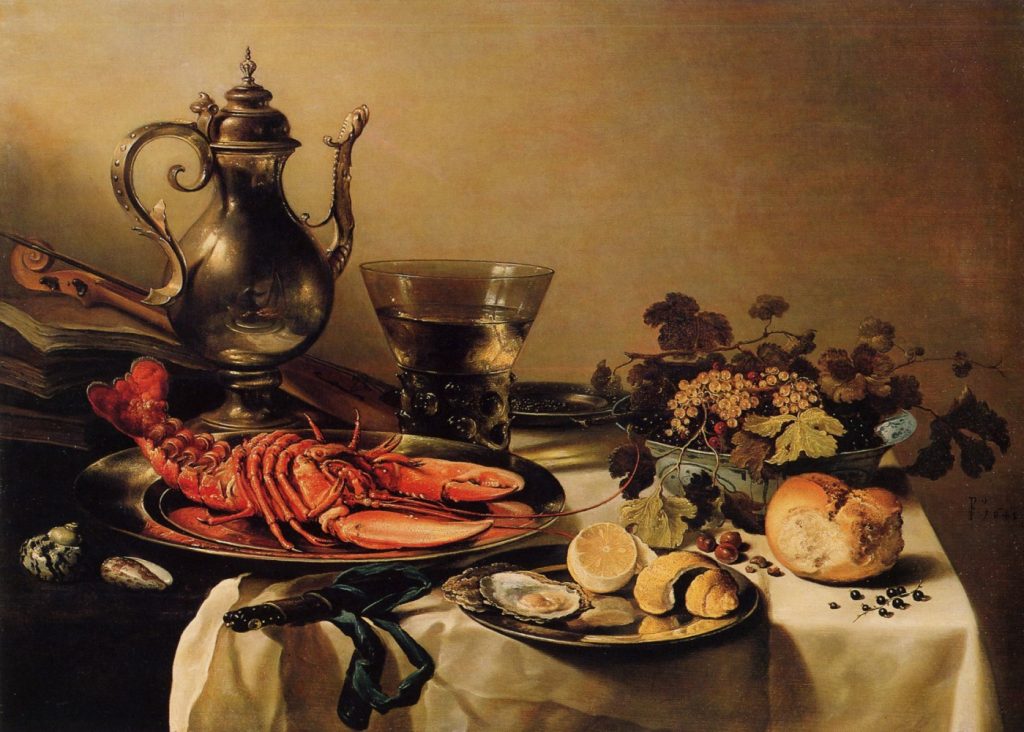
In Pieter Claesz, the mood is more restrained, but no less charged. In Still Life with Silverware and Lobster, splendor and impermanence coexist: silver, shellfish, lemon, reflective surfaces, and the sense that the banquet is already beginning to loosen and break apart. The same is true in Willem Claesz Heda’s goblets and breakfast pieces, where tilted glasses, disturbed tablecloths, and half-finished meals create an atmosphere of fragile equilibrium
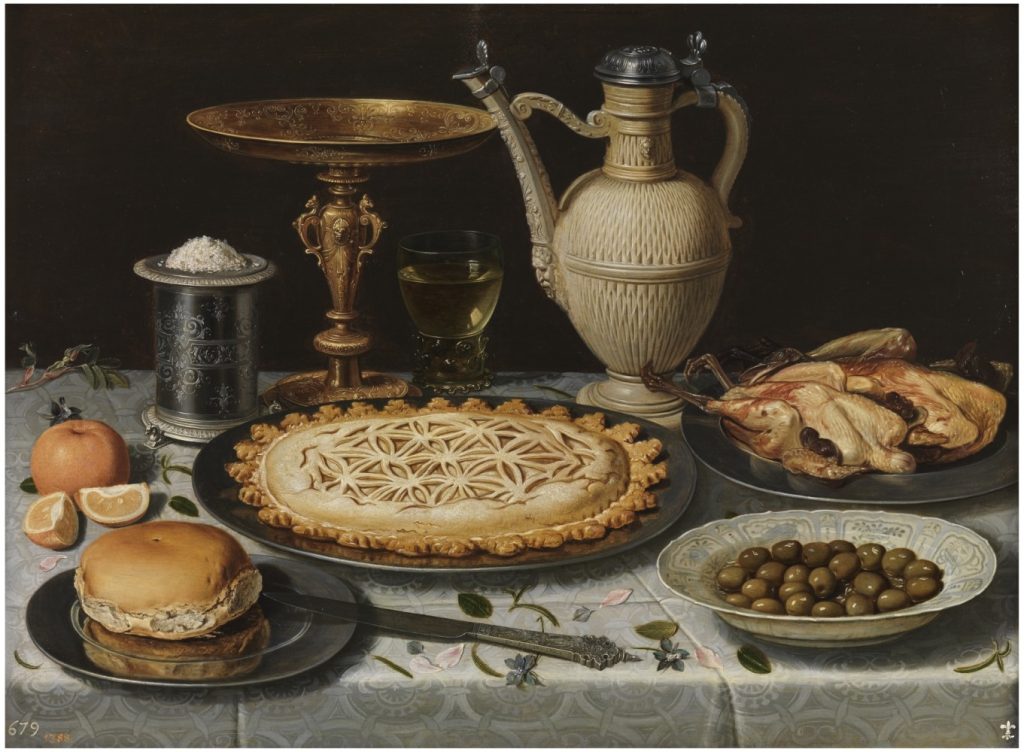
By the time Flemish still life reaches maturity, the genre has become capable of holding several ideas at once: abundance and warning, pleasure and restraint, wealth and fragility, beauty and decay. Food becomes a dense symbolic instrument, but also something more than symbolic: a way of thinking about class, mortality, and the instability of possession itself.
In the eighteenth century, Jean-Baptiste-Siméon Chardin changes the terms again. In a France shaped by Rococo elegance and the prestige of history painting, Chardin turns to humble objects—fruit, bowls, eggs, fish, copper pots—and paints them with such quiet concentration that they seem to stop time.
In The Basket of Wild Strawberries (1761), a pyramid of strawberries, a glass, and a few flowers become enough to build an entire world. Unlike Flemish still life, allegory recedes here. Chardin is less interested in moral tension or social display than in the intrinsic dignity of things. He does not flaunt abundance; he composes attention. The strawberries are not primarily symbols. They are presences.

The same intensity returns, more starkly, in The Ray, where a split-open fish is rendered with such material force that the painting becomes almost an encounter with flesh itself. Here still life brushes the body without losing its meditative calm.

Chardin matters in this history because he turns still life into an exercise in perception. He inherits the Flemish care for objects, but strips away much of the overt symbolism and theatricality. What remains is concentration: light, weight, texture, color, relation. In his hands, still life becomes less a stage of meanings than a space where looking itself becomes the subject.
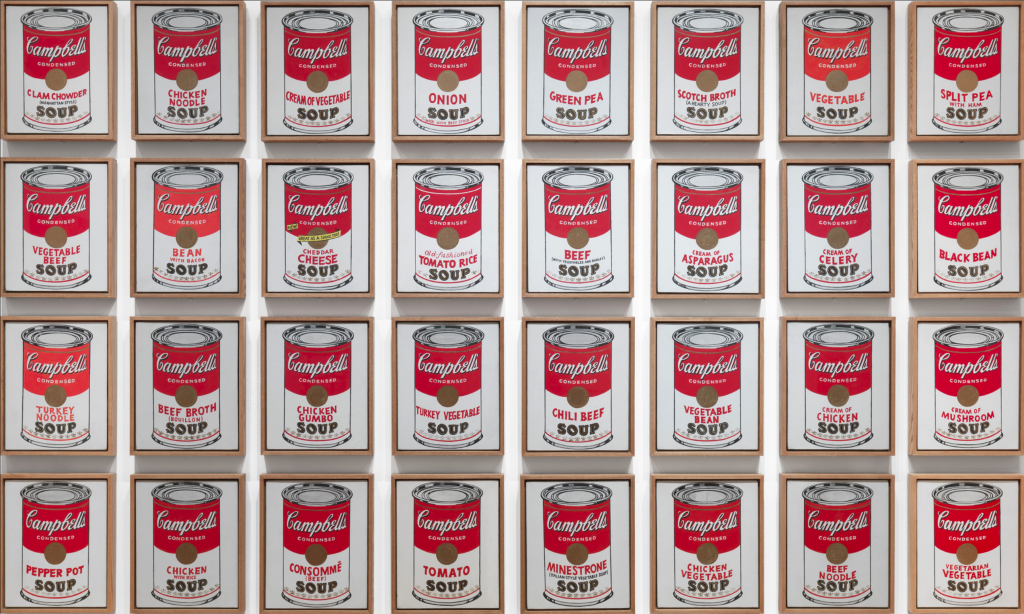
In the twentieth century, still life enters another visual regime altogether. The old mercantile world of the Dutch table finds an unexpected echo in consumer society. The objects change—cans, hamburgers, cakes, sugary surfaces—but the underlying question remains: what do these things reveal about the culture that produces and desires them?
Andy Warhol’s Campbell’s Soup Cans turns food into a ready-made image. The soup can is no longer nourishment; it is brand, repetition, accessibility, surface.
Claes Oldenburg’s Floor Burger makes food theatrical, oversized, and absurdly tactile.
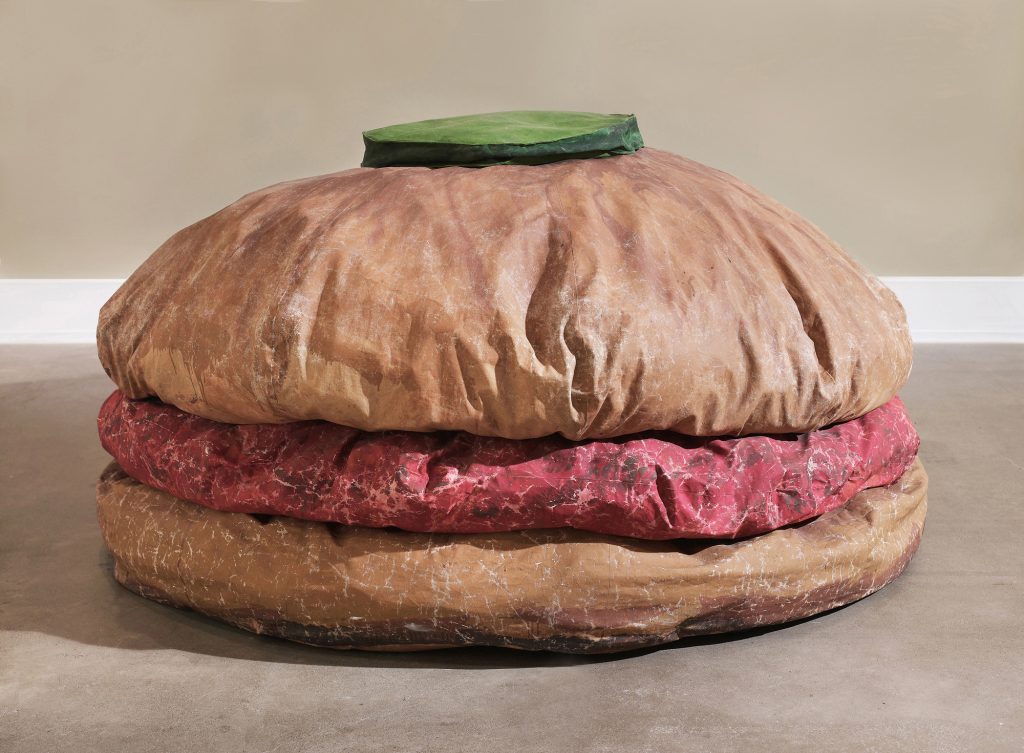
This is the crucial shift. Food stops functioning primarily as matter, warning, or concentrated presence and becomes image—something to be seen, wanted, displayed, repeated. Warhol cools desire into serial form. Oldenburg turns it into spectacle. Nourishment moves toward the eye.
This is the tradition generative art inherits—not as a single lineage, but as a field of problems. From Caravaggio comes food understood as tangible, perishable presence. From Flemish still life come precarious balance, vanitas, delight, and luxury, all under the shadow of decay. From Chardin comes meditative concentration. From Warhol, Oldenburg, and Thiebaud comes food as display, surface, and image of consumption.
What AI artists reactivate is rarely the whole tradition at once. More often, they isolate one of these tensions and push it further: precarious balance, luxury and delight, hypersaturated visual seduction, or the affective domesticity of nourishment. That is why still life remains such a fertile form.
In light of this trajectory, the food still life emerges as one of the most persistent topoi in the history of Western art. Over the centuries, its function and value have shifted. In every era, food has acted as a sensor of its time. It never exists simply as food; it exists as matter, sign, status, warning, desire, and visual construct.
It is within this lineage that the contemporary reinterpretation of still life by artists working with artificial intelligence takes shape. The point is not simply to assert that AI “revives” the tradition; it is to understand which elements of that tradition are isolated, reactivated, intensified, or transposed into a different regime of imagery.
In generative art, still life no longer springs from the direct observation of a set table or a basket of fruit, but from a layered visual memory: painting, photography, advertising, design, culinary culture, and digital imagery. Artists do not necessarily cite the tradition in full; more often, they select a single issue.
Some focus on compositional precariousness, others on luxury and pleasure, others still on the hypersaturated surface of consumption, and others on the affective domesticity of nourishment. In this sense, still life continues to serve as a laboratory—no longer solely for painting, but for the image itself.
To make this section more legible, it is useful to distinguish at least three lines of inquiry: precarious balance and contemporary vanitas; vital emphasis and pop color; food as care and affective language. These are not rigid compartments, but useful clusters for understanding how the tradition is reworked today.
A first line concerns the persistence of precariousness as both a formal and symbolic problem. German artist Jeannette Bergen, aka jea__ai, is compelling precisely because she does not merely cite Flemish still life at the superficial level of abundance or beauty. She works instead on balance, decomposition, and the tension between wealth and fragility.
In one of her most effective images, a slice of rustic bread, cut almost as though it were a mineral or an architectural block, reveals within it red and black caviar with a pat of butter. The crust, however, is already marked by mold or collapse. The contrast is stark: caviar, a contemporary emblem of wealth and refinement, is enclosed within humble matter already compromised. The tradition of Flemish vanitas is not mechanically repeated here. It is translated into a synthetic, almost emblematic form: the most ostentatious luxury and decay coexist within the same volume.

Bergen develops this discourse further in her food towers. Toast and butter support oysters, fish, lemon, pearl; elsewhere an avocado brunch is broken apart and recomposed into an unstable structure. What makes these images compelling is not their oddity as such, but their structure. The Flemish table is almost dismantled and reassembled vertically. The oyster, bread, fish, and lemon are no longer distributed horizontally across a silent banquet; they become elements in a precarious scaffolding. Balance, which in seventeenth-century still life was often implicit and entrusted to compositional sensitivity, is here made explicit and pushed to the brink of collapse.
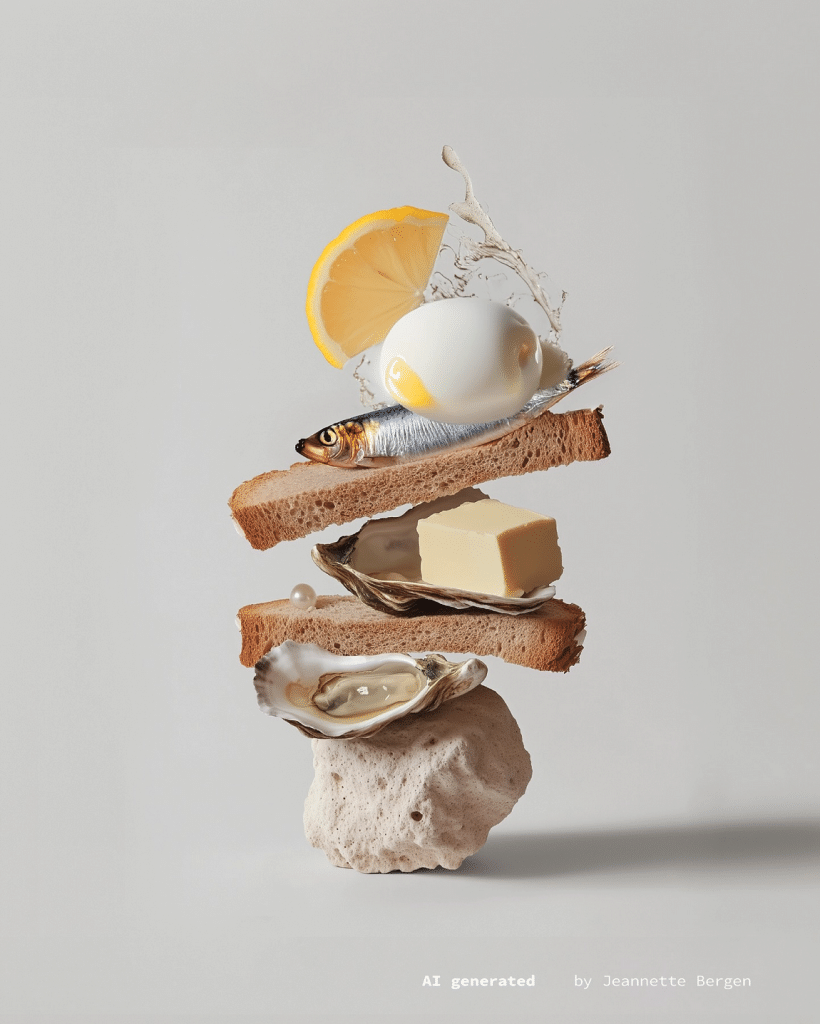
In another “tower,” an avocado brunch is deconstructed, playing with elements of softness and weight. The iconography recalls contemporary food culture, in which chefs produce conceptual dishes—often deconstructed—where ingredients are isolated and then recombined into new forms. As in haute cuisine, food here loses its primary function in order to become a mental construction.

This choice is not accidental. Precarious balance was already one of the great problems of ancient and modern still life: the unstable goblet, the overturned glass, the strip of peel falling back, the fruit about to drop. Bergen radicalizes this issue, turning it into something almost architectural. Vanitas no longer resides only in the detail that decays, but in the structure that threatens to give way. It is a convincing rereading precisely because it does not imitate Flemish painting; it makes one of its internal tensions explicit.
Synthetic Tomato engages one of the more rigorous lines of the generative still life.
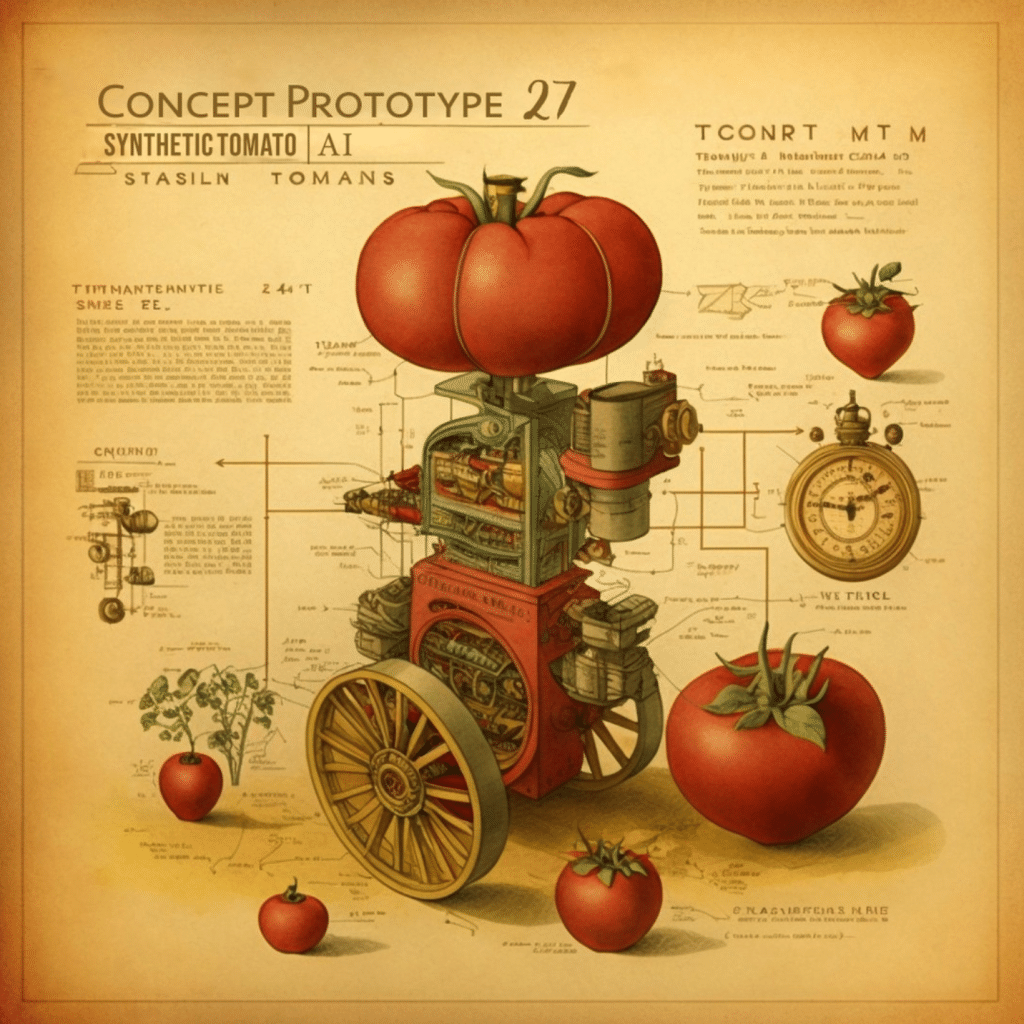
In Tomato Construct and Artificial Pomodoro Prototype No. 27, the tomato no longer appears as a simple botanical element or food emblem, but assumes the status of a constructed specimen: measured, classified, almost placed under protocol.
Still life is reactivated here not through abundance or visual seduction, but through an imaginary of verification, standardization, and device.
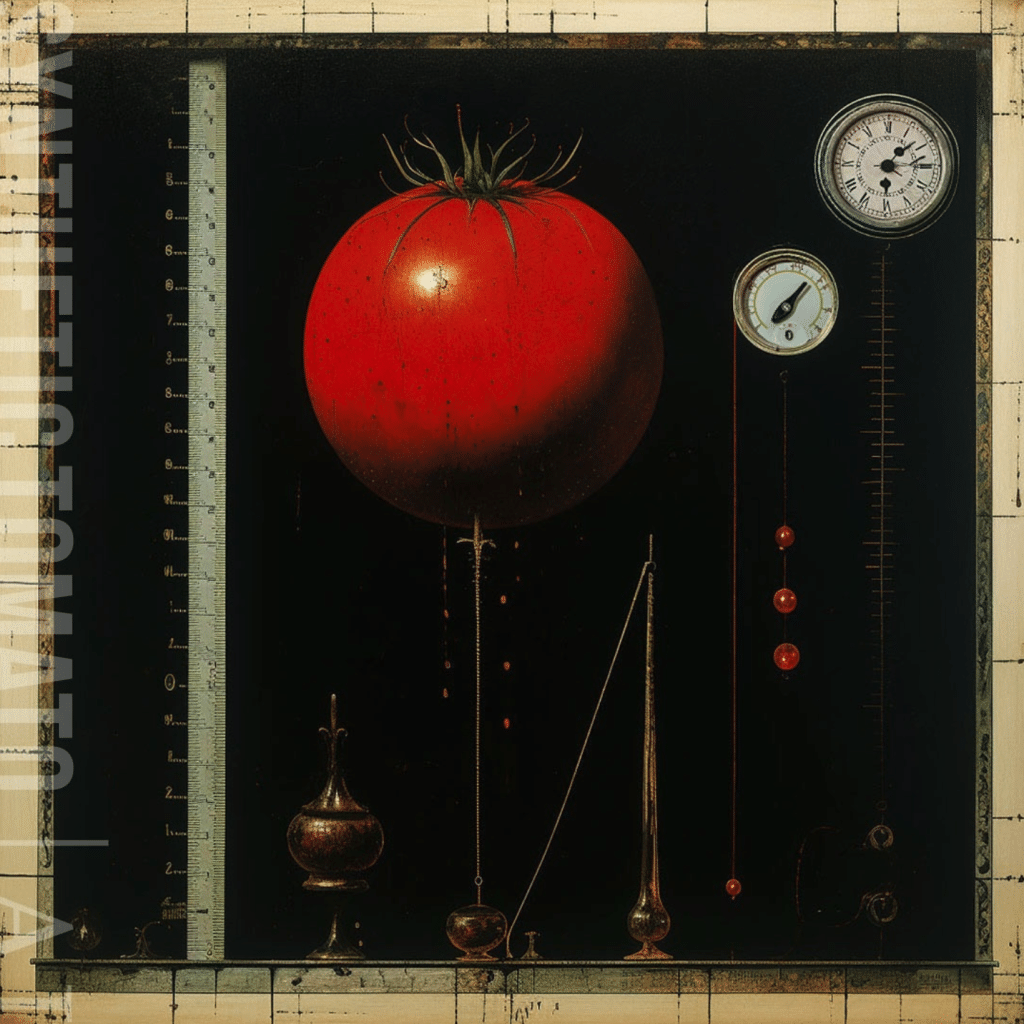
What emerges is a deliberately cool inflection of the genre, in which food is treated both as observable form and as technical hypothesis: suspended between specimen, project, and engineering fiction.
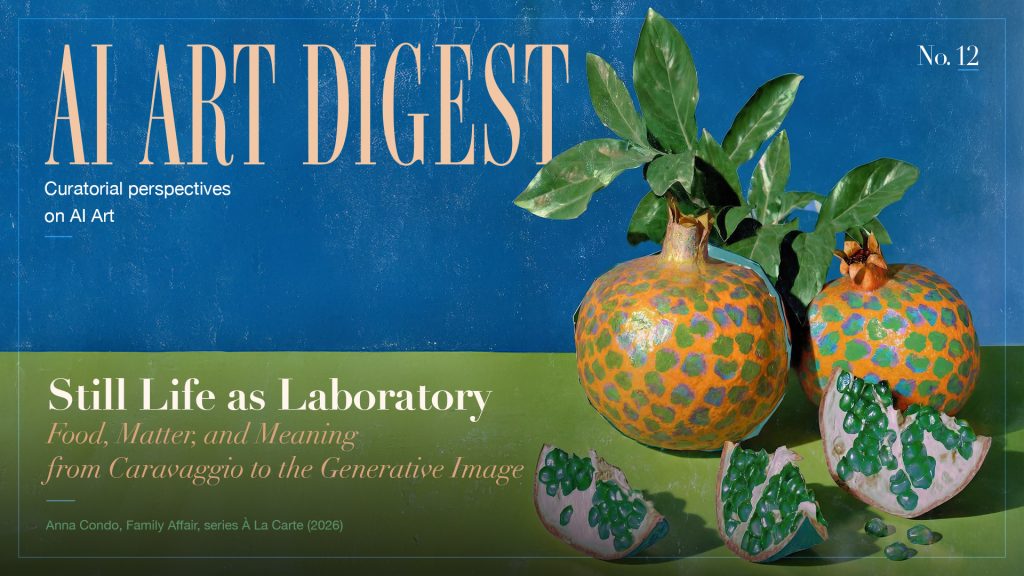
If Synthetic Tomato redirects still life toward protocol, measurement, and engineering fiction, Anna Condo moves in the opposite direction: toward preciousness, ceremony, and the staged seduction of the edible image.
Armenian artist Anna Condo constructs surreal yet intimate visual worlds in which still life drifts away from observation and toward artifice, ornament, and emotional displacement. In Chorus (2026), oysters appear less as food than as crystalline specimens, suspended between delicacy, mineralization, and display.


With Condo, food is no longer tested as specimen or construct, but refined into display—an ornamental, intimate, and faintly surreal surface that prepares the shift toward a more saturated, design-conscious visual regime.
Another way of reinterpreting food within the still-life tradition passes through hyper-saturated color, visual emphasis, and the immediate seduction of the image.
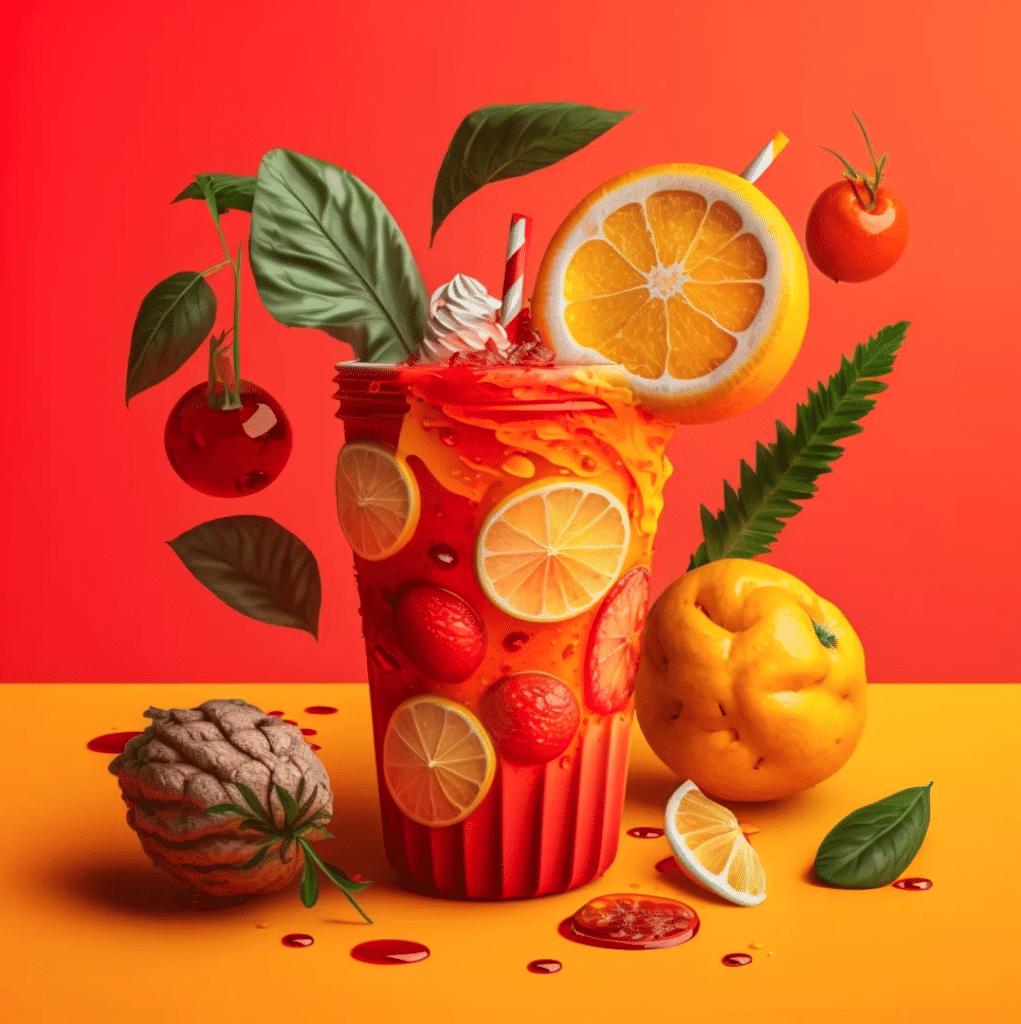
Indonesian artist Kinawa Punya takes up this legacy almost literally. His beverages and fruits have an unnatural, almost plastic brilliance. Strawberries, pineapples, oranges, and bananas appear polished, eternally youthful, immune to bruising or decay. This is a clear inversion of the fragile fruit destined to decay in the vanitas tradition. Where the worm-eaten apple or scorched peel once revealed time, here perfection seems to abolish it.
Food is suspended in a digital youth without expiration. It is an image of our present more than of sensible reality: a cult of appearance, artificial permanence, beauty made available and untouchable.
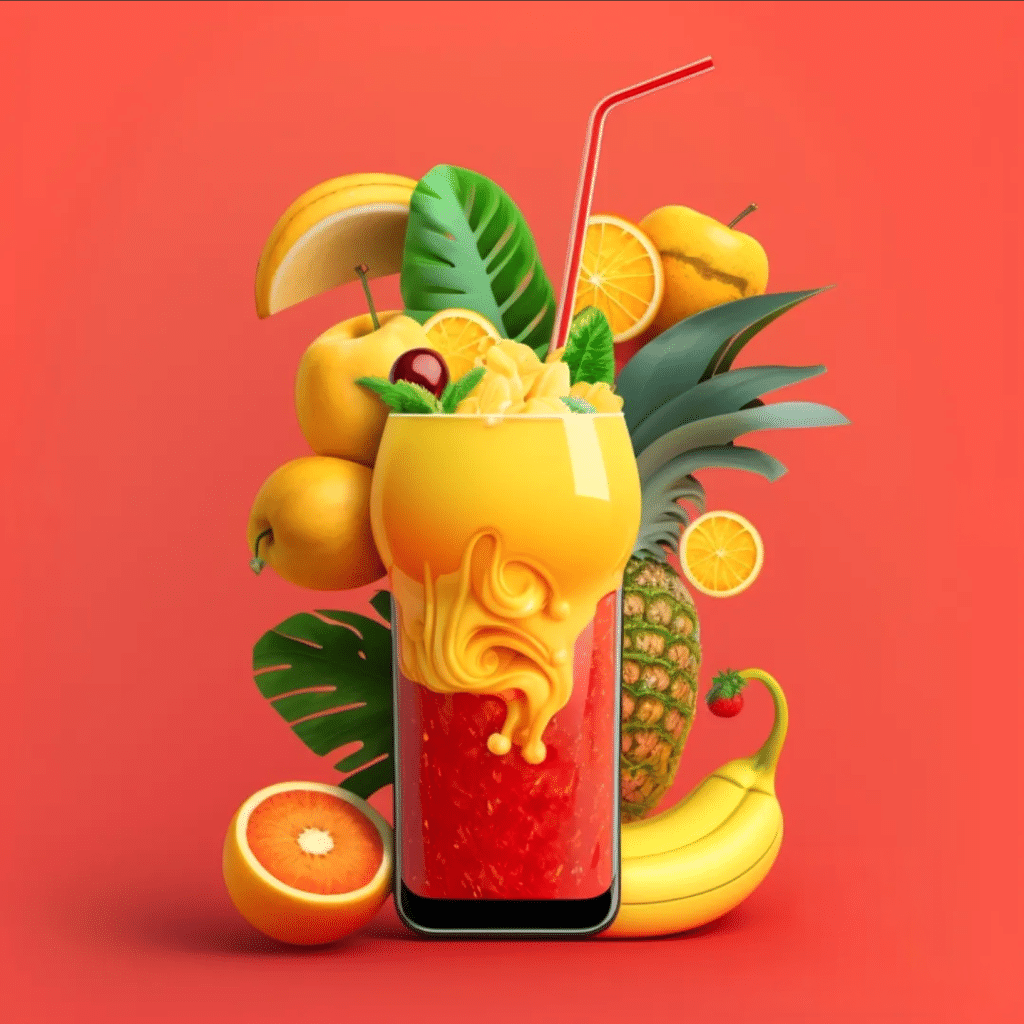

Indian artist Nitish Sarkar offers a more stylized and design-driven afterlife of still life. In works built from layered fruit, leaves, and food fragments, the genre moves away from banquet, decay, or display and becomes compositional syntax: food as pattern, curvature, surface, and visual assembly.
These images do not carry the symbolic pressure of vanitas or the social charge of Pop, but they show how generative art can absorb the still-life tradition into ornament, rhythm, and constructed form.
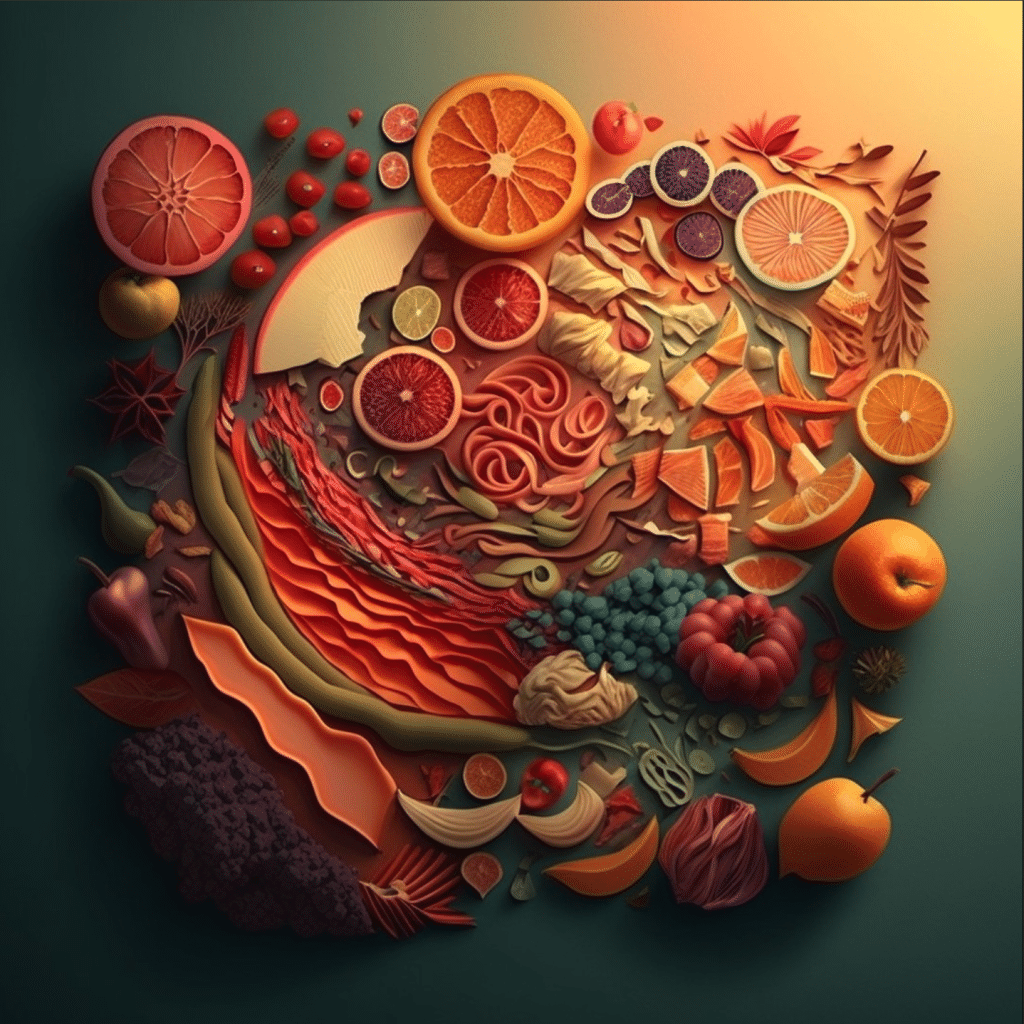
Taken together, these satellite examples show that in generative image-making, still life no longer survives as a single genre, but as a set of transferable visual problems: vitality and balance, ornament and display, abundance and the arrangement of matter itself.
If still life has often used food to speak of vanitas, luxury, desire, or display, Nice Aunties returns it to another register: food as care, food as attention, food as a language of relationships. In Nana Nator, the seemingly minor gesture of peeling and cutting a banana for one’s nephew becomes the image of an almost excessive solicitude—the wish that nothing be too difficult, too sharp, too inconvenient for those one loves. What matters here is not nourishment as object, but nourishment as bond.

From Caravaggio’s perishable basket to the engineered tomato, from Flemish abundance under pressure to Pop display and AI’s new visual syntax, still life continues to prove that food is never only food. It is matter, warning, ornament, desire, memory, and relation. What changes across time is not the genre’s relevance, but the questions it asks. In generative art, those questions do not disappear. They mutate — and still life remains one of the sharpest places to watch that mutation happen.
𝘝𝘪𝘵𝘰 𝘋𝘪 𝘉𝘢𝘳𝘪 𝘐 𝘍𝘰𝘳𝘮𝘦𝘳 𝘌𝘹𝘦𝘤𝘶𝘵𝘪𝘷𝘦 𝘋𝘪𝘳𝘦𝘤𝘵𝘰𝘳 𝘐𝘔𝘐 𝘜𝘕𝘌𝘚𝘊𝘖



© 2026 – Vito Di Bari – AI Art Digest – Scouting Gen AI styles and blue-chip generative artists.